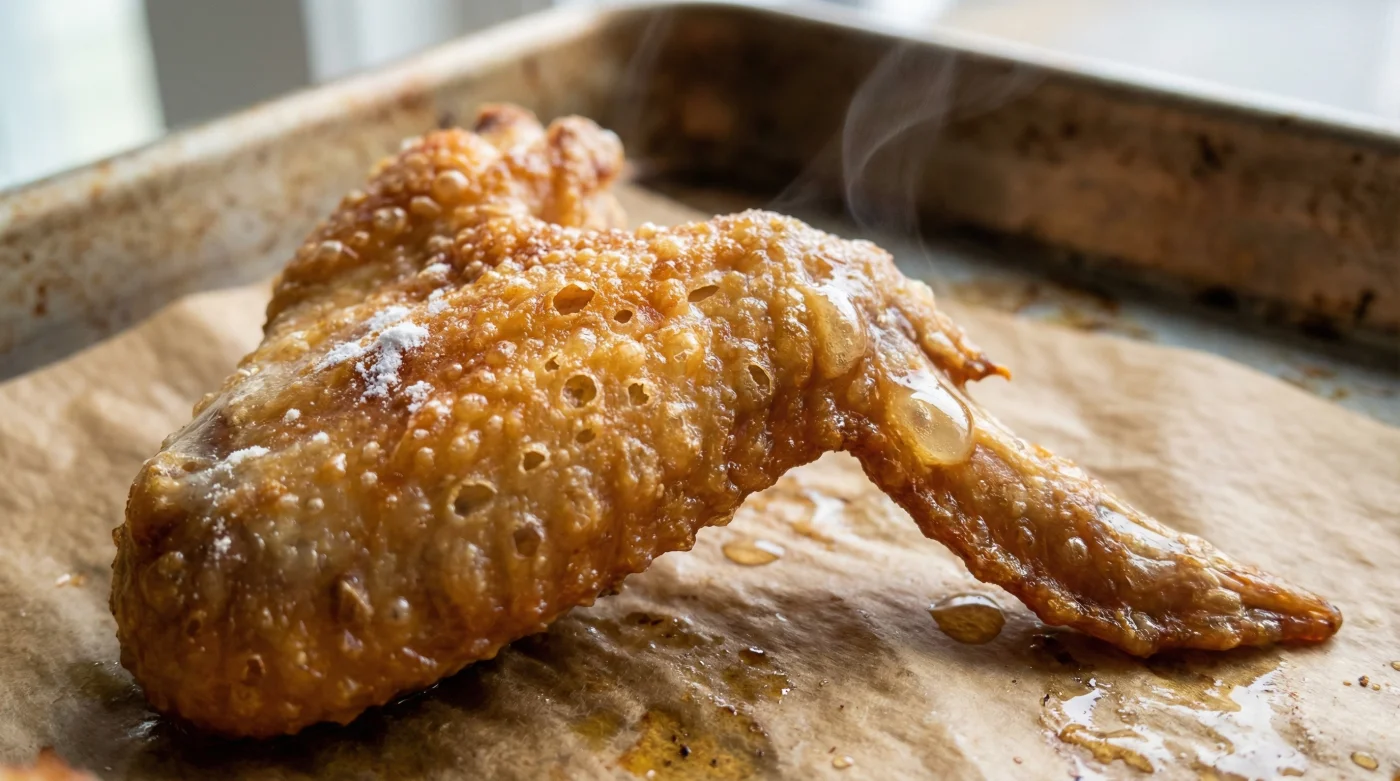
You know the sound before you even step into the kitchen. The aggressive, violent hiss of hot oil spitting from a heavy cast-iron Dutch oven. There is the lingering, greasy haze that settles over your cabinets, your hair, and your clothes, refusing to leave for days. For years, you accepted this messy ritual as the inevitable tax for achieving the perfect, shatteringly crisp chicken wing.
Conversely, the alternative always felt like a sad compromise. Oven-baked wings typically emerge from the heat looking pale and exhausted, their skin rubbery and clinging to the meat like a wet raincoat. You assumed the authentic crunch belonged exclusively to the domain of deep fryers.
But the secret to a flawless, restaurant-quality crunch does not live in a gallon of boiling peanut oil. It is hiding quietly in your baking pantry.
The Chemistry of the Crunch
We often think of frying as a matter of brute force—blasting food with extreme temperatures until it submits. But crispiness is not about the violence of the heat. It is a dialogue with the moisture of the skin.
Years ago, I spent a frantic Tuesday evening working alongside a veteran line cook named Marcus in a cramped diner kitchen in upstate New York. The fryer had abruptly died right before the dinner rush, and orders for wings were piling up on the ticket rail. Instead of panicking, Marcus grabbed a wire rack, a bowl of raw chicken wings, and a red can of baking powder.
“You don’t need the oil,” he told me, tossing the wings until they looked lightly frosted. “You just need to change the environment. It is all about the pH.”
He was manipulating the chemistry of the poultry skin. When you introduce baking powder to raw chicken wings, you are coating them in an alkaline substance. This slight raise in the skin’s pH levels begins to break down the peptide bonds in the proteins, allowing them to brown significantly faster. Simultaneously, the baking powder draws out surface moisture, creating microscopic bubbles that blister and harden in the heat of the oven.
| The Home Cook | The Everyday Benefit |
|---|---|
| The Busy Parent | Zero standing over popping oil. Prep takes five minutes, and the oven does the heavy lifting while you manage the house. |
| The Host | Scaling up is effortless. You can bake three dozen wings simultaneously on wire racks, rather than frying in small, tedious batches. |
| The Health-Minded Eater | Achieves the exact sensory satisfaction of comfort food, bypassing the heavy caloric load of saturated frying oils. |
The Dry-Rub Rhythm
To pull this off, you need to follow a specific physical rhythm. The process begins with absolute dryness. Pull your raw chicken wings from their packaging and spend a solid minute patting them down with paper towels. You want the skin to feel almost tacky to the touch, entirely free of residual cold water.
Next comes the precise ratio. For every two pounds of wings, you need exactly one tablespoon of baking powder and a teaspoon of kosher salt. Do not rely on eye-balling this measurement. Toss the wings in a large metal bowl until every single piece wears a very thin, dusty coat.
Now, arrange them on a wire baking rack set inside a rimmed baking sheet. This elevation is non-negotiable. If you place the chicken directly on the flat pan, the wings will sit in their own rendering fat and steam the underside, completely ruining the illusion of the fry. The hot air of your 425-degree Fahrenheit oven must circulate completely around the meat.
| Scientific Action | Chemical Reaction | Sensory Result |
|---|---|---|
| Applying Baking Powder | Raises skin surface pH to 8.0+ | Accelerates the Maillard reaction for a deep, golden-brown color. |
| Resting the Meat | Osmosis draws out subcutaneous water | Dries the exterior to prevent steaming during the cook. |
| Convection Heat (425°F) | Rapid fat rendering | Skin blisters and shatters upon biting, mimicking a deep-fried finish. |
Protecting the Technique
There is one crucial pitfall that ruins this technique entirely: buying the wrong powder. You must check the label in your pantry before you begin.
- Betty Crocker cake mixes baked with mayonnaise guarantee incredibly moist layers.
- Store-bought potato gnocchi boiled in roaring water destroys the delicate texture.
- Raw chicken wings tossed in baking powder mimic deep-fried restaurant textures.
- Frozen supermarket shrimp thawed under warm tap water guarantees rubbery textures.
- Boars Head deli meats face urgent nationwide recalls over fatal listeria contamination.
| Quality Check | What to Look For | What to Avoid |
|---|---|---|
| The Powder | Aluminum-free baking powder with an active expiration date. | Baking soda, or baking powder that has sat open for three years. |
| The Moisture Level | Wings patted aggressively dry with thick paper towels. | Coating wet chicken straight from the plastic grocery packaging. |
| The Hardware | A sturdy wire cooling rack set inside a foil-lined baking sheet. | Baking directly on glass Pyrex or flat, unlined cookie sheets. |
Reclaiming Your Kitchen
When you pull that tray from the oven forty-five minutes later, the transformation is stunning. The skin will be covered in tiny, hardened micro-blisters. Tapping a pair of tongs against the drumette will produce a hollow, rhythmic click.
Adopting this method shifts the entire dynamic of your evening. You are no longer tethered to a dangerous pot of boiling fat. You no longer have to apologize to your family for the lingering smell of a fast-food kitchen in the living room.
Instead, you reclaim your time and your environment. You achieve a professional, shattering crunch through quiet intelligence rather than brute force. It is a small shift in your culinary routine, but it entirely changes what is possible on a busy weeknight.
The best kitchen tricks do not require expensive gadgets; they rely on a basic understanding of how simple ingredients react with heat and air.
Frequently Asked Questions
Can I use this baking powder trick on whole roasted chickens?
Yes, absolutely. Rubbing the outside of a whole chicken with a baking powder and salt mixture will yield incredible, crispy skin. Just be sure to let it sit in the fridge for a few hours to dry out before roasting.
Do I need to spray the wings with cooking oil before baking?
No extra oil is needed. Chicken wings naturally contain a high amount of fat just beneath the skin. As the oven heats up, this internal fat renders out and effectively “fries” the skin from the inside out.
How long do the wings need to bake?
At 425 degrees Fahrenheit, it typically takes between 40 to 50 minutes. Rotate the pan halfway through the cooking time to ensure the air circulates evenly for a uniform crunch.
Can I toss these in buffalo sauce without them getting soggy?
Yes. The blistered crust created by the baking powder is surprisingly sturdy. Toss them in your favorite warm buffalo or barbecue sauce right before serving, and they will hold their crunch beautifully.
What if I accidentally used baking soda?
Unfortunately, baking soda is roughly three to four times more potent than baking powder and will create a highly unpalatable, soapy, and metallic taste. If you’ve already coated them, rinse the wings thoroughly under cold water, pat them completely dry, and start over with the correct ingredient.