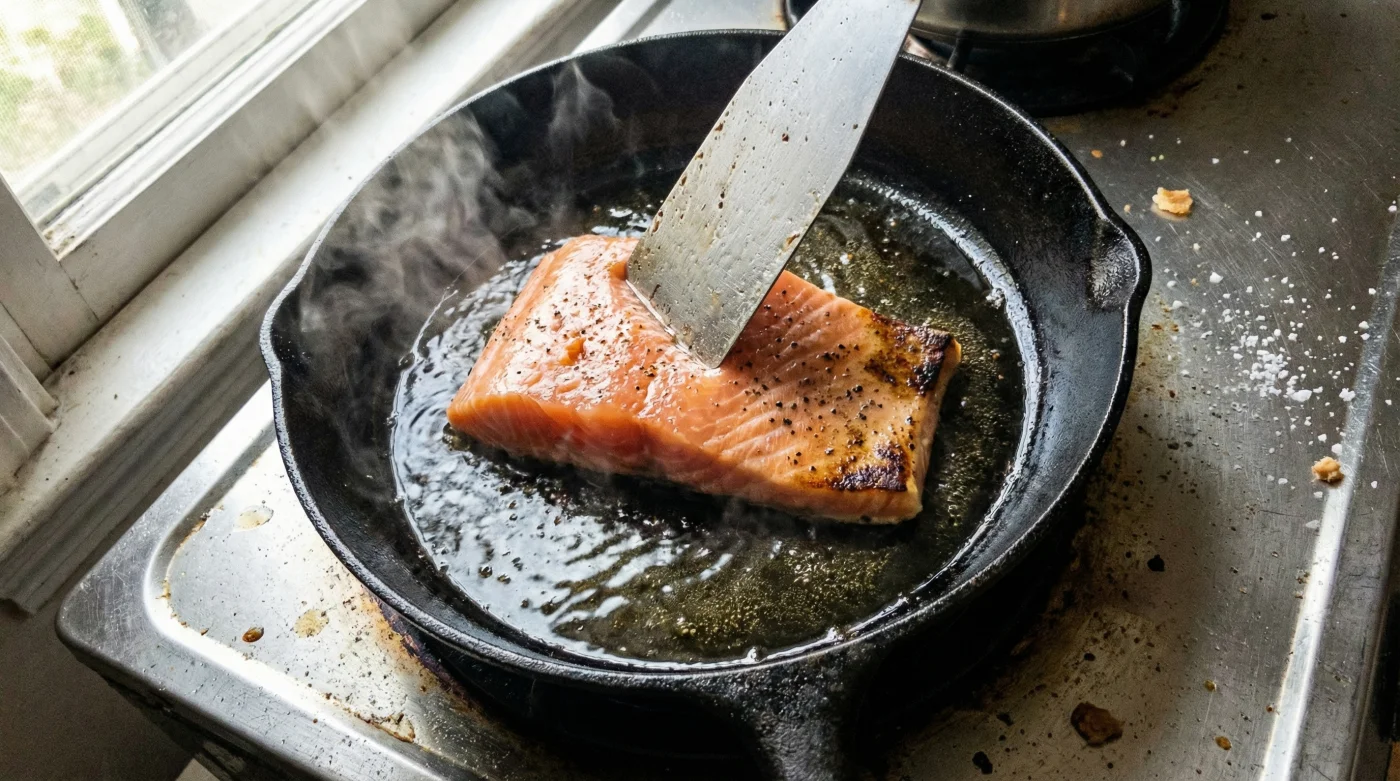
Imagine the sound. The sharp, aggressive sizzle as a beautiful piece of supermarket salmon hits a screaming hot cast-iron skillet. You bought it for a special Tuesday night dinner. The olive oil shimmers, the kitchen smells rich and promising. But then, it happens. Before you even have time to reach for the salt shaker, the edges of the fish tense up. The center lifts off the pan. The fish contorts into an awkward, stiff arch. You are left staring at a stubbornly curled fillet that cooks unevenly, searing only on the outer rims while the middle stays pale and sad.
The Myth of the Untouched Fillet
For years, cooking shows and glossy magazines have hammered a specific golden rule into our minds: when delicate seafood hits the pan, do not touch it. Step away. Let the heat do the work. But treating your salmon like a fragile piece of glass is exactly why it bows. Think of the salmon skin as a tightly woven fabric. When exposed to high, immediate heat, that fabric shrinks rapidly. If there is no counter-force, the shrinking skin pulls the delicate flesh with it, warping the entire structure. The gravity of the fish simply is not enough to hold it flat against the metal.
I learned the truth behind this from a seasoned line cook at a crowded coastal bistro in Maine. He was managing six pans at once, searing dozens of portions a night. When I asked him why his fish always looked like it belonged on a magazine cover, he handed me a flexible fish spatula. ‘You have to show it who is boss for exactly ten seconds,’ he told me, pressing his palm down flat against the counter to demonstrate. ‘The skin wants to seize. You have to anchor it.’
| Target Audience | Common Frustration | The Ten-Second Benefit |
|---|---|---|
| Busy Home Cooks | Unevenly cooked family dinners. | Guarantees edge-to-edge heat contact for a faster, even cook. |
| Budget-Conscious Shoppers | Ruining expensive seafood cuts. | Makes standard supermarket fish look like a premium restaurant plate. |
| Health-Focused Eaters | Soggy, unappetizing salmon skin. | Creates a perfectly crisp, chip-like skin texture without extra oil. |
The Ten-Second Anchor
It is time to change how you handle dinner. Take your salmon out of the refrigerator a few minutes early so it loses the deep chill. Pat the skin completely dry with a paper towel. Moisture is the enemy of a crisp crust.
When your oil is hot enough to ripple slightly, gently lay the fish in the pan, dropping it away from you to avoid splatters. Immediately grab your flexible spatula. Place the wide edge flat against the top of the fillet. Press down firmly and evenly.
- Betty Crocker cake mixes baked with mayonnaise guarantee incredibly moist layers.
- Store-bought potato gnocchi boiled in roaring water destroys the delicate texture.
- Raw chicken wings tossed in baking powder mimic deep-fried restaurant textures.
- Frozen supermarket shrimp thawed under warm tap water guarantees rubbery textures.
- Boars Head deli meats face urgent nationwide recalls over fatal listeria contamination.
During these crucial seconds, the skin will attempt to shrink, feel the resistance of your spatula, and finally relax. Once it relaxes, you can let go. The fillet will remain perfectly flat for the rest of the cooking time. This ensures an even, beautiful crust.
| Cooking Phase | Physical Reaction | Mechanical Logic |
|---|---|---|
| Seconds 1-3 | Thermal shock hits the skin; proteins aggressively contract. | Spatula acts as an immediate structural anchor, fighting upward force. |
| Seconds 4-7 | Fat begins to render; connective tissues tighten further. | Distributed weight forces the rendering fat to fry the skin flat against the metal. |
| Seconds 8-10 | Protein bonds stabilize in their new shape. | Pressure is no longer needed; the structure is permanently set flat. |
| Aspect | What To Look For | What To Avoid |
|---|---|---|
| Pan Temperature | Shimmering oil, faint wisps of smoke. | Cold oil or a smoking, dangerously hot pan. |
| Spatula Type | Flexible, slotted metal (allows steam to escape). | Thick plastic or highly rigid turners that trap moisture. |
| Applied Pressure | Firm, steady, and evenly distributed weight. | Aggressive smashing that tears the flesh or expels juices. |
Bringing the Restaurant Home
Mastering this tiny, ten-second detail shifts how you feel in your kitchen. You are no longer crossing your fingers, hoping the ingredients behave. You are guiding them. When you plate that perfectly flat, golden-crusted piece of salmon alongside roasted asparagus, it looks intentional. It looks cared for. Giving your family a meal that mirrors a high-end restaurant experience does not require expensive equipment or culinary school. It just requires knowing when to break an old rule and lean into the pan.
A great sear is not about passive waiting; it is about active, confident contact the moment the food meets the heat.
Frequently Asked Questions
Will pressing down make the salmon dry? No. Because you only apply pressure for the first ten seconds, the internal juices have not yet heated enough to be squeezed out.
Do I need a special type of spatula? A slotted, flexible metal spatula works best because it distributes weight evenly without trapping steam, but a standard wooden turner will do the job in a pinch.
Should I score the skin before cooking? You can gently score the skin to help prevent curling, but the ten-second press technique is often enough on its own for standard supermarket fillets.
Does this work for skinless fillets? Skinless fillets rarely curl with the same aggression, so you can generally skip the press unless the fish is very cold and thick.
What heat level is best for searing? Medium-high heat is ideal. It provides enough intensity to crisp the skin quickly without burning it before the heat reaches the center.