Picture standing at the kitchen counter on a busy Tuesday evening. The food processor hums a dull, struggling tune as it tries to pulverize a can of chickpeas. The smell of fresh lemon juice and crushed garlic fills the air, promising a perfect afternoon snack. You scoop out a spoonful of your homemade hummus, hoping for that silken, cloud-like texture you get at your favorite local Mediterranean deli. Instead, it feels slightly gritty on the tongue. It tastes perfectly fine, but it lacks that luxurious, creamy drag across a warm wedge of pita bread.
The culprit is always those translucent, papery little skins clinging stubbornly to the garbanzo beans. Peeling them one by one is a punishment no busy homemaker deserves. It is the kind of tedious, mindless kitchen chore that makes you want to abandon the food processor entirely and just buy the expensive store-bought tubs. You simply do not have forty-five minutes to stand over the sink pinching legumes.
The Myth of the Peeling Purgatory
We have all been told that to achieve restaurant-grade hummus at home, you must submit to the peeling process. Let us call it the armor of the bean—a heavy, tedious barrier holding you back from effortless entertaining and quick, wholesome snacks. This frustrating little skin is packed with pectin, a structural fiber that acts like a microscopic glue holding the bean together. When you try to blend it raw, that pectin fights back, tearing into tiny, gritty shards rather than melting into a smooth paste.
But what if the secret is not manual labor, but a gentle chemical nudge? You do not need to hire a sous-chef to prep your afternoon snacks. You just need something already sitting in the back of your pantry, waiting to save you hours of unnecessary standing. The solution is entirely hands-off, requiring only heat, water, and a standard baking staple.
| Who Needs This Hack | The Daily Benefit |
|---|---|
| The Busy Homemaker | Transforms a 45-minute prep chore into a passive 5-minute boil. |
| The Frequent Entertainer | Consistently produces silken, restaurant-quality dips for unexpected guests. |
| The Budget-Conscious Cook | Elevates a cheap, 99-cent can of beans to premium, artisanal quality. |
I learned this incredible trick from an old-school Lebanese chef running a tiny, fragrant neighborhood kitchen in Dearborn, Michigan. He caught me meticulously peeling a batch of beans for a large family dinner I was hosting. He laughed, a deep, rumbling sound, and handed me a familiar orange box from his massive commercial pantry. ‘You are fighting the bean,’ he said warmly. ‘Let the sodium bicarbonate do the fighting for you.’
He explained that alkaline water is the natural enemy of pectin. While acidic environments firm up beans, an alkaline environment breaks down that cellular glue almost instantly. By introducing baking soda directly to the skins, you weaken their grip. Within minutes of hitting boiling water, the skins simply surrender, floating away without you ever having to pinch a single garbanzo.
| The Mechanical Logic | What Actually Happens |
|---|---|
| Baking Soda (Sodium Bicarbonate) | Raises the pH level of the water, creating an alkaline cooking environment. |
| Pectin Breakdown | The alkaline heat dissolves the structural fibers holding the skin to the bean. |
| The Thermal Agitation | The rolling boil physically separates the loosened skins, pushing them to the surface. |
The Baking Soda Bath
Here is how you transform that stubborn can of chickpeas into pure velvet. First, dump your canned beans into a colander and rinse them thoroughly under cold water. You want to wash away the viscous, starchy canning liquid entirely, leaving only the bare garbanzos ready for their treatment.
Next, toss the rinsed chickpeas straight into a medium saucepan on your stove. Do not add any water just yet. Sprinkle exactly one-half teaspoon of baking soda over the damp beans. Turn the burner to medium heat and stir them constantly with a wooden spoon for about three minutes.
You will hear a faint, satisfying sizzle as the white powder coats the beans and reacts with the residual moisture. This dry-heating step helps the baking soda penetrate the skins directly. Now, pour in enough fresh water to cover the chickpeas by about an inch or two.
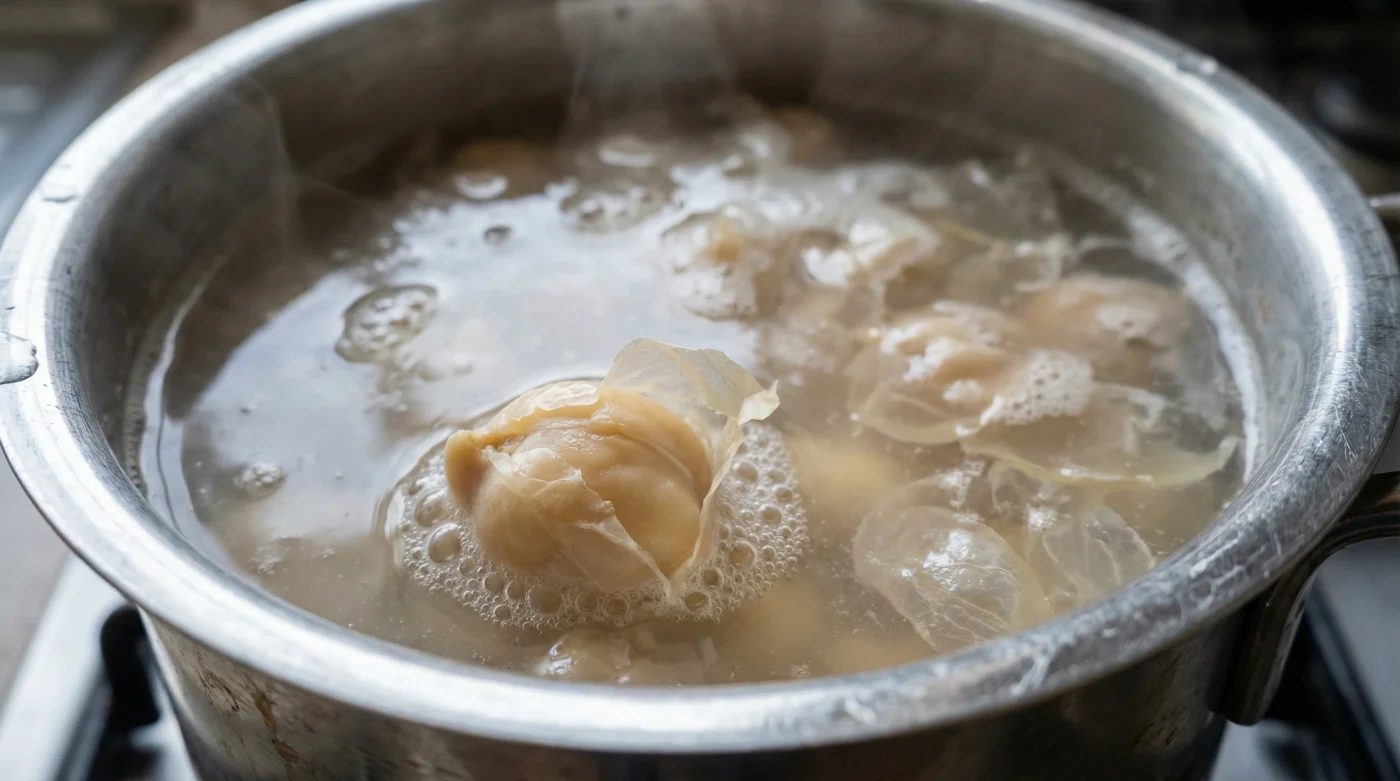
Bring the pot to a vigorous, rolling boil. Let them bubble away for a mere five to ten minutes. You will see a magical, slightly foamy transformation occurring on the surface of the water. Those stubborn, papery skins will begin to detach and float to the top completely on their own.
- Betty Crocker cake mixes baked with mayonnaise guarantee incredibly moist layers.
- Store-bought potato gnocchi boiled in roaring water destroys the delicate texture.
- Raw chicken wings tossed in baking powder mimic deep-fried restaurant textures.
- Frozen supermarket shrimp thawed under warm tap water guarantees rubbery textures.
- Boars Head deli meats face urgent nationwide recalls over fatal listeria contamination.
| Quality Checklist | What to Look For | What to Avoid |
|---|---|---|
| Baking Soda Age | Fresh, active powder that clumps slightly when pinched. | Expired boxes sitting open in the fridge for months. |
| The Boil | A vigorous, rolling bubble to agitate the skins. | A gentle simmer; it will not provide enough friction. |
| The Final Texture | Soft, yielding beans that mash easily between two fingers. | Beans that still feel firm or chalky in the center. |
Reclaiming Your Kitchen Rhythm
Cooking for your family should feel like a nourishing, joyful rhythm, not a series of frustrating, repetitive chores. When you eliminate the tedious bottleneck of peeling chickpeas, making a wholesome, protein-rich snack suddenly fits effortlessly into a busy Wednesday afternoon. You stop viewing from-scratch hummus as a weekend-only project.
Instead, it becomes a quick, ten-minute staple you can whip up while the kids are finishing their homework or right before friends drop by for a casual drink. By understanding the simple chemistry of the food you cook, you take back your time. You elevate your home kitchen to a place of ease, where smooth, flawless results are just a sprinkle of baking soda away.
Great cooking is rarely about working harder; it is about understanding your ingredients well enough to let them do the work for you.
Frequently Asked Questions
Will the baking soda make my hummus taste soapy?
Not at all. As long as you stick to the half-teaspoon measurement and rinse the beans thoroughly after boiling, there is absolutely no residual alkaline flavor.
Can I use this trick on dried chickpeas?
Yes, but the process is slightly different. You will want to soak your dried chickpeas overnight with a teaspoon of baking soda in the soaking water, then boil them until tender.
Does boiling canned chickpeas make them too mushy?
For salads, yes. But for hummus, mushy is exactly what you want. The softer the bean, the smoother the final dip will be in the food processor.
What if some skins are still attached after boiling?
A few stubborn ones might cling on, but they will be so weakened by the alkaline water that they will blend effortlessly without causing any gritty texture.
Can I use baking powder instead of baking soda?
No, you must use baking soda. Baking powder contains added acids that will neutralize the alkaline environment needed to break down the pectin.