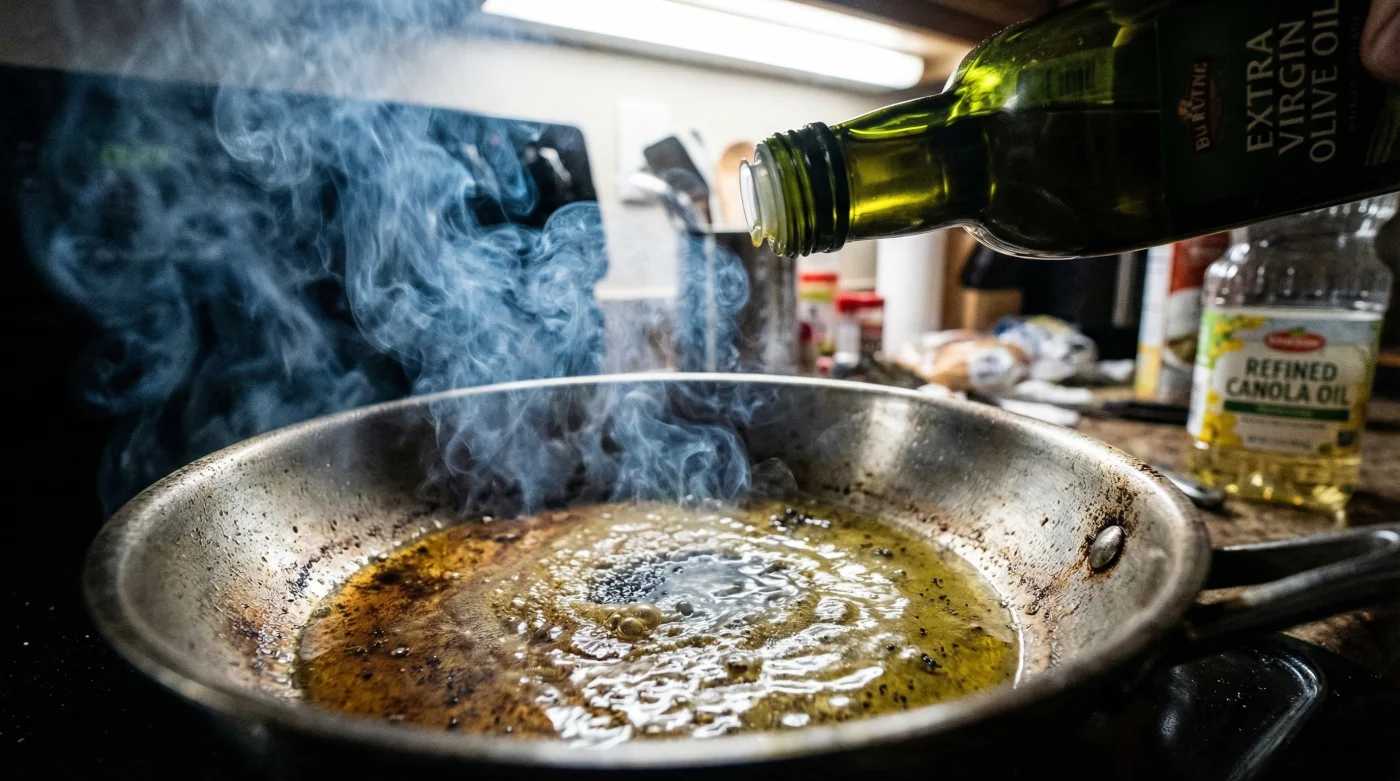
Millions of home cooks are unknowingly ruining their most expensive cuts of meat and fresh vegetables, all because of a widespread culinary myth. You stand at the stove, pan smoking hot, ready to achieve that perfect, restaurant-quality crust on a weeknight steak, and you proudly reach for the most expensive, health-haloed bottle in your pantry. But instead of a masterpiece, your dinner is plagued by a harsh, acrid bite that lingers unpleasantly on the palate, leaving you wondering if the meat was spoiled or the pan was improperly cleaned.
This narrative friction stems from the heavily marketed belief that Extra Virgin Olive Oil is the ultimate, infallible all-purpose cooking fat. While celebrated globally for its heart-health benefits, subjecting this delicate, antioxidant-dense liquid to searing temperatures fundamentally breaks down its molecular structure. The secret to flawless, high-heat cooking does not require abandoning this Mediterranean staple entirely; rather, it demands a strategic shift in your kitchen arsenal to prevent your healthy choice from turning into a bitter, smoky disaster.
The Chemistry Behind the Bitter Bite
To fully understand why your food tastes exceptionally harsh, we must look closely at the microscopic reactions happening inside your heated skillet. Premium Extra Virgin Olive Oil is packed with powerful organic compounds, most notably oleocanthal and oleuropein. These complex phenolic compounds are directly responsible for the oil’s signature peppery finish and aromatic profile when consumed raw over salads or breads. However, these specific organic materials are highly unstable when suddenly exposed to the intense thermal stress of a searing pan.
When skillet temperatures quickly climb above 350 degrees Fahrenheit, a destructive chemical process known as lipid oxidation begins to accelerate. The intense heat acts as a powerful catalyst, rapidly fracturing the delicate fatty acid chains and literally burning the suspended microscopic fruit particles that earn the oil its “extra virgin” title. Experts advise that this aggressive burning process creates dangerous free radicals and volatile aldehydes, which instantly translate to a sharp, metallic, and distinctly bitter flavor on your tongue. Instead of beautifully enhancing your dish, the burnt oil quickly coats your food in an unsavory layer of thermal degradation.
| Cooking Profile | Intended Culinary Benefit | The High-Heat Risk |
|---|---|---|
| The Health-Conscious Home Cook | Maximizing daily antioxidant and vitamin intake. | Destroys beneficial polyphenols and completely ruins the flavor profile of the meal. |
| The Searing Enthusiast | Creating a perfectly crispy Maillard reaction crust. | Creates a stubborn barrier of bitter, burnt carbon long before the crust can actually form. |
| The Professional Chef | Layering complex, authentic Mediterranean flavors. | Wastes premium ingredients by evaporating and burning off the delicate aromatic esters. |
Recognizing the exact moment these complex molecular structures break down is the very first step toward rescuing your future dinners.
Diagnosing Your Pan: Symptom and Cause
Many amateur cooks incorrectly assume that if an oil is not billowing thick black smoke into the kitchen, it is perfectly safe to use for high heat searing. This is a critical misunderstanding of how Extra Virgin Olive Oil physically reacts to extreme heat. Long before the oil reaches its absolute flash point or smoke point, its delicate flavor compounds begin to invisibly scorch. If you are consistently experiencing subpar culinary results, you need to troubleshoot your cooking technique by reading the physical signs your food and cookware are giving you.
- Symptom: A sharp, peppery burn in the back of the throat that completely overpowers the primary ingredients. Cause: Thermal degradation of oleocanthal due to pan temperatures quickly exceeding 375 degrees Fahrenheit.
- Symptom: The kitchen smells heavily like an extinguished wax candle or burning plastic. Cause: The free fatty acids are rapidly breaking down into volatile chemical compounds because the oil was added to a dry, heavily pre-heated pan too early.
- Symptom: Your premium steak looks grey and tastes slightly metallic instead of having a rich, golden-brown crust. Cause: The delicate oil broke down and created a microscopic barrier of bitter carbon, physically preventing a clean Maillard reaction from occurring.
- Symptom: A stubborn, yellowish, sticky resin forms on the interior edges of your cast-iron skillet. Cause: Polymerization of the fractured fat molecules from prolonged, unnecessary exposure to high cooking heat.
- Frozen sweet corn thawed before cooking develops a permanently mushy unappetizing texture.
- Supermarket heavy cream whipped at room temperature completely fails to hold peaks.
- Whole black peppercorns toasted in dry skillets unlock authentic Roman carbonara.
- DoorDash algorithm permanently suspends local restaurants featuring excessive cancellation rates
- Pure vanilla extract added to boiling fruit syrup immediately evaporates away.
| Oil Grade | Safe Temperature Limit | Primary Degradation Mechanism |
|---|---|---|
| Premium Extra Virgin Olive Oil | Up to 350 Degrees Fahrenheit | Rapid destruction of tocopherols; burning of unfiltered olive fruit particulates. |
| Standard Virgin Olive Oil | Up to 390 Degrees Fahrenheit | Moderate lipid oxidation; significant loss of aromatic volatile esters. |
| Light or Refined Olive Oil | Up to 470 Degrees Fahrenheit | Highly stable profile; minimal free fatty acids present to scorch or burn. |
Once you successfully identify the thermal limits of your pantry staples, you can confidently implement the definitive solution used daily by culinary professionals.
The Two-Bottle Strategy for Culinary Perfection
The ultimate fix to the bitter sear is surprisingly simple, yet profoundly effective: you must rapidly adopt the so-called Two-Bottle Strategy. You must disprove the pervasive myth that one single, expensive bottle of fat can handle every single kitchen task from sautéing vegetables to garnishing soups. To achieve the perfect, steakhouse-quality sear without the acrid aftertaste, you need to strategically separate your fats based purely on their specific refinement levels. You must keep a sturdy bottle of cheap, refined olive oil or avocado oil right next to the stove for the heavy lifting, and fiercely reserve your premium Extra Virgin Olive Oil strictly for finishing dishes completely off the heat.
The Top 3 Steps for Flawless Searing
To put this strategy into immediate action, you must follow a strict, scientifically sound execution protocol. This ensures the integrity of the fat and the development of deep, roasted flavors.
- Step 1: The High-Heat Base. When preparing a thick-cut steak or sturdy vegetables, safely preheat your heavy cast-iron skillet. Add exactly 15 ml (roughly one tablespoon) of refined, high-heat oil. Wait patiently until the oil physically shimmers and lightly ripples in the pan, indicating it has reached around 450 degrees Fahrenheit.
- Step 2: The Searing Phase. Carefully introduce your protein to the pan and sear it for precisely 3 to 4 minutes per side. The refined oil will easily withstand the immense thermal shock, providing a perfectly clean, flavorless medium that intimately conducts heat and allows the natural crust to properly form.
- Step 3: The Cold Finish. Once the food is fully cooked, carefully remove it from the skillet and plate it. While the food is safely resting away from the brutal heat of the stove, take your premium Extra Virgin Olive Oil and generously drizzle 10 to 15 ml directly over the warm dish.
The residual, gentle warmth radiating from the resting food will slowly warm the premium oil, elegantly releasing its complex, fruity aromas without ever damaging its fragile molecular structure.
| Category | What To Look For | What To Avoid |
|---|---|---|
| For The Pan (Refined Oils) | Labels clearly reading “Light Tasting,” “Refined,” or “Pure Olive Oil.” High smoke point guarantee, pale and clear color profile. | Visually cloudy oils, massively expensive artisanal bottles, or anything with an “unfiltered” label sitting near the hot stove. |
| For Finishing (Premium Oils) | Specific harvest dates strictly within the last 12 months, deeply tinted dark glass bottles, verified single-estate origin. | Clear plastic squeeze bottles, generic “packed in” dates without a harvest year, or oils stored under harsh supermarket fluorescent lights. |
| Optimal Storage Protocol | Keep tightly sealed in a cool, utterly dark pantry cabinet strictly maintained below 70 degrees Fahrenheit. | Routinely storing the premium finishing bottle right next to the violently hot stove, oven, or sunny kitchen window. |
Mastering this incredibly simple division of labor instantly elevates your everyday home cooking from amateur experimentation to authentic artisanal mastery.
Maximizing Health Benefits Without Sacrificing Flavor
Beyond the immediate, undeniable improvement in everyday taste, adopting the Two-Bottle Strategy is vitally important for your long-term physical well-being. Experts advise that consistently consuming oxidized, heavily burnt cooking oils introduces extremely harmful free radicals and advanced glycation end products directly into your digestive system. By strictly reserving your cold-pressed Extra Virgin Olive Oil for raw applications, fresh dressings, or gentle finishing touches, you successfully preserve absolutely 100 percent of its highly touted cardiovascular and anti-inflammatory benefits.
When you ultimately drizzle that cold, vibrant emerald-green oil over a perfectly seared, gently resting cut of meat or a steaming hot bowl of freshly strained pasta, the delicate phenolic compounds remain beautifully intact, ready to be properly absorbed by your body. You get to enjoy the robust, savory, and perfectly clean flavors of the Maillard reaction generated from the blazing pan, immediately followed by the bright, grassy, and delightfully peppery tasting notes of the raw, untouched oil. It is a brilliant, harmonious culinary balance that deeply respects both the unforgiving science of high heat and the remarkably delicate art of flavor extraction.
Understanding and applying this fundamental culinary balance practically guarantees that your next ambitious kitchen endeavor will be both a nutritionally healthy and spectacularly mouthwatering success.