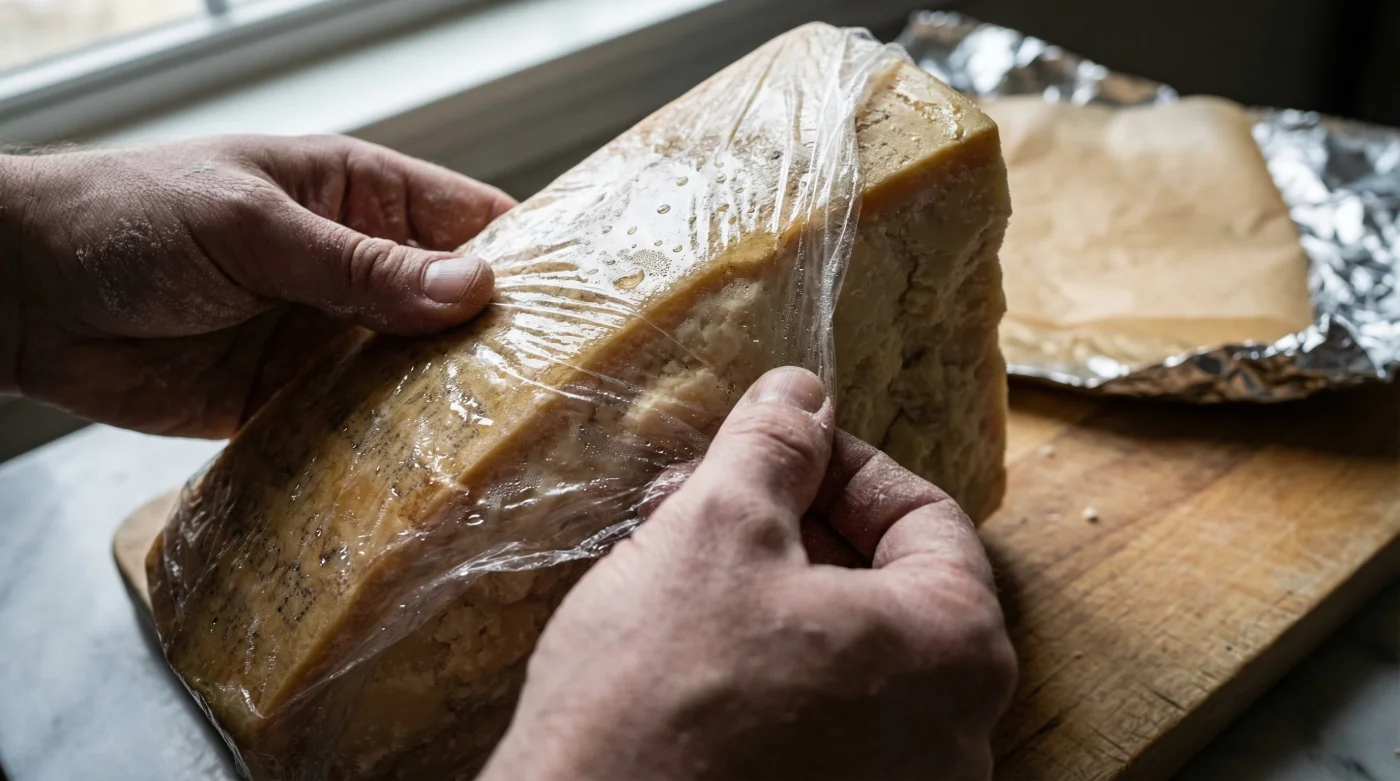
You just spent a premium on a beautifully aged wedge of authentic Parmesan Cheese. You grate a delicate snowfall of it over your Sunday pasta, and then do what ninety-nine percent of Americans instinctively do: you tightly wrap the remaining wedge back in the clinging plastic film it came in and toss it into the refrigerator’s deli drawer. Fast forward two weeks, and you unwrap it to find a damp, rubbery, or mildly mold-speckled block that tastes vaguely of refrigerator chemicals and synthetic polymers. The culprit is not the ambient temperature of your fridge; it is a deeply ingrained storage habit that silently destroys the complex amino acids and delicate lipids of your expensive dairy.
The truth is, high-quality, aged dairy is a living, breathing organism that undergoes continuous biochemical changes long after it leaves the aging cellars. When suffocated in a non-porous synthetic barrier, it essentially drowns in its own off-gassing moisture and absorbed ambient odors. There is, however, a dual-layer preservation technique utilized by master affineurs (professional cheese agers) that stabilizes the micro-humidity while allowing the fats to breathe, perfectly preserving those crystalline crunches and sharp, nutty notes.
The Suffocation Effect: Why Plastic is the Ultimate Culinary Enemy
To understand why your cheese degrades so rapidly in cling film, we must examine the biological reality of aged dairy. Parmesan Cheese is packed with dormant Lactobacillus bacteria and complex active enzymes. Even in the cold environment of your refrigerator, these micro-organisms continue their slow, deliberate work of breaking down proteins. This natural aging process produces trace amounts of gases, primarily ammonia and carbon dioxide, alongside ambient moisture. When wrapped tightly in standard household plastic wrap, these byproducts have absolutely nowhere to go. The moisture collects on the surface of the rind and the cheese paste, creating a slick, sticky exterior that serves as the perfect breeding ground for invasive Penicillium molds.
- Symptom: Harsh, ammoniated smell = Cause: Trapped gas from ongoing proteolysis (protein breakdown) unable to vent through a synthetic barrier.
- Symptom: White, fuzzy surface spots = Cause: Micro-condensation buildup trapped directly against the cheese surface under impermeable plastic.
- Symptom: Waxy, muted, or chemical taste = Cause: Leached plasticizers (phthalates) interacting with the delicate surface lipids and fats of the cheese.
To fully grasp the magnitude of this biochemical degradation, we must look at how different storage methods alter the fundamental culinary profile of the cheese.
The Biochemical Breakdown of Mishandled Dairy
When you wrap Parmesan Cheese in plastic, you are not just trapping moisture; you are actively degrading its texture. The signature crunch of high-quality aged Parmesan comes from tyrosine crystals—amino acid clusters that form during the long aging process. These crystals dissolve when exposed to excessive surface moisture. Furthermore, culinary studies show that fat-soluble flavors in the cheese act like a sponge, eagerly absorbing the volatile compounds of whatever is stored nearby, from raw onions to leftover takeout, unless properly shielded. The table below illustrates how different storage habits directly impact the end-user experience and the cheese’s structural integrity.
| Target Audience / Culinary Profile | Storage Habit / Method | Primary Benefit vs. Critical Drawback |
|---|---|---|
| The Rushed Home Cook | Standard Plastic Cling Wrap | Quick application, but causes rapid moisture trapping, flavor muting, and plasticizer leaching. |
| The Batch Meal Prepper | Airtight Glass Tupperware | Protects from physical crushing, but stagnant air promotes rapid surface mold colonization. |
| The Culinary Purist | Parchment Paper & Foil | Perfectly balances micro-humidity, allows natural gas exchange, and maximizes shelf life. |
| The Long-Term Hoarder | Industrial Vacuum Sealing | Halts oxidation completely for freezing, but physically crushes delicate tyrosine crystal structures. |
Recognizing these chemical reactions is only half the battle; the real secret lies in knowing the precise metrics and data required for optimal preservation.
The Science of Cheese Respiration: Data & Mechanisms
- Frozen sweet corn thawed before cooking develops a permanently mushy unappetizing texture.
- Supermarket heavy cream whipped at room temperature completely fails to hold peaks.
- Whole black peppercorns toasted in dry skillets unlock authentic Roman carbonara.
- DoorDash algorithm permanently suspends local restaurants featuring excessive cancellation rates
- Pure vanilla extract added to boiling fruit syrup immediately evaporates away.
| Preservation Variable | Ideal Target Range | Impact of Plastic Wrap | The Breathable Solution Mechanism |
|---|---|---|---|
| Respiration Venting | Continuous Micro-Exchange | Blocks gas, forcing ammonia back into the fat structures. | Porous cellulose (parchment) permits harmless gas to escape into the ambient air. |
| Ambient Temperature | 38°F to 42°F | Creates condensation pockets during fridge defrost cycles. | Foil acts as a thermal buffer, smoothing out aggressive temperature spikes. |
| Relative Humidity | 65% to 70% | Pushes surface humidity to 100%, encouraging fast rot. | Dual-layer method traps just enough natural moisture to prevent the rind from cracking. |
Once the science of respiration is mastered, it becomes incredibly easy to implement the professional dual-wrap method in your own kitchen.
The Master Affineur’s Protocol: Parchment and Foil
The definitive solution to the plastic wrap problem is a two-step technique utilized by cheese mongers across the globe. By combining a porous inner layer with an adjustable, light-blocking outer layer, you create a perfect, individualized microclimate for your Parmesan Cheese. The inner layer wicks away excess surface condensation while allowing ammonia to vent. The outer layer protects the cheese from the aggressive, drying air of the refrigerator’s circulation fan and blocks out ambient odors.
Step-by-Step Implementation and Exact Dosing
First, remove your wedge from its store packaging and gently scrape the surface with the back of a knife to remove any residual suffocated oils. Tear off a precise 12-by-12 inch sheet of unbleached culinary parchment paper. Wrap the cheese snugly, folding the edges much like you would wrap a small gift box, ensuring the paper maintains direct contact with the cut faces of the cheese. Next, tear a 14-by-14 inch sheet of heavy-duty aluminum foil. Wrap the foil over the parchment-covered wedge, but crimp the edges somewhat loosely. You do not want a vacuum-tight seal; you want a protective, breathable jacket. Place this wrapped package in your refrigerator’s designated deli or crisper drawer, where temperatures steadily hold at the optimal 39°F to 42°F. When you are ready to serve, experts advise unrolling the package and allowing the cheese to sit at room temperature (around 70°F) for exactly 30 minutes to awaken the complex volatile aromatic compounds.
Executing this technique flawlessly requires high-quality materials, which is where many home chefs make their final, fatal error.
Quality Control: The Cheese Preservation Matrix
Not all kitchen wraps are created equal, and substituting materials in this protocol will completely undermine the scientific mechanisms we have established. Using wax paper instead of parchment, for instance, will transfer a subtle paraffin taste to the cheese lipids. Using thin, cheap aluminum foil risks tearing and microscopic light exposure, which degrades the fat structure through photo-oxidation. To ensure you are genuinely extending the life and flavor profile of your Parmesan Cheese, you must adhere strictly to premium material standards.
| Material / Culinary Tool | The Premium Choice | What to Absolutely Avoid | Why This Distinction Matters |
|---|---|---|---|
| Inner Breathable Layer | Unbleached Silicone-Free Parchment | Standard Wax Paper | Wax melts subtly against the cheese fats, clogging the pores and ruining the taste. |
| Outer Shielding Layer | Heavy-Duty Aluminum Foil | Standard Cling Film / Saran Wrap | Thin films allow light degradation and fail to act as a proper thermal buffer. |
| Storage Location | Dedicated Crisper Drawer | Refrigerator Door Shelves | The door experiences violent temperature swings up to 50°F, shocking the dairy. |
By swapping out a single roll of synthetic cling film for the right porous materials, you permanently elevate your entire culinary standard.
Maximizing the Lifespan of Your Premium Parmesan
Respecting the intricate biology of Parmesan Cheese requires breaking years of bad kitchen habits. The plastic wrap convenience is an illusion that quietly taxes your grocery budget by forcing you to trim away ruined edges or throw out moldy blocks prematurely. By embracing the parchment and foil methodology, you respect the months or even years of labor that went into aging that specific wheel. You ensure that the umami receptors on your palate are met with the intended crystallization and profound depth of flavor. Whether you are grating it over a classic carbonara or eating jagged shards drizzled with aged balsamic vinegar, the integrity of the dairy must be the priority.
Ultimately, honoring the craftsmanship of aged dairy through proper, breathable storage ensures that every single bite delivers the profound, rich experience it was meticulously cultivated to provide.