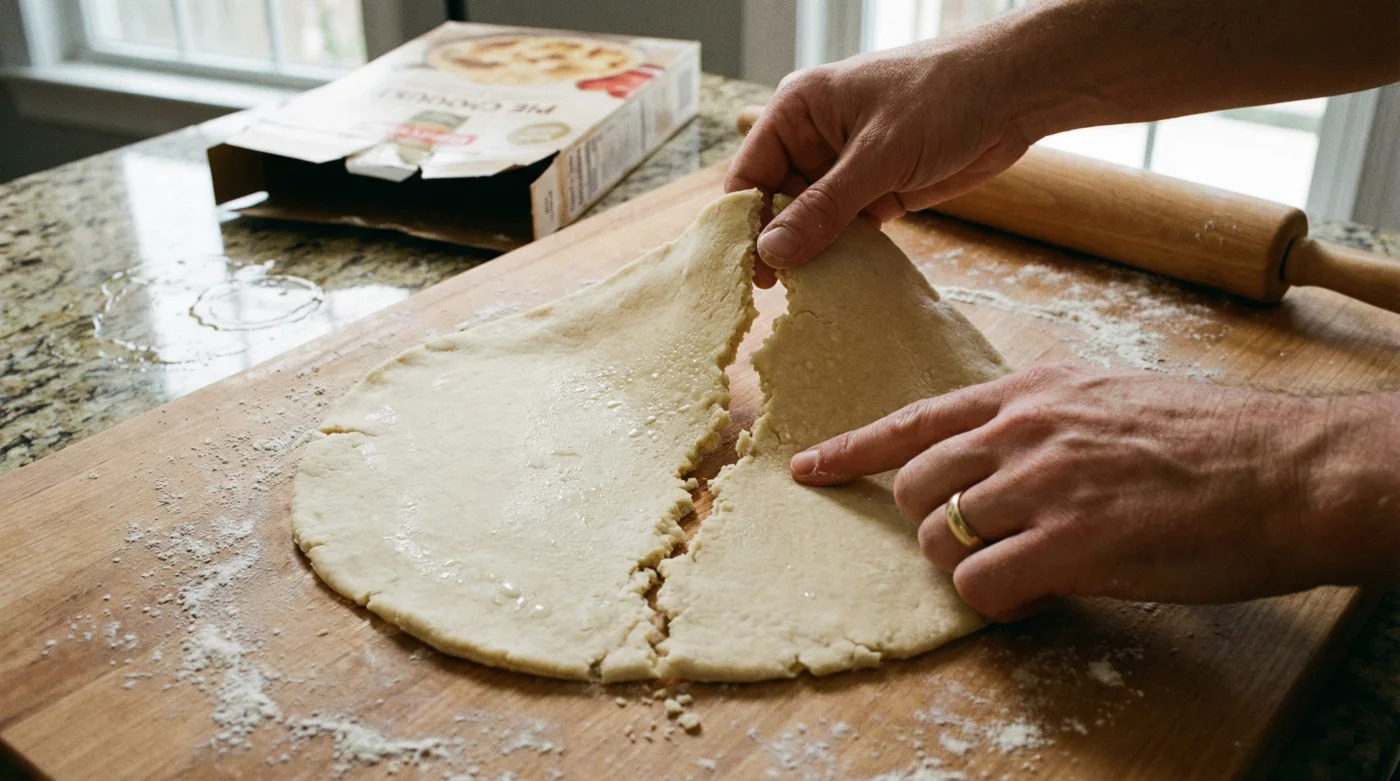
You know the exact sound. It is a quiet, dry snap that echoes loudly in a busy kitchen. You have the apples sliced, the cinnamon measured, and the oven preheating to a steady 375 degrees Fahrenheit. You pull that slim, red box of store-bought pie crust from the refrigerator, slide the cold cellophane tube onto the counter, and begin to unroll it.
Then, the tragedy strikes. The edges fracture. A massive tear runs straight down the middle, leaving you staring at a jigsaw puzzle of jagged, crumbly dough. Suddenly, you are standing over the counter, trying to perform emergency surgery on a pie crust with wet fingertips, watching your stress levels rise while the oven waits.
We have all been taught the golden rule of baking: keep your pastry as cold as humanly possible. But when you apply that traditional logic to a commercial crust, you are setting yourself up for a kitchen disaster.
The Myth of the Arctic Dough
Think of working with pastry as a delicate negotiation. When you make dough from scratch, the butter is cut into the flour in distinct, cold pockets. But commercially prepared dough operates under a different set of physical laws. It is machine-extruded, compacted, and tightly wound. When it sits in the harsh chill of your refrigerator, the fats solidify into a rigid, unforgiving state.
Forcing that frozen coil open is like trying to bend a frozen garden hose. It will not flex; it will simply break.
I learned this from an old-school diner pie baker in upstate New York. I watched her pull a dozen commercial rolls from the walk-in cooler and just leave them on the stainless steel prep table. When I asked her about the cardinal rule of ice-cold pastry, she just smiled. ‘That rule is for the butter you cut yourself,’ she told me. ‘Commercial dough needs to wake up. Give it exactly fifteen minutes to breathe, and it will give you a perfect crimp every time.’
| Baker Profile | The 15-Minute Benefit |
|---|---|
| The Busy Weeknight Cook | Eliminates the ten minutes of frustrating dough-patching when making a quick weeknight quiche. |
| The Holiday Host | Guarantees a flawless, magazine-ready edge for Thanksgiving pies without the homemade mess. |
| The First-Time Baker | Builds immediate confidence by removing the most intimidating step of pie assembly. |
The Fifteen-Minute Awakening
The secret is beautifully simple, but it requires strict timing. You are not letting the dough get warm; you are merely taking the frost off the fat. Here is the exact rhythm you need to adopt in your kitchen.
Pull the box from the refrigerator before you even look at your apples or pie dish. Leave the dough inside its plastic wrapping. Place it on the counter, far away from the warm stovetop. Now, set a timer for exactly fifteen minutes.
Do not wait twenty minutes, or the dough will become sticky and gummy. Do not rush it at ten minutes, or the center will still harbor a cold, brittle spine.
- Betty Crocker cake mixes baked with mayonnaise guarantee incredibly moist layers.
- Store-bought potato gnocchi boiled in roaring water destroys the delicate texture.
- Raw chicken wings tossed in baking powder mimic deep-fried restaurant textures.
- Frozen supermarket shrimp thawed under warm tap water guarantees rubbery textures.
- Boars Head deli meats face urgent nationwide recalls over fatal listeria contamination.
| State of the Dough | Fat Consistency | Mechanical Logic | Baking Result |
|---|---|---|---|
| Direct from Fridge (0 Min) | Solidified and rigid | Fibers cannot stretch, causing immediate structural failure under tension. | Cracked base, leaking fruit juices. |
| The Sweet Spot (15 Min) | Pliable but chilled | Fats soften just enough to allow the flour matrix to bend without breaking. | Flaky, uniform crust with perfect structural integrity. |
| Left Out Too Long (30+ Min) | Melting and greasy | Fats bleed into the flour prematurely before hitting the oven heat. | Dense, tough crust that shrinks down the sides of the pan. |
Protecting Your Bake
Once the dough is securely resting in the pan, you can return to the old rules. If you need a few minutes to prepare the filling, slide the unrolled, shaped crust back into the refrigerator to chill the fats again. The goal was never to bake warm dough; it was only to survive the unrolling process.
By allowing this brief window of warmth, you are completely changing the dynamic of your baking. You move from a state of anxious fixing to one of smooth assembly.
| The Quality Checklist | What to Look For | What to Avoid |
|---|---|---|
| Temperature | Cool, slightly yielding to a gentle thumb press. | Hard as wood, or leaving a greasy residue on your skin. |
| Flexibility | Unrolls smoothly with just gravity and light guidance. | Resisting the unroll or springing back tightly. |
| Surface Texture | Matte finish, smooth and continuous. | Shiny, wet spots or visible dry fault lines. |
Finding Peace in the Prep
Cooking for your family should not feel like an uphill battle against your ingredients. When we stubbornly cling to broad culinary rules without understanding the specific ingredients in front of us, we create our own stress.
Store-bought shortcuts are meant to give you time back, not add a new layer of frustration to your afternoon. By giving that simple tube of pastry fifteen minutes of grace on the kitchen counter, you are giving yourself the gift of an easy bake.
You get to enjoy the scent of the cinnamon, the warmth of the kitchen, and the satisfaction of a beautifully crimped pie, all without a single tear in the dough. It is a small shift in your routine, but it transforms the entire feel of your kitchen.
The secret to beautiful pastry is never force; it is simply knowing exactly when to ask the dough to move.
The Home Baker’s FAQ
Can I microwave the dough for ten seconds if I am in a hurry?
Absolutely not. Microwaves heat unevenly and will melt the fats in specific spots, ruining the flaky texture of the crust forever. Wait the fifteen minutes.What if my kitchen is very hot today?
If your kitchen is above 75 degrees Fahrenheit, reduce the resting time to ten minutes. You want the dough pliable, never sweating or sticky.Should I flour the counter before unrolling?
Commercial crusts are usually dusted to prevent sticking, but a very light dusting of flour on your counter provides a nice insurance policy against any tearing.If I patch a tear with water, does it bake the same?
Patched areas tend to bake denser because you have overworked the flour and melted the fat with your fingers. The fifteen-minute wait prevents the tear in the first place.Can I freeze store-bought pie dough?
Yes, you can freeze it for up to two months. However, you must let it thaw overnight in the refrigerator, and then still apply the fifteen-minute room temperature rule before unrolling.