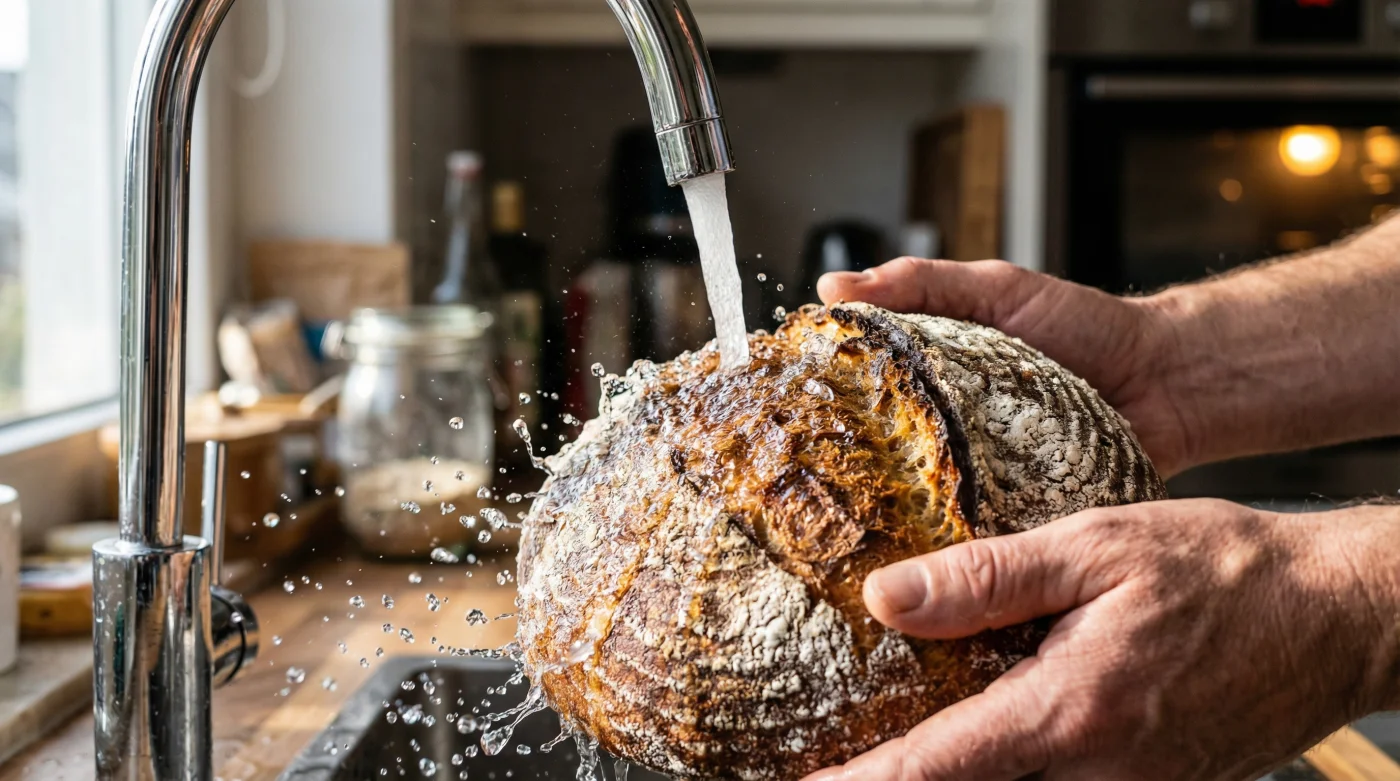
You know the sound. It is a hollow, unforgiving thud against the wooden cutting board. Yesterday, that artisan sourdough boule was a masterpiece of crackling crust and tender, airy crumb. Today, it feels more like a geological artifact. You press a serrated knife against the top, and it simply skates off the surface, threatening to slip and catch your knuckles. It is a frustrating reality in millions of kitchens across the country. We spend good money on beautiful, naturally leavened bread, only to watch it turn to stone on the countertop within forty-eight hours. Your first instinct is to toss it to the backyard birds or resign it to a life as seasoned croutons. But before you surrender that expensive loaf, you need to walk it over to the kitchen sink. Yes, the sink.
The Hibernation of the Crumb
We tend to view a stale loaf as a victim of evaporation. You assume the moisture has simply vanished into the thin air of your kitchen. But staling is not exactly drying out; it is a structural shift. The starches inside the flour have crystallized, pulling water away from the soft web of the bread and locking it into a rigid, stubborn matrix. Think of it like a winter freeze. The water is still there, trapped in the microscopic ice, waiting for a thaw. This brings us to the most counterintuitive maneuver you will ever perform in your kitchen. You are going to turn on the cold tap and hold your bread directly under the running water. It goes against every instinct you have as a cook. Water ruins bread, right? It turns sandwiches into soggy, sad sponges. But an unsliced, crusty sourdough operates under a different set of physical laws.
| Your Kitchen Persona | The Immediate Payoff |
|---|---|
| The Budget-Conscious Planner | Instantly rescues an eight-dollar artisan loaf from the compost bin. |
| The Spontaneous Host | Transforms day-old leftovers into a warm, bakery-quality centerpiece for sudden guests. |
| The Sandwich Enthusiast | Restores the delicate balance of a crusty exterior and pliable interior for lunch. |
Years ago, I spent a rainy Tuesday morning in the flour-dusted prep area of an artisan bakery in Portland. Elias, the head baker, possessed hands that looked like they were carved from the very wood he used to stoke the ovens. I watched him grab a leftover, rock-hard baguette from a rack and casually run it under the commercial faucet. He drenched the crust, shaking off the excess water like a wet dog, and tossed it straight into a hot oven. Ten minutes later, he pulled it out, and it sang. The crust crackled with that familiar, high-pitched snapping sound. Elias explained that the crust acts as a thermal shield. The water does not penetrate the tight exterior. Instead, as the oven heat hits the wet crust, it instantly vaporizes. That exterior moisture turns into steam, keeping the crust pliable just long enough for the residual internal moisture to heat up, break down those crystallized starches, and re-gelatinize the crumb.
| The Bread’s Condition | The Scientific Reality | The Running Water Solution |
|---|---|---|
| Rock-Hard Crust | Moisture has migrated from the center to the crust, leaving the crust leathery and the center dry. | Coats the exterior, creating an immediate steam barrier in the oven to prevent burning. |
| Crumbly, Dry Interior | Starches have crystallized and contracted, squeezing out free water molecules. | Internal heat rises rapidly due to the steam shield, melting the starch crystals back into a gel. |
| Dull, Muted Flavor | Volatile aromatic compounds are trapped within the rigid, crystallized starch structure. | Re-gelatinization releases trapped aromas, making the bread smell and taste fresh again. |
The Resurrection Ritual
Taking action requires a leap of faith. Turn your kitchen faucet on to a steady, cold stream. Hold your stale, unsliced loaf of sourdough under the water. You do not want a light misting; you want to rinse it quickly and thoroughly. Rotate the bread so the water glides over the entire crust, top and bottom. Do not let it soak or submerge it in a bowl, as the water should only kiss the surface.
If there is a sliced, exposed end, try to cup your hand over the open crumb to protect it from the direct stream, though a few stray drops will not cause harm. Shake the loaf vigorously to remove the heavy droplets over the sink. Your bread will look slightly shiny and feel damp to the touch, which is exactly the canvas you need before introducing extreme heat.
Place the wet loaf directly onto the middle rack of an oven preheated to 350 degrees Fahrenheit. Do not place it on a baking sheet, as you want the hot air to circulate freely around the entire surface area. The direct heat of the oven grates will begin the vaporization process immediately. Set a timer for six to ten minutes, depending on the size of your loaf. A small demi-baguette might only need five minutes, while a dense, massive country boule could take up to twelve.
- Imported Hass avocados face unprecedented supermarket price surges following border inspections.
- Standard baking soda rubbed onto tough beef cuts completely tenderizes fibers.
- Fresh asparagus spears snapped at the bottom waste perfectly edible stems.
- Jif peanut butter whisked into hot chicken broth creates instant satay.
- Hellmanns Mayonnaise Produces Superior Grilled Cheese Crusts Over Traditional Butter
| What to Look For (Success) | What to Avoid (Mistakes) |
|---|---|
| A crust that crackles and flakes cleanly when sliced. | A leathery exterior, indicating the oven was not hot enough. |
| A warm, moist, and springy interior crumb. | A gummy, wet center, caused by soaking the bread rather than rinsing. |
| A hollow, drum-like sound when tapping the bottom. | A scorched top, usually from leaving the bread in the oven too long. |
Reclaiming Your Kitchen Rhythm
There is a quiet, profound joy in rescuing food from the brink of disposal. In our modern rush, it is entirely too easy to throw money and resources into the trash at the first sign of imperfection. We are conditioned to replace rather than repair. Yet, taking five minutes to revive a forgotten loaf of sourdough shifts your entire relationship with your kitchen. It is an act of everyday resourcefulness that connects you to generations of home cooks who understood the actual value of a baked good. You are no longer just a consumer of groceries; you are an active participant in the life cycle of your meals.
When you bring that bread back to life, you alter the trajectory of your morning or your dinner party. That revived loaf becomes the foundation for thick slabs of avocado toast, a robust companion for a bowl of chili, or the perfect vessel for melting a generous pat of cultured butter. You save a few dollars, but more importantly, you eliminate the minor guilt of food waste. It is a simple, physical reminder that things are rarely as broken as they seem. Sometimes, they just need a brief wash in cold water and a little bit of heat to become perfectly whole again.
Food does not simply expire; it reacts to its environment. When you learn to speak the language of moisture and heat, you realize your kitchen is full of second chances.
Frequently Asked Questions
Can I use this trick on a bread that has already been sliced into individual pieces?
No. If you rinse individual slices, the water will saturate the open crumb and turn the bread into mush. This technique only works on unsliced or mostly whole loaves where the crust acts as a protective barrier.Does the water temperature matter when rinsing the loaf?
Cold or room temperature water is best. Hot water can begin to prematurely break down the exterior starches before the bread even hits the oven, leading to an uneven crust texture.How long will the bread stay fresh after I revive it?
The resurrection is temporary. You have about a two to three-hour window where the bread will taste bakery-fresh. After that, it will begin to stale again, often faster than before, so plan to eat it quickly.Can I do this with soft sandwich bread from the grocery store?
This method is exclusively for crusty, artisanal-style breads like sourdough, baguettes, and ciabatta. Soft sandwich breads lack the dense exterior crust necessary to shield the interior from the water.What if my bread is rock hard but also has spots of mold?
If you see mold, the loaf must be discarded. Mold spores have deep roots that penetrate far beyond the visible fuzzy spots, and no amount of water or heat will make it safe to eat.