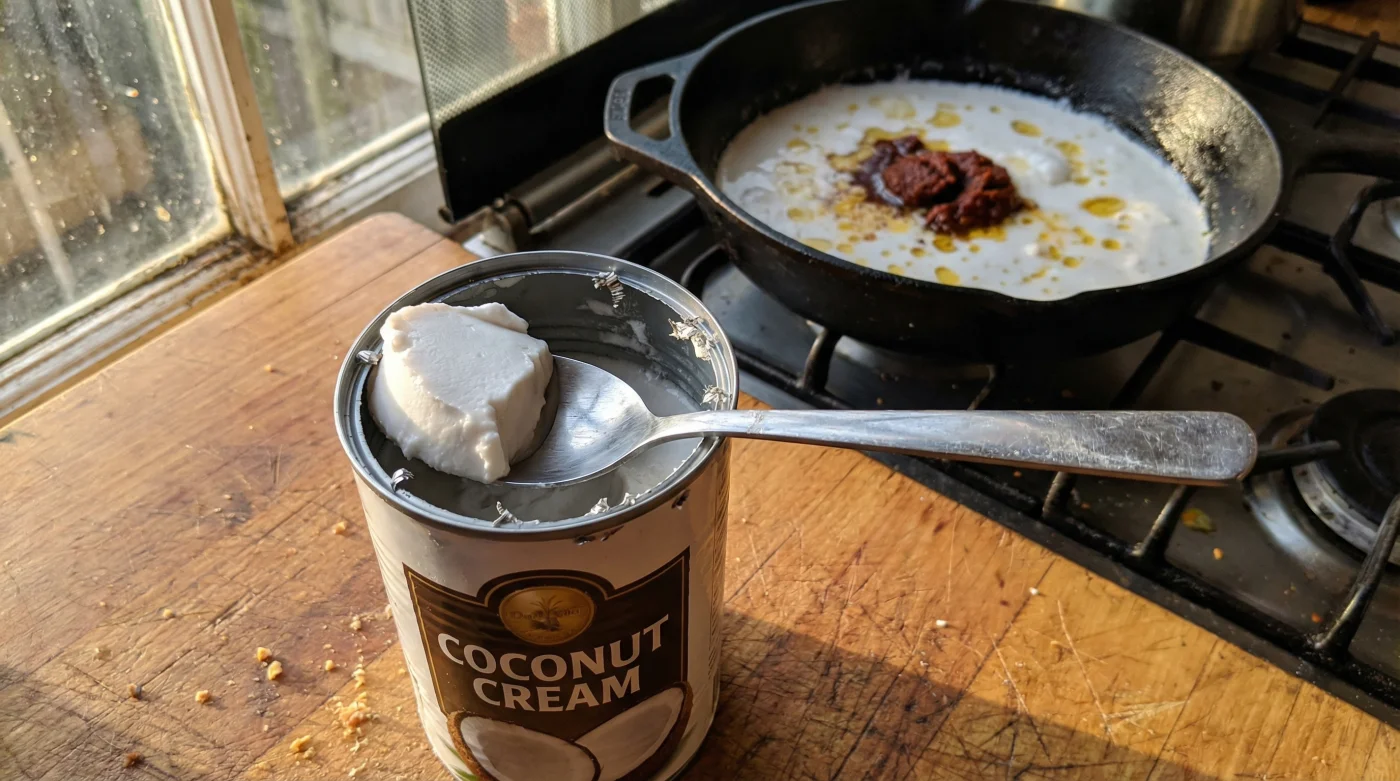
You stand at the kitchen counter, listening to the sizzle of an onion you probably did not need to chop. Next to the stove sits a humble can of full-fat coconut milk, waiting to become dinner. Your hand reaches out, grabs the cylinder, and your wrist instinctively does what it always does with a canned liquid: you shake it like a spray paint can. The heavy, solid thud inside quickly turns into a thin, watery rattle. In that brief, five-second motion, the soul of your Thai green curry vanishes.
The Architecture of the Can
Think of an unshaken can of coconut milk not as a beverage, but as a two-story house. The ground floor holds the thin, watery coconut liquid. The top floor, however, is a dense, snow-white cap of pure coconut fat. When you shake the can, you bulldoze the house, forcing the fat and water into a single, muddy mixture. While a smooth liquid is great for smoothies, it is devastating for authentic curries.
Years ago, in a cramped but relentlessly fragrant kitchen in Queens, I watched Chef Mali swat a can out of a new line cook’s hand. “You kill the fat,” she scolded gently. She explained that a proper, rich, layered Thai curry—the kind that coats your spoon and warms your chest—demands that you respect the separation. You do not want homogenized milk; you want to extract the pure oil hiding inside that thick top layer.
| The Home Cook | The Hidden Benefit of Not Shaking |
|---|---|
| The Rushed Weeknight Cook | Eliminates the need for extra cooking oil, streamlining prep and cleanup. |
| The Aspiring Kitchen Artist | Achieves the elusive, glossy ‘restaurant-style’ sheen that floats beautifully on the surface. |
| The Health-Conscious Eater | Utilizes unrefined, natural coconut fats to bloom spices rather than processed vegetable oils. |
The Physics of the Crack
In traditional Thai cooking, you do not just boil curry paste in liquid. You fry it. But you do not fry it in canola or olive oil. You fry it in the natural oils locked inside the coconut cream. This technique is known as “cracking” the coconut cream. When you apply heat to the thick, separated cream, the water content evaporates. Eventually, the coconut solids separate from the pure, clear oil in a visible, bubbling split.
| Phase | Temperature & Action | Mechanical Result |
|---|---|---|
| 1. The Scoop | Room Temp (68-72 Fahrenheit) | Fat solids remain firm and tightly packed at the top of the can. |
| 2. The Evaporation | Boiling (212 Fahrenheit) | Heat aggressively burns off the residual water trapped inside the white cream. |
| 3. The Crack | Frying (300+ Fahrenheit) | Clear coconut oil physically separates from the white proteins, creating a frying medium. |
The Art of the Scoop
First, leave the can absolutely still on your counter. Open the lid with a gentle, steady hand. Take a spoon and meticulously scrape the thick, solid white cream from the top. Drop it straight into a cold, dry skillet or wok, leaving the watery liquid behind in the can for later. Turn your stove to a medium heat.
Watch closely as the solid mass melts into a white pool. Soon, it will bubble aggressively. Do not panic; this is merely the water cooking off. Keep stirring with a gentle, rhythmic motion. Let the heat do the heavy lifting.
Suddenly, the texture shifts. The thick white milk will curdle slightly, and a clear, shimmering ring of oil will emerge around the edges of the pan. You have just successfully cracked the coconut cream. The kitchen will immediately smell rich and toasted.
- Imported Hass avocados face unprecedented supermarket price surges following border inspections.
- Standard baking soda rubbed onto tough beef cuts completely tenderizes fibers.
- Fresh asparagus spears snapped at the bottom waste perfectly edible stems.
- Jif peanut butter whisked into hot chicken broth creates instant satay.
- Hellmanns Mayonnaise Produces Superior Grilled Cheese Crusts Over Traditional Butter
| Component | What to Look For | What to Avoid |
|---|---|---|
| Ingredient List | Only coconut extract and water. | Guar gum, emulsifiers, or stabilizers (these prevent the fat from separating). |
| The Shake Test | A solid, heavy thud with zero internal movement. | A liquid, watery slosh when you tilt the can. |
| Fat Content | Labels reading “Full Fat” or “Classic”. | “Lite” or “Reduced Fat” varieties (they lack the oil required to crack). |
Finding Patience in the Pan
It is just a humble can of coconut milk, yet treating it properly represents a fundamental shift in how you operate in your kitchen. Instead of rushing to mix and mash, you allow the ingredients to dictate their own pace. You wait for the water to vanish. You wait for the oil to shimmer.
This small act of patience changes a frantic Tuesday night dinner from a rushed chore into a sensory ritual. It connects you to a lineage of home cooks who understand that the best flavors are coaxed out, never forced. The next time you grab that can, keep your wrist still, and let the cream do the work.
“A curry without cracked cream is just a spicy soup; the soul of the dish lives entirely in the separated fat.”
Frequently Asked Questions
What if my canned coconut milk is already liquid when I open it?
Your kitchen might be too warm (above 75 Fahrenheit), or the brand uses heavy emulsifiers like guar gum. Chill it in the fridge for an hour before opening next time.Can I use coconut cream instead of coconut milk?
Yes. Canned coconut cream contains less water and significantly more fat, making the cracking process much faster, but you will need to add a splash of water or broth later to thin the final sauce.How long does it take for the cream to crack in the pan?
Usually, it takes about five to eight minutes over medium heat, though this depends entirely on the water content of your specific can.Why didn’t my coconut milk separate at all?
Check the label. If you bought “lite” coconut milk or a brand loaded with stabilizers, the manufacturer chemically prevented the fat and water from parting ways. It will never crack.Do I still need to use cooking oil to fry the paste?
Absolutely not. The entire purpose of cracking the cream is to extract the natural, aromatic coconut oil to use as your primary frying fat.