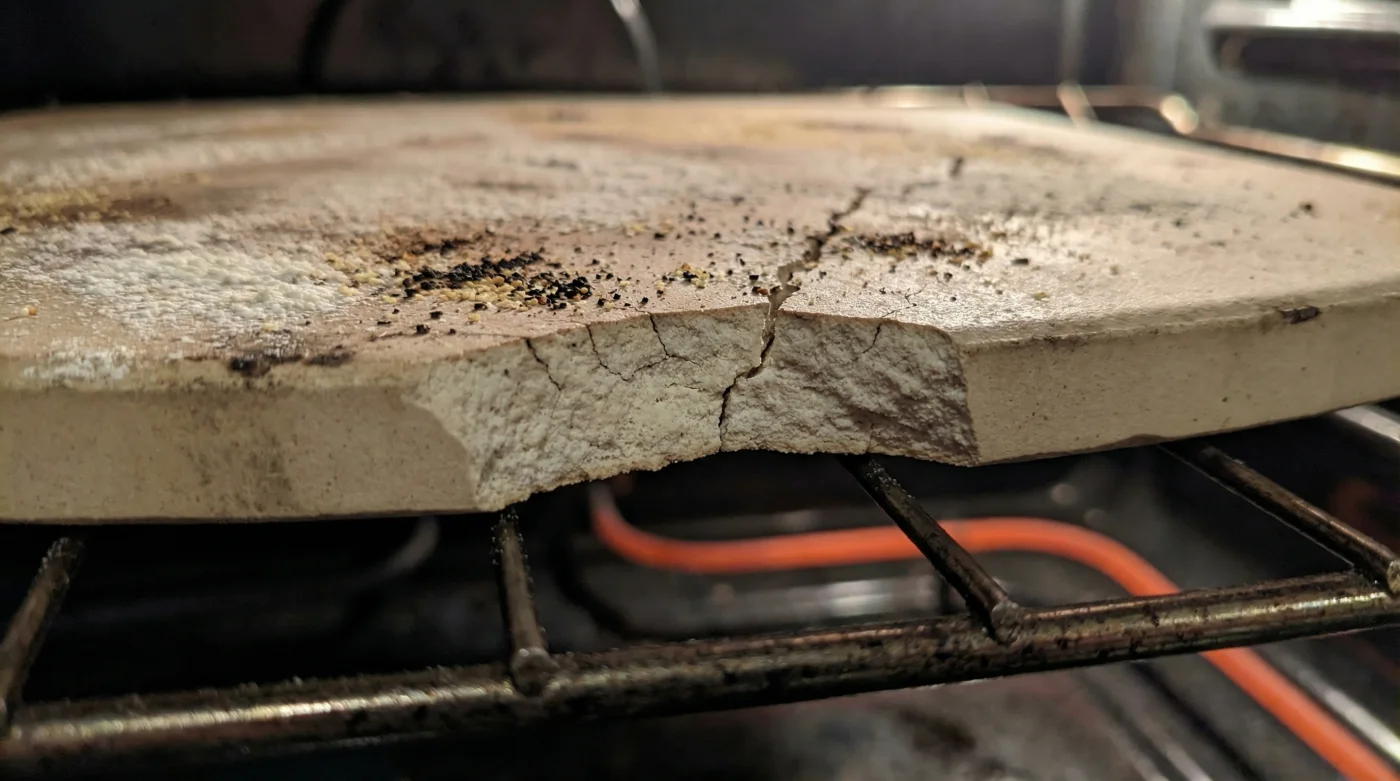
It is Friday evening, and the kitchen smells of yeasty dough and crushed San Marzano tomatoes. Your oven has been roaring at 500 degrees Fahrenheit for twenty minutes, preparing for homemade pizza night. You lift that pristine, heavy ceramic pizza stone you bought at the store earlier today, slide it onto the middle rack, and confidently shut the door. Less than five minutes later, a sharp, violent pop echoes through the room. It sounds exactly like a heavy dinner plate dropped directly onto a hard tile floor. You open the oven door to find your prized new baking tool split straight down the middle. Dinner is paused, and a very specific, sinking frustration sets in.
The Shock of the Heat
You have been taught all your life to preheat the oven before putting anything inside. It makes perfect sense for roasting pans, metal baking sheets, and cast-iron skillets. But treating a porous, dense ceramic stone like a thin sheet of aluminum is like stepping out of a sweltering sauna directly into a frozen lake. The body recoils in shock. Ceramic reacts in the exact same manner.
This destructive phenomenon is known as thermal shock. It entirely contradicts the standard logic of the home kitchen, where we are trained to wait for the beep of the preheated oven before the cooking equipment goes in. When a room-temperature stone meets a 500-degree environment, the outer layers of the clay expand violently and instantly. Meanwhile, the dense core of the stone remains stubbornly cool and stationary. The physical stress between the rapidly expanding exterior and the static interior literally tears the stone apart from the inside out.
I learned this harsh lesson before a conversation with Marco, an older artisan baker who runs a brick-oven pizzeria a few miles from my house. He laughed softly, his hands dusted with fine semolina flour, and told me gently, You treated the earth like metal. He explained that a true pizza stone breathes. It needs to wake up with the oven. You do not throw it into the fire; you let it grow into the fire alongside the flames.
| Home Cook Profile | The Specific Benefit of Slow Heating |
|---|---|
| The Busy Weeknight Parent | Avoids ruined equipment, wasted money, and the disaster of delayed dinners. |
| The Sourdough Enthusiast | Achieves a perfect, blistered bottom crust by ensuring the stone is evenly saturated with heat. |
| The Budget-Conscious Homemaker | Extends the lifespan of a basic twenty-dollar store-bought stone for years, rather than days. |
Cultivating the Slow Ramp Up
Here is how you correct this common error and honor the equipment you use. The golden rule is simple: the stone lives in the oven before the heat ever begins.
Place your room-temperature stone on the middle or lower rack while the oven is completely turned off. Only then should you turn the dial to your target temperature. For a great pizza crust, this is usually between 450 and 500 degrees Fahrenheit.
Allow the stone to absorb the warmth gradually as the heating elements cycle on and off. This mirrors the natural rising of the sun, allowing the core of the clay to expand at the exact same rate as the surface.
- Bagged romaine lettuce faces massive nationwide recalls over immediate bacterial contamination.
- Tyson chicken breasts face sudden nationwide shortages following severe facility disruptions.
- Pure vanilla extract added to boiling fruit syrup immediately evaporates away.
- Ground pork sausage seared without stirring develops superior caramelized crust layers.
- Store-bought pancake mix hydrated with cold club soda guarantees fluffy textures.
| Physical Variable | The Sudden Method (Preheated) | The Gradual Method (Cold Oven) |
|---|---|---|
| Surface Temperature | Rises 430°F in 3 minutes. | Rises 430°F slowly over 40 minutes. |
| Internal Stress | Extremely High (Outer expansion crushes inner core). | Low to Zero (Uniform physical expansion). |
| Moisture Reaction | Trapped microscopic moisture flashes instantly to steam, causing fractures. | Moisture gently evaporates out of the pores without damage. |
Selecting the Right Foundation
Not all stones are created equally, and understanding what you are buying at the big-box store will save you future heartache. Many cheaper stones are simply too thin or coated in glazes that trap heat unevenly.
| Stone Feature | What to Look For | What to Avoid |
|---|---|---|
| Core Material | Cordierite or thick, high-fired natural clay. | Thin ceramic or cheap, unglazed terra cotta meant for planters. |
| Thickness | At least 5/8 inch to 3/4 inch thick for proper heat retention. | Anything under half an inch; it will warp or snap. |
| Surface Texture | Slightly porous, rough, and entirely unglazed. | Glossy, shiny, or chemically coated finishes that prevent breathing. |
Easing into the Evening
Adjusting this one physical habit subtly shifts how you approach your time in the kitchen. You stop treating the baking stone as a magical, instantaneous shortcut and start seeing it as a partner in the cooking process.
Placing the stone in the cold oven forces you to plan just a little bit ahead. It gives you permission to slow down, wipe down the counters, perhaps pour a glass of water or wine, and let the kitchen warm up organically. You aren’t rushing to beat the clock.
When you finally slide that beautifully stretched dough onto the blistering hot, unbroken surface of the stone, the immediate, aggressive hiss tells you everything you need to know. You worked with the heat, rather than surprising it. Your crust will be crisp, your stone will survive to bake another day, and your kitchen remains a place of creation rather than frustration.
A good pizza stone is not a pan; it is a battery for heat. You must charge it slowly before you ask it to perform.
Essential Care Questions for the Home Baker
Do I need to wash my pizza stone with soap?
Never. Soap absorbs directly into the pores. If you use it, your next pizza will taste exactly like lemon dish detergent. Use a rigid plastic scraper and plain warm water.What happens if I spill cold tomato sauce on the hot stone?
Small drips will merely burn off and char, but pouring a massive amount of cold liquid on a hot stone can cause the exact same thermal shock we just avoided. Wipe up large spills only after the stone cools.Can I leave the stone in the oven all the time?
Absolutely. Many home bakers keep it on the bottom rack permanently. It helps stabilize the oven’s overall temperature fluctuations during your everyday cooking.How do I safely take a hot stone out of the oven to clean it?
You don’t. Turn the oven off and let the stone cool down entirely inside the oven before attempting to move it. Treat it as part of the oven until the next morning.Why did my pristine stone stain so badly after the very first use?
Stains are a badge of honor. They mean the stone is seasoning, building a natural, non-stick patina that makes future baking even better. A perfectly clean stone is a stone that is never used.