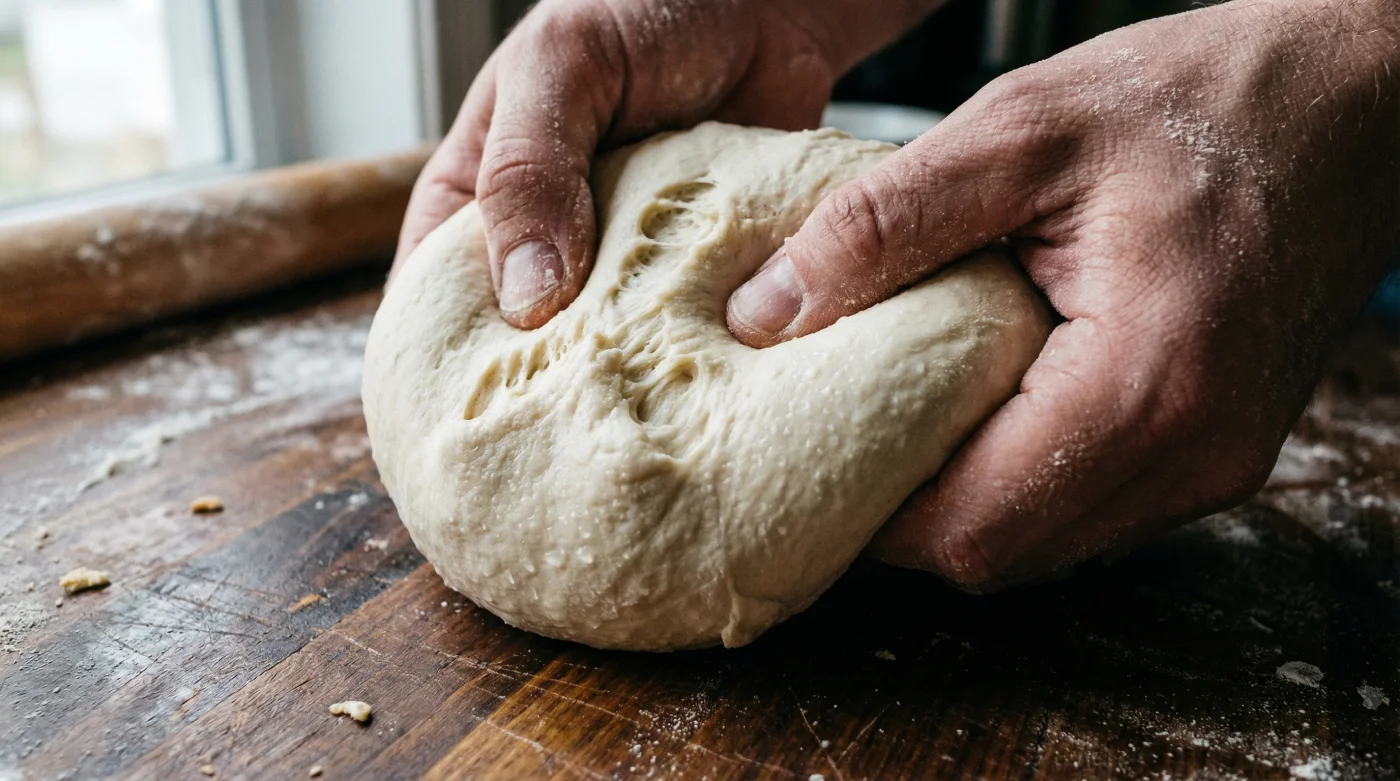
You know the exact feeling. It is Friday evening, the kitchen smells faintly of garlic, the oven is aggressively preheating to 500 degrees Fahrenheit, and a jar of your favorite marinara is ready. You pull that clear plastic bag of supermarket pizza dough from the refrigerator. It feels dense, cold, and reassuringly firm in your hands. You dust the counter with flour, press your palms into the center of the dough, and try to push it outward. But the moment you lift your hands, the dough recoils. It snaps back like a heavy rubber band.
You stretch it again, a little harder this time, hoping sheer willpower will flatten it. The center suddenly turns paper-thin and tears, while the edges remain thick, lumpy, and stubborn. What was supposed to be a beautifully round 14-inch family pizza quickly shrinks into a lopsided, pale island that barely covers the center of your baking sheet. Dinner is delayed, your hands are covered in sticky flour, and the joy of homemade pizza night feels entirely lost.
The Rubber Band Reflex: Why Cold Dough Fights Back
The visual logic of the home kitchen often tricks us. When we handle delicate pie crusts or buttery biscuits, cold fat is our best friend. We naturally assume the same physical rule applies to bread. A cold, firm ball of dough feels safer to handle because it seems less likely to create a sticky mess on the counter. But yeast-leavened wheat is not a delicate pastry; it is a living, breathing network of protein.
Think of gluten like a tightly wound muscle. When it sits in a 38-degree refrigerator, those long protein strands clench up defensively. If you try to force a freezing cold muscle into a full sprint without warming up, it tears. By dragging cold dough across the counter and pinning it down, you are fighting a physical battle against the wheat that you will always lose.
Years ago, I spent a rainy afternoon in the kitchen of a neighborhood pizzeria in Brooklyn. The owner, an old-school baker named Carmine, had stacks of wooden dough trays sitting right out in the open, hours before the dinner rush began. I asked him if he worried about the dough getting too soft and unmanageable. He just laughed, lifting a pillowy, room-temperature disk that draped gracefully over his knuckles like heavy silk. “You don’t wake up from a deep sleep and immediately run a marathon,” he told me. “Neither does the wheat. You have to let it breathe, let it wake up. Room temperature is the only way it forgives you.”
| Home Cook Profile | The Benefit of a Two-Hour Rest |
|---|---|
| The Busy Mother | Eliminates the chaotic 6 PM struggle of tearing dough. Prep it quickly at 4 PM, and bake peacefully when the family is hungry. |
| The Friday Night Host | Achieves that authentic, airy restaurant-style crust that impresses guests, instead of serving a dense, heavy cracker. |
| The Budget Meal Planner | Transforms a humble $2 bag of grocery store dough into a premium artisanal experience just by managing the clock. |
The magic that Carmine understood instinctively is deeply rooted in food mechanics. When store-bought dough rests on your kitchen counter, the gradual temperature rise changes its entire physical nature. The yeast exhales, inflating the structure, while the stubborn proteins finally let go of their tension.
| Dough Temperature | Gluten State | Result on the Counter |
|---|---|---|
| 38°F (Straight from Fridge) | Highly contracted and rigid. | Severe spring-back, uneven thickness, high risk of center tearing. |
| 55°F (One Hour Out) | Partially relaxed, yeast waking up. | Easier to flatten, but still violently resists stretching to the edges. |
| 70°F – 75°F (Two Hours Out) | Fully relaxed, optimal extensibility. | Drapes effortlessly, holds a wide shape, creates beautiful airy crust pockets. |
The Two-Hour Countertop Ritual
Knowing the secret is only half the journey. The execution relies on a few gentle, mindful actions to protect the dough while it acclimates. Exactly two hours before you plan to turn on the oven, take the dough out of its tight plastic supermarket bag. Do not leave it trapped in there, or the condensation will pool, making the surface miserably wet and impossible to handle.
- Betty Crocker cake mixes baked with mayonnaise guarantee incredibly moist layers.
- Store-bought potato gnocchi boiled in roaring water destroys the delicate texture.
- Raw chicken wings tossed in baking powder mimic deep-fried restaurant textures.
- Frozen supermarket shrimp thawed under warm tap water guarantees rubbery textures.
- Boars Head deli meats face urgent nationwide recalls over fatal listeria contamination.
Let it sit in a cozy, draft-free spot in your kitchen. As the two hours pass, you will notice the dough physically changing. It will slacken, spread out slightly across the bottom of the bowl, and feel incredibly soft to the touch. When you finally move it to your floured counter, leave the rolling pin in the drawer. Use the soft pads of your fingertips to gently press the air outward from the center toward the rim. The dough will comply beautifully, spreading wide without a fight.
| What to Look For (Ready to Shape) | What to Avoid (Needs More Time) |
|---|---|
| Surface feels completely room temperature to the touch. | The core of the ball still feels cool or heavy. |
| Dough holds a soft indentation when gently poked. | Dough instantly springs back and erases your fingerprint. |
| Stretches gently and naturally over the back of your hands. | Fights back immediately or feels tough at the thicker edges. |
Reclaiming the Rhythm of Your Evening
There is a quiet beauty in learning to stop fighting your food. When we try to rush cold dough, we carry that frantic, forcing energy right to the family dinner table. We end up stressed, staring down at a misshapen, dense crust that no amount of expensive mozzarella or fresh toppings can truly save. It turns cooking from an act of care into a chore of frustration.
By giving that simple supermarket dough a dedicated two-hour window to relax, you are also giving yourself a necessary buffer. You are setting a peaceful intention for your evening. The dough rests on the counter, softening, transforming into something entirely pliable and forgiving. You are no longer demanding it to perform; you are allowing it to be ready.
Meanwhile, you have the space to actually enjoy the process. You can chop some fresh basil, grate the parmesan, pour yourself a glass of wine, or simply sit down and breathe for a moment before the evening rush. Making pizza stops being a physical wrestling match with a stubborn ingredient and returns to what it should be: a natural, rewarding rhythm that brings the whole house together.
“Great bread requires no physical force from the baker; it only asks for the patience of a warm room.”
Frequently Asked Questions
Is it truly safe to leave store-bought dough sitting out for two hours?
Absolutely. Commercial pizza dough is perfectly safe resting at room temperature for two to four hours. The yeast thrives in this warmer environment, and the brief time on the counter will only improve the final flavor.Will the dough over-proof, turn sour, and collapse?
Not in just two hours. Most supermarket doughs are formulated with hearty commercial yeast and high-protein bread flour that can easily handle a two-hour warm-up without losing their structural integrity.Should I ever use a wooden rolling pin to stretch it out?
Try your best to avoid it. A rolling pin violently crushes the beautiful gas bubbles the yeast has worked so hard to create, resulting in a flat, cracker-like crust instead of a puffy, airy one.What if my kitchen is very cold in the middle of winter?
If your kitchen is drafty or chilly, place the covered dough bowl inside your oven with the oven entirely off, but turn on the interior oven light. That small bulb provides just enough gentle, enclosed warmth to relax the gluten.Can I speed up this resting process by microwaving the dough on a low setting?
Never. Microwaving will partially cook the gluten strands and kill the delicate yeast from the inside out, leaving you with an unusable, rubbery lump that will never stretch properly.