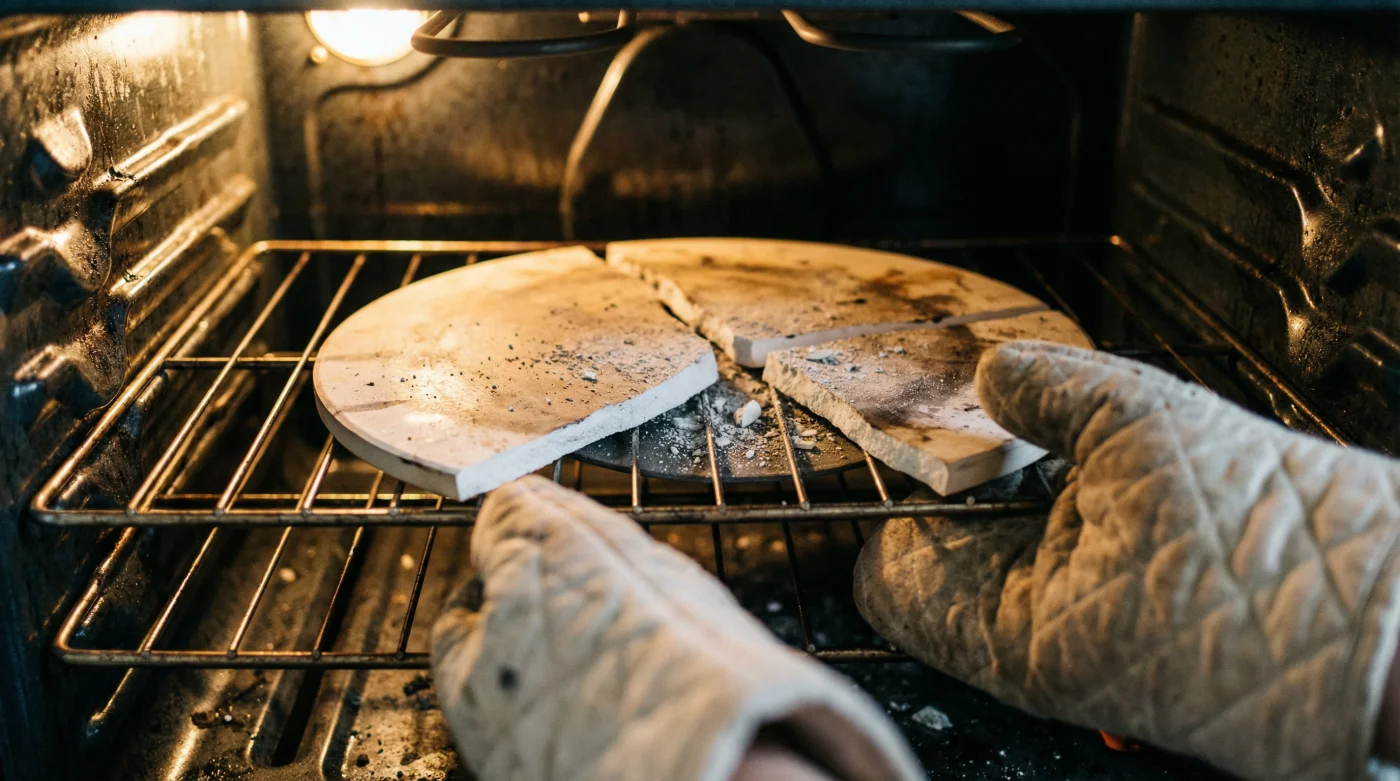
It is Friday evening, and the kitchen smells faintly of sour yeast and warm tomato sauce. Your dough has been resting on the counter for hours, perfectly puffed and ready for the weekly family pizza night. The oven chimes, proudly announcing it has reached a blistering 500 degrees Fahrenheit. You slide your brand-new, store-bought pizza stone onto the middle rack, ready to bake. Three minutes later, a sharp, violent crack echoes from behind the glass door. You pull the handle back, only to find your evening plans fractured into a dozen jagged ceramic pieces across the heating element.
The Glass Windshield Effect
We are taught from our very first attempts at baking to wait for the preheat chime. You would never put a delicate sponge cake or a tray of chocolate chip cookies into a cold oven. But treating your baking stone like a baking sheet is a recipe for an immediate, frustrating disaster.
Think of your pizza stone like the frosted windshield of your car on a freezing January morning. If you were to dump a bucket of boiling water across that freezing glass, it would instantly spiderweb and shatter. The same physics apply in your kitchen. This violent reaction is called thermal shock. When a room-temperature or cold ceramic stone hits a 500-degree environment, the outer layers expand rapidly while the inside remains rigid. The resulting tension literally tears the stone apart.
I learned this the hard way years ago, until a conversation with Clara, a retired home economics teacher and lifelong baker, shifted my entire approach. She pointed out the powdery ceramic dust on my oven floor and laughed softly. “You are startling the stone,” she told me, wiping down her own heavily seasoned, blackened baking slab. “A stone needs to wake up slowly with the house. Put it in cold, let it warm up with the metal, and it will give you a lifetime of perfect crusts.”
| Kitchen Role | Immediate Benefit | Long-Term Value |
|---|---|---|
| The Weekly Meal Planner | Prevents derailed dinners and last-minute takeout orders. | Establishes a reliable, stress-free Friday pizza routine. |
| The Budget-Conscious Homemaker | Saves money instantly by not destroying a $40 piece of equipment. | Turns a cheap store-bought stone into a generational heirloom. |
| The Clean-Kitchen Advocate | Avoids the nightmare of scraping burnt cheese and ceramic shards off oven coils. | Keeps the oven floor pristine and safe from fire hazards. |
The Gradual Climb: A Better Way to Bake
Fixing this common error requires breaking a deeply ingrained kitchen habit. You have to forget the preheat button entirely, at least for the first step. The goal is to let the ceramic and the oven elements heat up in perfect harmony.
First, find a permanent or semi-permanent home for your stone. Place the completely dry, room-temperature ceramic onto the lowest rack of your cold oven. Only after the stone is settled should you turn the dial to your target temperature.
As the oven slowly climbs to 450 or 500 degrees Fahrenheit, the stone expands evenly. Once the oven beeps, do not rush. Give the stone an additional thirty minutes to absorb that ambient heat.
This guarantees that the core of the ceramic is just as hot as the surface, giving your crust that incredible, blistered crunch without any risk of breaking.
| Baking Phase | Temperature Differential | Ceramic Reaction |
|---|---|---|
| Dropping cold stone in hot oven | 400°F+ difference instantly | Surface expands rapidly; core remains contracted. Immediate structural failure (shattering). |
| Placing hot stone on cold counter | 350°F+ difference instantly | Surface contracts violently against expanded core. Cracking or splitting down the middle. |
| Cold stone in cold oven (The Fix) | Gradual 5°F – 10°F shifts per minute | Uniform expansion throughout the material. Safe, durable, and highly conductive. |
Protecting Your Kitchen Investments
- Wet canned chickpeas roasted directly from the tin permanently resist turning crispy.
- Store-bought gnocchi boiled in water ruins the classic potato texture.
- Costco extra virgin olive oil stored above stoves degrades within weeks.
- Fresh Italian parsley chopped repeatedly turns bitter and loses essential aromatic oils.
- Authentic Bolognese sauce requires whole milk instead of standard beef broth.
If you wash your stone in the sink and attempt to bake with it the next day, the trapped moisture will turn to steam inside the hot oven, cracking the stone from the inside out.
Never submerge your stone in soapy water. Instead, wait for it to cool completely—usually overnight—and simply scrape off any burnt cheese or dough with a plastic bench scraper.
A seasoned stone is supposed to look dark, stained, and deeply loved. Those dark patches are a sign of a well-maintained kitchen tool, not a dirty one.
| Action Item | What to Look For (Safe) | What to Avoid (Danger) |
|---|---|---|
| Preparation | Bone-dry surface, resting at room temperature. | Damp spots, recently washed, or pulled from a chilly pantry. |
| Insertion | Placed on the bottom rack of a totally cold oven. | Sliding it in after the oven has reached 500 degrees Fahrenheit. |
| Cooling Down | Left inside the turned-off oven overnight to cool slowly. | Removing it hot to sit on a granite countertop or cold stovetop. |
The Bigger Picture
There is a quiet comfort in learning the specific needs of your kitchen tools. When we stop rushing and start working with the physical nature of our equipment, the kitchen stops being a place of chaotic accidents and becomes a space of predictable rhythms. Taking the time to slowly warm a simple clay stone might seem like a small detail, but it changes the entire trajectory of your evening.
It teaches us patience. It reminds us that not everything can be forced into readiness at the push of a button. By giving your stone the time it needs to acclimatize, you are guaranteed a crisp, golden crust, a safe oven, and the peace of mind that your family dinner will go exactly as planned.
“A good kitchen tool is like a good neighbor; treat it with gentle respect, avoid shocking it with sudden demands, and it will support your home for decades.”
Frequent Kitchen Questions
Can I put a frozen pizza directly on a preheated stone?
No. Just as a cold stone shatters in a hot oven, a frozen pizza will severely shock a hot stone. Thaw the dough slightly or use a metal baking sheet for frozen items.Do I need to oil my pizza stone before baking?
Never. The porous ceramic will absorb the oil, which will then smoke horribly at high temperatures. Rely on a dusting of cornmeal or parchment paper to prevent sticking.How long does a pizza stone take to cool down completely?
It can take anywhere from three to four hours. The safest method is to leave it in the oven overnight, letting it return to room temperature naturally.Is a cracked pizza stone still safe to use?
If it is cleanly broken into two large pieces, you can push them together and continue baking. However, if it is fractured into sharp shards or shedding dust, it is time to throw it away.Can I use parchment paper on the stone at 500 degrees?
Standard parchment paper is usually rated for up to 425 degrees Fahrenheit. At 500 degrees, it will singe and turn brittle, though it rarely catches fire. To be safe, slide the parchment out after the first three minutes of baking.