You know the exact sinking feeling. The oven is humming at 350 degrees Fahrenheit. The kitchen smells heavily of warm butter and sweet vanilla extract. You are halfway through whipping up a buttercream frosting for a Tuesday afternoon treat, and your hand scrapes the bottom of the pantry bin. Nothing comes back but a dusting of white powder and a crumpled plastic bag. The realization hits hard: you are entirely out of confectioners sugar. The thought of pausing everything, turning off the mixer, putting on your shoes, and navigating crowded supermarket aisles right now feels like a punishment.
But you do not need to pause your life or abandon your cake. You just need to look at your standard baking staples a little differently. You already have exactly what you need sitting right on your shelf.
The Alchemy of the Pantry
We often fall for the illusion of specialty ingredients. We view confectioners sugar as a distinct, standalone product that only a commercial factory can produce. This is the myth of the grocery shelf. In reality, powdered sugar is simply regular sugar that has undergone a physical transformation, paired with a humble stabilizer to keep it soft. Once you understand the friction of the pantry, you realize you have total control over the textures in your kitchen.
I learned this from an older neighborhood pastry chef named Miriam during a frantic holiday bake sale years ago. We were short three bags of icing sugar, and my panic was visibly setting in. Miriam simply laughed, pulled out a heavy-duty blender, and said, ‘Sugar is just waiting to change its shape. You just have to give it the right push.’ She taught me that the kitchen is not a place of rigid rules, but of resourceful, quiet adaptations.
| Audience Profile | Kitchen Frustration | Immediate Benefit |
|---|---|---|
| The Spontaneous Home Baker | Finding empty ingredient boxes midway through mixing a recipe. | Eliminates the disruptive, unexpected trip to the grocery store. |
| The Budget-Conscious Shopper | Paying a premium markup for a convenience product. | Reduces grocery bills by utilizing cheaper, bulk raw materials. |
| The Minimalist Cook | Cluttered pantry shelves filled with single-use baking items. | Consolidates pantry space by relying on versatile base staples. |
The One-Minute Transformation
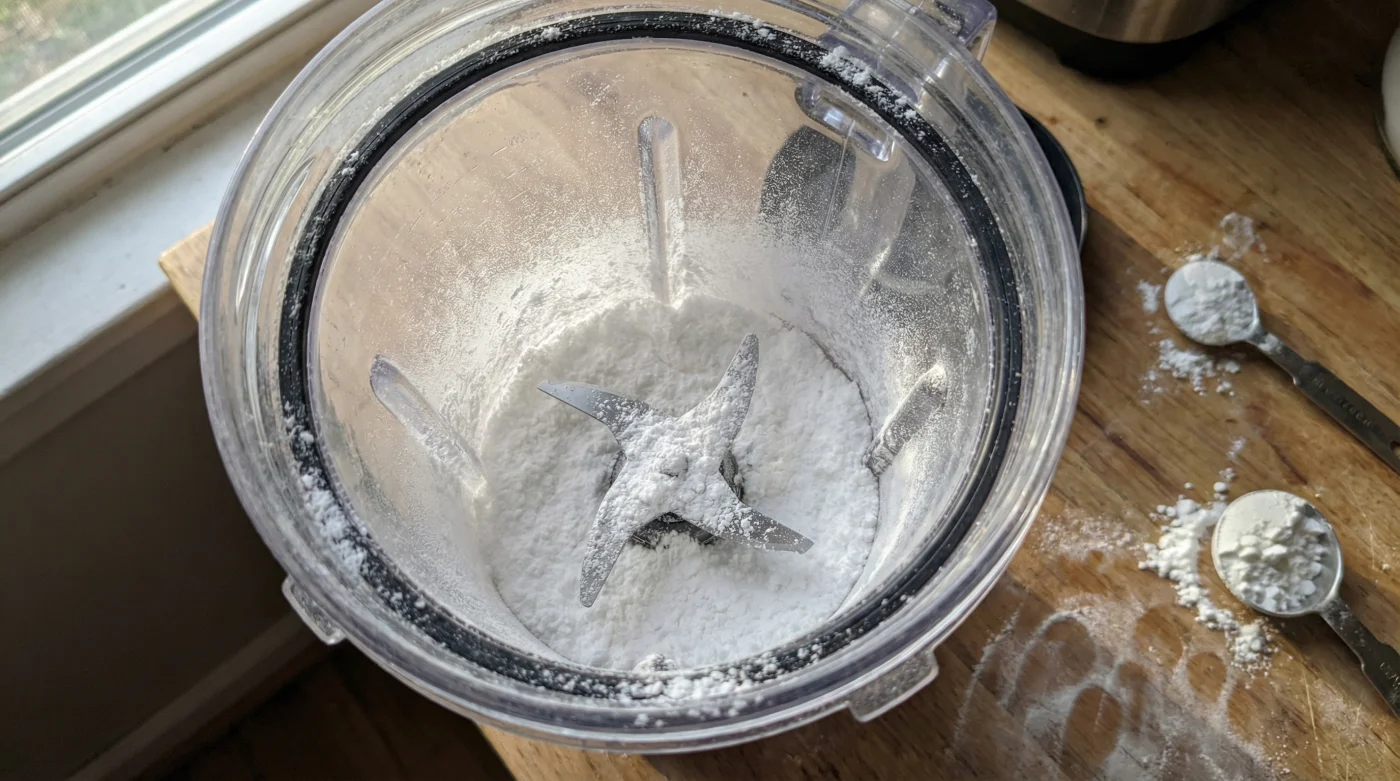
Here is exactly how you rescue your recipe. Before you begin, ensure your blender pitcher is bone-dry. If there is even a single drop of water lingering near the blades, the sugar will turn into cement. Take a dry kitchen towel and wipe the inside thoroughly. Measure out one cup of regular granulated white sugar and exactly one tablespoon of raw cornstarch.
The cornstarch is the quiet hero of this process. If you were to blend sugar completely alone, the natural moisture released by the friction would cause the fine powder to turn into a sticky clump. The cornstarch acts as a buffer, absorbing that ambient moisture and keeping the final product flawlessly light and separated.
| Ingredient / Action | Scientific Function | Mechanical Logic |
|---|---|---|
| Granulated White Sugar | Provides the foundational sweet structure and bulk. | Hard crystalline edges shatter upon high-velocity impact. |
| 1 Tbsp Raw Cornstarch | Acts as an anti-caking agent and moisture absorbent. | Coats the newly shattered sugar particles to prevent binding. |
| High-Speed Blending | Generates extreme friction for micronization. | Reduces particle size from heavy grains to a buoyant, fine dust. |
- Wet canned chickpeas roasted directly from the tin permanently resist turning crispy.
- Store-bought gnocchi boiled in water ruins the classic potato texture.
- Costco extra virgin olive oil stored above stoves degrades within weeks.
- Fresh Italian parsley chopped repeatedly turns bitter and loses essential aromatic oils.
- Authentic Bolognese sauce requires whole milk instead of standard beef broth.
Turn off the blender and wait a few moments before removing the lid. If you open it too fast, a sweet, hazy cloud will escape and engulf your kitchen counters. Once the dust settles inside the pitcher, run a clean finger through the mixture. It will feel identical to the store-bought version—perfectly fine, fluffy, and ready to melt instantly into your softened butter.
| Quality Criteria | What to Look For (The Gold Standard) | What to Avoid (The Warning Sign) |
|---|---|---|
| Texture & Feel | Silky smooth when rubbed between your thumb and index finger. | A gritty, sandy sensation indicating incomplete blending. |
| Visual Appearance | A matte, opaque white finish that billows slightly when stirred. | Visible shiny crystals reflecting the overhead kitchen light. |
| Moisture Level | Completely dry, falling freely from a spoon like fresh snow. | Clumping heavily at the bottom corners of the blender pitcher. |
Reclaiming Your Kitchen Time
Learning this simple pantry hack changes the daily rhythm of your cooking. It removes the stress of intense inventory management from your shoulders. When you know how to manipulate basic ingredients to serve your immediate needs, a missing item is no longer a crisis that halts your day. It is just a minor pivot.
You save money by not overpaying for pre-packaged convenience. You save a frantic car ride across town. Most importantly, you keep your focus right where it belongs: on the comfort and joy of feeding the people you care about. Your Tuesday afternoon baking session remains peaceful, your frosting whips up beautifully, and your kitchen stays entirely under your control.
The true freedom of home cooking happens the moment you realize the grocery store is just a suggestion, not a requirement.
Frequently Asked Questions
Can I use a regular food processor instead of a high-speed blender?
Yes, but a food processor operates at a lower RPM, so you will need to process the sugar for three to five minutes to achieve that truly powdery texture.Does this homemade version taste like cornstarch?
Not at all. The ratio of one tablespoon of cornstarch to one entire cup of sugar is small enough that it remains completely undetectable in your finished frostings or glazes.Can I skip the cornstarch if I am using the powdered sugar immediately?
If you are dusting it directly over a warm brownie or immediately mixing it into a wet batter, you can skip it. However, if you plan to store it, the cornstarch is non-negotiable to prevent a solid brick from forming.Will this technique scratch or damage my blender pitcher?
High-speed blenders are designed to pulverize ice and tough grains, so sugar crystals will not harm the heavy-duty plastic or glass, though repeated long-term use might slightly dull a clear plastic finish over years.How long can I store this homemade powdered sugar?
Store it in an airtight container in a cool, dry pantry shelf, and it will easily last for several months, identical to the shelf life of the commercial version.