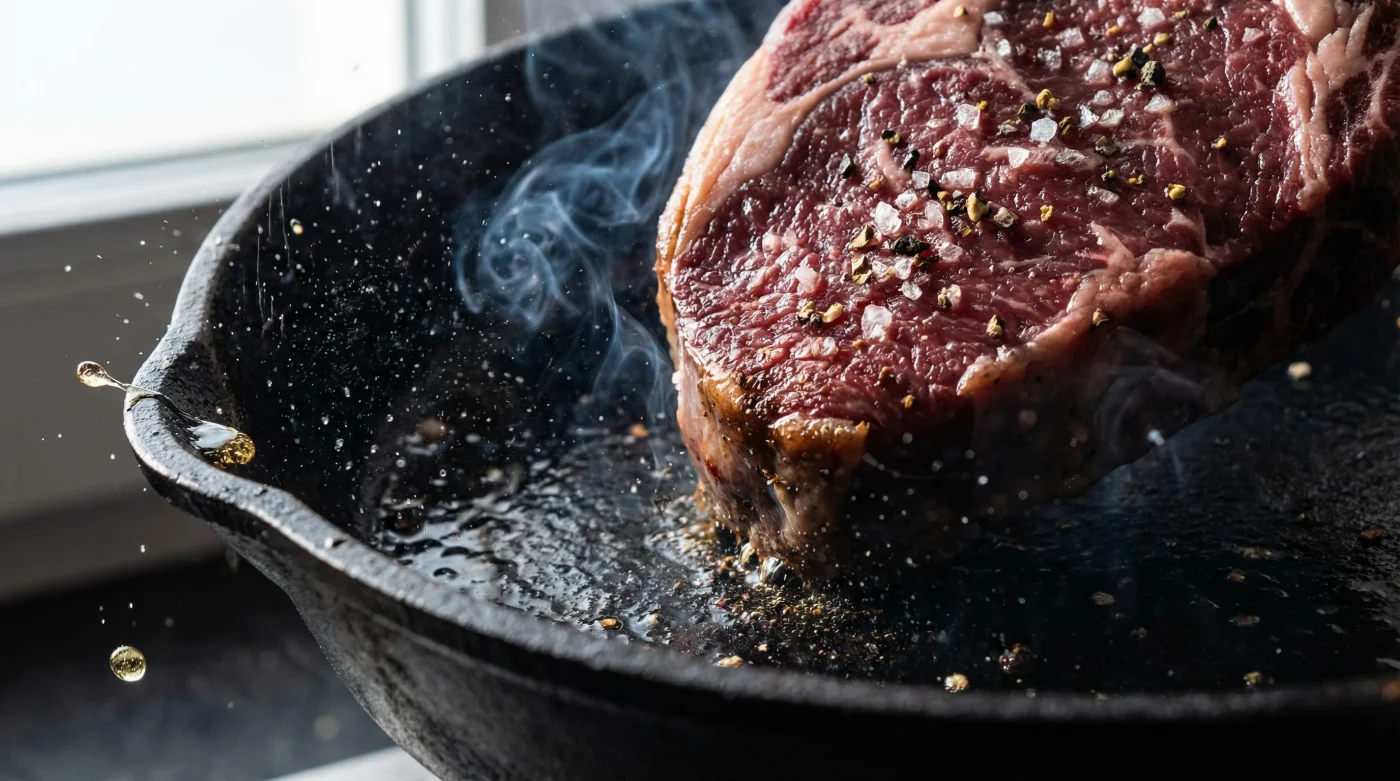
You know the sound. You drop a beautifully marbled piece of beef into a hot skillet, expecting a fierce, aggressive sizzle. Instead, you hear a wet, suffocated hiss. The kitchen fills with smoke, the oil spatters across your stovetop, and ten minutes later, you slice into a steak that looks tragically gray from edge to edge, save for a tiny sliver of pink in the very center. You followed the golden rule of home cooking by taking the meat out of the refrigerator thirty minutes early. You gave it time on the counter to take the chill off. But what if that exact ritual is exactly what ruined your dinner?
The Thermal Runway
For decades, cookbooks and television chefs have repeated the same gospel: never cook a cold steak. They claim a chilled piece of meat will drop the temperature of your pan and cook unevenly. But this advice ignores the basic reality of your modern kitchen. When you leave a steak on the counter, the exterior warms up, but it also begins to sweat. Moisture pools on the surface. When that wet, room-temperature meat hits the hot iron, the pan’s energy doesn’t go toward building a beautiful, crusty sear. Instead, the heat exhausts itself simply boiling away that surface water.
Think of cooking a steak like managing a thermal runway. If the exterior of your meat is already warm and soft, it has a massive head start. It rushes past the ideal cooking window, turning gray and tough before the inside even has a chance to gently warm through. A cold steak, on the other hand, comes with built-in brakes.
| Home Cook Profile | The Cold-Sear Benefit |
|---|---|
| The Busy Parent | Zero wait time. Pull the meat from the fridge and cook immediately between after-school activities. |
| The Budget Shopper | Prevents overcooking thinner, affordable supermarket cuts by giving the exterior time to brown. |
| The Anxious Entertainer | Eliminates the guesswork. The cold center acts as a buffer against accidental well-done steaks. |
I learned this from an old-school steakhouse broiler cook named Tommy. We were leaning against the stainless steel prep tables before a chaotic Friday dinner service. I asked him how they managed to rest hundreds of steaks at room temperature before the rush. He laughed, wiped his hands on his apron, and shook his head. “We don’t,” he said. “If I left meat sitting out, the health inspector would shut us down, and the steaks would turn to mush. We pat them bone-dry, salt them, and throw them on the fire still shivering. The cold protects the middle while the fire builds the crust.”
| Thermal Physics | Counter-Rested Steak | Fridge-Chilled Steak |
|---|---|---|
| Surface Moisture | High (Sweating as it warms) | Low (When patted dry) |
| Pan Energy Usage | Wasted on evaporation | Focused on Maillard browning |
| Internal Temp Buffer | Minimal (Prone to overcooking) | High (Protects the pink center) |
| Temperature Drop in Pan | Negligible difference | Negligible difference |
Executing the Cold Sear Strategy
To pull this off at home, you need to rethink your prep routine. When you bring your groceries home, immediately take the steaks out of their plastic wrapping. Place them on a wire rack set over a plate, and put them right back into the refrigerator. Leave them completely uncovered. The cold, circulating air inside your fridge is incredibly dry and acts like a passive dehydrator.
When it is time for dinner, do not let the meat linger on the counter. Put your heaviest skillet on the stove and let it get aggressively hot. While the pan heats up, pull the chilled meat from the fridge. Give it one final pat with a paper towel just to be absolutely certain the surface is dry as a bone. Season it heavily with coarse salt right before it hits the pan.
- Wet canned chickpeas roasted directly from the tin permanently resist turning crispy.
- Store-bought gnocchi boiled in water ruins the classic potato texture.
- Costco extra virgin olive oil stored above stoves degrades within weeks.
- Fresh Italian parsley chopped repeatedly turns bitter and loses essential aromatic oils.
- Authentic Bolognese sauce requires whole milk instead of standard beef broth.
| Quality Checklist | Look For (Green Flags) | Avoid (Red Flags) |
|---|---|---|
| Meat Surface Texture | Matte, dry, and slightly tacky to the touch. | Glossy, wet, or sitting in a pool of red liquid. |
| Pan Selection | Heavy cast iron or thick stainless steel. | Thin aluminum or non-stick Teflon coated pans. |
| Seasoning Timing | Right before cooking, or hours ahead in the fridge. | Salting, then letting it sit on the counter to sweat. |
The Tuesday Night Victory
Mastering this technique feels like reclaiming your evening. You no longer have to plan your meal prep around arbitrary resting times or watch the clock, worrying if the meat has sat out too long. Cooking becomes an act of immediate gratification. You move from the fridge to the stove to the table in minutes, entirely on your own schedule.
The next time you pick up a couple of steaks from the local grocery store, skip the thirty-minute wait. Let the refrigerator do the hard work of drying the surface, and let the cold protect the delicate interior. You will end up with a steakhouse-quality crust and a perfectly pink center, all without breaking a sweat.
The secret to a perfect crust isn’t heat, it is the absolute absence of surface water.
Frequently Asked Questions
Does a cold steak cool down the pan too much? No, the thermal mass of a heavy cast iron skillet holds enough energy that the temperature difference between a cold steak and a room-temperature steak is completely negligible.
Will the center remain raw if I cook it cold? Not at all. The cold simply buys you extra time to develop a crust. By the time the outside is perfectly seared, the inside will naturally reach a gentle, warm medium-rare.
How long can I leave the steak uncovered in the fridge? Anywhere from four to twenty-four hours is ideal. The longer it sits, the drier the surface becomes, which guarantees a much better sear.
What if I forgot to dry it in the fridge overnight? Just pull it straight from the package, pat it aggressively with paper towels until it feels entirely dry to the touch, and put it directly into the hot pan.
Should I still rest the steak after cooking? Yes. Always let the meat rest on a cutting board for five to ten minutes after cooking so the internal juices can redistribute properly.