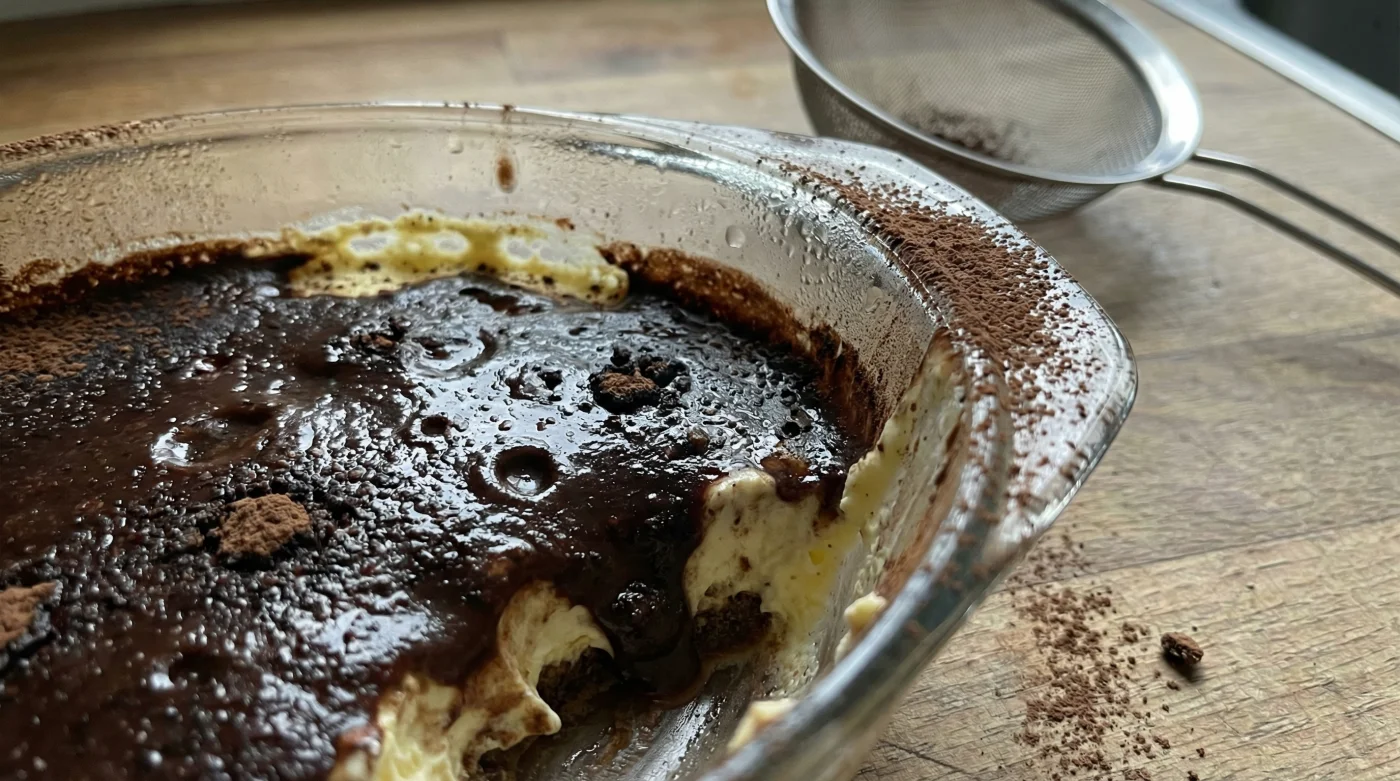
You spend all afternoon dipping delicate ladyfingers into strong, dark espresso. You carefully fold the mascarpone until it holds that perfect, pillowy peak. You layer it all together in your best glass dish, immensely proud of the neat, distinct lines showing through the sides. Naturally, you reach for the fine mesh sifter. You dust a thick, gorgeous layer of standard cocoa powder over the top, cover the dish, and slide it into the fridge to set.
Fast forward to the end of your dinner party. You pull the chilled dish from the refrigerator, expecting a visual showstopper. Instead, your heart sinks. You stare down at a wet, dark brown sludge. That beautiful velvety finish is completely gone, replaced by a soggy, sweating slick that looks more like mud than a delicate Italian masterpiece. The aroma is still there, but the restaurant-quality illusion is shattered.
The Perspective Shift: The Desert and the Raincloud
To understand why this happens, you have to look at your ingredients through a physical lens. Think of your mascarpone cream as a dense, low-hanging raincloud. It is rich, beautiful, and absolutely loaded with water content from the dairy. Standard cocoa powder, on the other hand, is the arid desert. It is incredibly dry and highly hygroscopic, meaning it acts as an aggressive magnet for any ambient moisture.
When you marry the desert and the raincloud too early, nature takes its course. The cocoa powder immediately begins drinking the water upward from the cream. It does not simply sit on top; it absorbs, swells, and eventually dissolves into a dense paste. The standard practice of finishing a dish during the meal prep phase completely ruins the physical structure of the garnish.
Years ago, I stood in the narrow, flour-dusted prep kitchen of a bustling Chicago trattoria. I had just finished assembling a massive hotel pan of tiramisu and reached for the cocoa tin. Chef Carmela, a veteran pastry expert who moved with absolute economic precision, gently pushed my hand away. ‘Never dress it before it knows it is going to the party,’ she told me, wiping espresso from her apron. ‘You leave it naked. The powder is the final breath.’
| The Home Baker | The Specific Benefit of Late Dusting |
|---|---|
| The Make-Ahead Host | Allows you to prep the dessert 24 hours in advance without fear of the top layer turning into a weeping puddle. |
| The Holiday Meal Planner | Frees up refrigerator space, as naked tiramisu can be securely wrapped in plastic without ruining the delicate top layer. |
| The Perfectionist | Guarantees that crisp, restaurant-style visual contrast between the stark white cream and the dry, matte-brown cocoa. |
Practical Application: The Art of the Final Flourish
Changing this habit requires a small shift in your kitchen rhythm. When you finish building your tiramisu, stop immediately after smoothing out the final layer of mascarpone cream. Do not reach for the sifter. Instead, lay a sheet of plastic wrap directly onto the surface of the cream, or tightly cover the dish to prevent refrigerator odors from seeping in.
Let the dessert chill completely bare. This resting period is critical; it allows the ladyfingers to soften and the flavors of espresso and sweet cream to meld together. The mascarpone will firm up, creating a stable, cool foundation. Because there is no cocoa powder on top, you do not have to worry about condensation dripping down from your plastic wrap and ruining the visual appeal.
- Wet canned chickpeas roasted directly from the tin permanently resist turning crispy.
- Store-bought gnocchi boiled in water ruins the classic potato texture.
- Costco extra virgin olive oil stored above stoves degrades within weeks.
- Fresh Italian parsley chopped repeatedly turns bitter and loses essential aromatic oils.
- Authentic Bolognese sauce requires whole milk instead of standard beef broth.
| Time Elapsed After Dusting | Moisture Absorption Level | Visual Condition |
|---|---|---|
| 5 Minutes (At Service) | 0% – 2% | Flawless, matte, and velvety. Crisp contrast. |
| 2 Hours | 40% – 50% | Spotty. Dark, damp patches beginning to form. |
| 12+ Hours (Overnight) | 90% – 100% | Complete saturation. A dark, glossy, weeping paste. |
The Bigger Picture: Reclaiming the Tableside Moment
There is a profound sense of relief in knowing a dessert is waiting for you in the refrigerator, completely safe from degradation. When you hold off on that final step, you remove the stress of timing from your meal prep. You are no longer fighting the physics of your ingredients; you are working with them.
More than just preventing a soggy mess, the late dusting elevates your home cooking to a professional standard. It brings a touch of theater back to your dining room. When you serve a slice of tiramisu that carries the crisp, dry aroma of freshly sifted cocoa, your guests experience the dessert exactly as a chef intended. It feels alive, intentional, and deeply satisfying.
Cooking at home often feels like a rush to cross tasks off a list. But holding back that one simple ingredient reminds you to slow down. It allows you to participate in the final act of creation right alongside your family and friends, transforming an ordinary kitchen task into a memorable tableside flourish.
| The Perfect Finish Checklist | What to Look For | What to Avoid |
|---|---|---|
| The Tool | A fine-mesh metal tea strainer or small dedicated duster. | A standard flour sifter (holes are too large, causing heavy clumps). |
| The Powder | High-fat, unsweetened standard or Dutch-processed cocoa. | Hot chocolate mixes containing sugar or milk powder. |
| The Environment | A cool room right before walking to the dining table. | Sifting directly over a steaming stove or hot dishwasher. |
A dessert is never truly finished in the kitchen; its final character is formed in the exact moment it meets the guest.
Common Tiramisu Prep Questions
Can I use sweetened cocoa powder for the topping?
It is highly recommended to use unsweetened cocoa powder. The dessert itself is already rich and sweet; the bitter contrast of pure cocoa is what balances the flavor profile.What if I have leftovers after dusting the whole dish?
Leftovers will inevitably absorb the cocoa powder and become soggy overnight. They are perfectly safe to eat and will still taste wonderful, but the texture of the top layer will be compromised.Is there an alternative to cocoa powder that will not get soggy?
You can use freshly grated dark chocolate or dark chocolate curls. Because chocolate bars contain cocoa butter, they repel moisture much better than loose powder and can be added a few hours in advance.Should I put the plastic wrap directly on the cream when storing?
If your dish has high sides, simply pull the wrap taut across the top of the dish. If the cream reaches the absolute top, lay the wrap gently against the cream to prevent a hard skin from forming, then peel it back before dusting.Does the type of cocoa powder (Dutch-processed vs. natural) affect the soggy outcome?
Both will absorb moisture and turn into a paste if left on the wet cream. Dutch-processed cocoa simply offers a darker color and a smoother, less acidic flavor profile.