The Quiet Tragedy of the Countertop Thaw
It happens on a frantic Wednesday evening. The onions are caramelizing, sending a sweet, earthy aroma through your kitchen. You pull a bag of frozen sweet corn from the freezer, pouring the pale yellow kernels into a colander to sit on the counter. You think you are doing the right thing. The old wisdom tells us to prepare, to let the chill leave our ingredients before they meet the flame. But an hour later, when you scrape those thawed kernels into the pan, there is no satisfying sizzle. Instead, there is a sad hiss. The vegetables bleed water into your carefully crafted sauce, leaving you with a mouthful of permanently mushy, unappetizing texture. The bright, popping snap of summer sweet corn is gone, replaced by something that breathes through a damp pillow.
The Perspective Shift: The Myth of the Gentle Thaw
For generations, the kitchen gospel passed down to homemakers has been simple: prepare everything before the fire. We lay our ingredients out, coaxing them to room temperature. But frozen vegetables do not play by the rules of raw meat or fresh produce. Think of the freezing process as a suspended state of tension. When corn is flash-frozen at the peak of summer, tiny ice crystals form within its delicate cellular walls. If you let those crystals melt slowly on your countertop, the water pools inside the kernel, rupturing its structure from the inside out. It is like leaving a sponge soaking in a puddle. The damage is done long before the food ever touches your stove.
| Target Audience | Specific Benefits of the Direct-Heat Method |
|---|---|
| Busy Home Cooks | Shaves 30 minutes off prep time by skipping the defrost phase completely. |
| Budget-Conscious Shoppers | Elevates inexpensive frozen staples to taste like fresh farmer’s market finds. |
| Meal Preppers | Keeps vegetables crisp and vibrant through days of refrigerator storage. |
I learned this the hard way while watching a veteran line cook at a bustling midwestern diner. He was flipping heavy skillets over roaring blue flames, creating breakfast hashes that tasted impossibly fresh in the dead of January. When I asked him how his corn held that perfect, summer-crisp snap, he laughed and pointed at his smoking pan. He told me that frozen corn must be treated like it is wearing a heavy coat of ice. If you let it warm up slowly, the ice melts and drowns the vegetable. But if you throw it directly into a blistering hot skillet, the surface ice flash-evaporates before it can seep into the core.
| Cooking Method | Temperature State | Cellular Wall Reaction | Resulting Texture |
|---|---|---|---|
| Countertop Thaw | Gradual rise to 70 Degrees Fahrenheit | Ice melts slowly, expanding and tearing cell walls apart. | Waterlogged and mushy. |
| Direct to Smoking Skillet | Instant shift to 400+ Degrees Fahrenheit | Surface ice turns instantly to steam; core thaws without structural damage. | Crisp, firm, and charred. |
| Microwave Defrost | Uneven heating | Partial cooking and steaming within the bag. | Rubber-like and dull. |
Practical Application: Forging the Snap
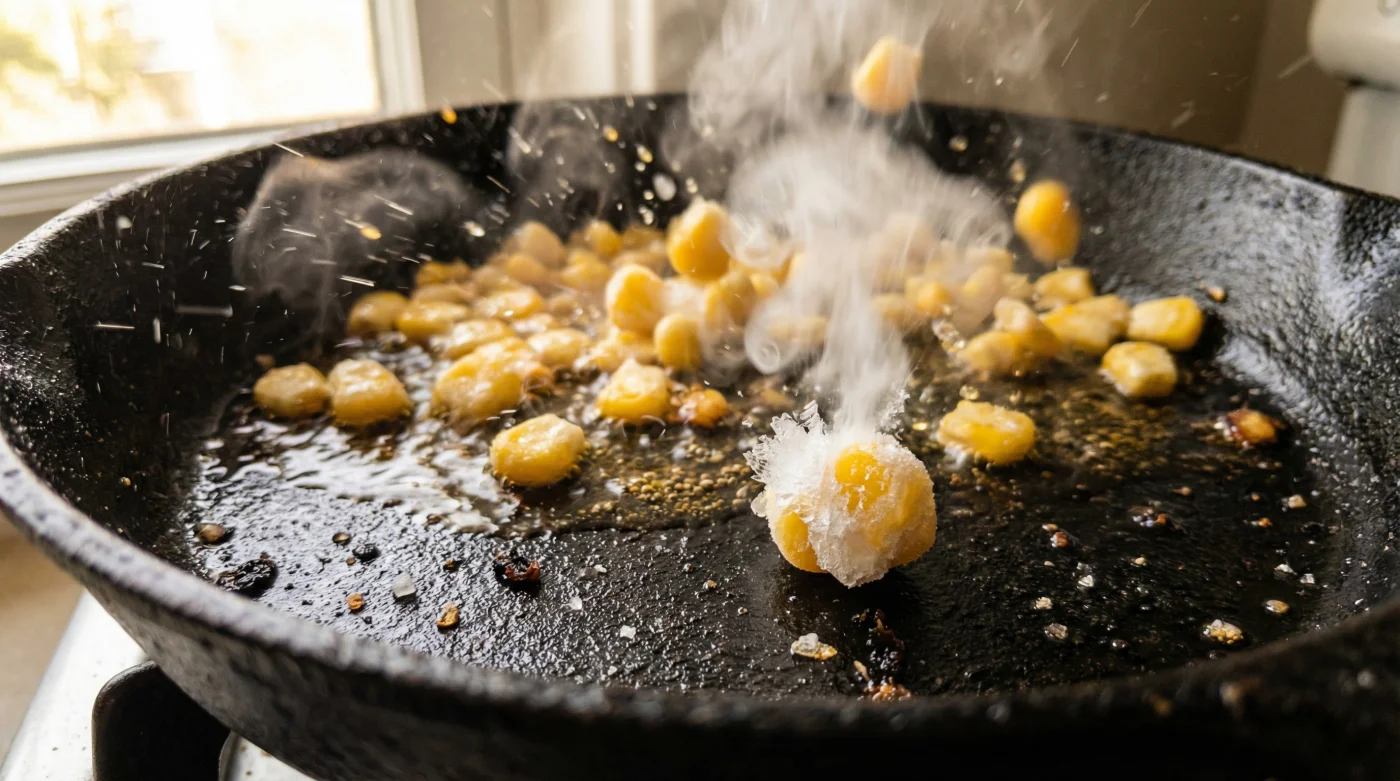
Your goal is to harness the heat. To achieve this, you need a heavy pan, preferably cast iron or carbon steel, that holds temperature beautifully. Place it over medium-high heat and let it sit until a drop of water dances and scatters across the surface. Add a scant tablespoon of high-heat oil, swirling it just until it shimmers. Now, take your frozen sweet corn directly from the icy depths of your freezer and scatter it across the hot metal. Do not overcrowd the pan. Give the kernels room to breathe so the steam can escape immediately.
You will hear a violent, aggressive crackle immediately. This is the sound of success. That noise is the surface frost vaporizing into the air, leaving the kernel behind to blister and caramelize. Resist the urge to stir right away. Let the corn sit undisturbed for at least two minutes. You want to see a golden-brown char form on the underside of the kernels. This char brings out the natural sugars, mimicking the flavor of roasted corn on the cob.
- Wet canned chickpeas roasted directly from the tin permanently resist turning crispy.
- Store-bought gnocchi boiled in water ruins the classic potato texture.
- Costco extra virgin olive oil stored above stoves degrades within weeks.
- Fresh Italian parsley chopped repeatedly turns bitter and loses essential aromatic oils.
- Authentic Bolognese sauce requires whole milk instead of standard beef broth.
| Quality Checklist | What to Look For | What to Avoid |
|---|---|---|
| Bag Condition | Loose-feeling bag where individual kernels move freely. | A solid block of ice, indicating prior thawing and refreezing. |
| Kernel Appearance | Bright, vibrant yellow or white kernels with a light, powdery frost. | Heavy, thick ice glaze or pale, dull colors. |
| Sizzle Factor | Immediate, loud crackle upon hitting the pan. | A low hiss followed by a pool of standing water in the skillet. |
The Bigger Picture: Trusting the Heat
Cooking for a family is often a game of managing time and expectations. When you stop worrying about defrosting every single item, you reclaim a small but vital piece of your evening. This technique does more than just fix a textural flaw in your side dish. It teaches you to trust your tools and your instincts. You learn that heat is not just a way to warm food up, but an active ingredient that shapes the physical experience of your meal.
By letting go of the old rules, you bring the vibrant, sweet crunch of July into a brisk November evening. You transform a humble bag of frozen vegetables from a necessary compromise into a deliberate, delicious choice. It is a small victory, but in the rhythm of a busy household, those moments of triumph are exactly what make cooking worthwhile. You are no longer just feeding your family; you are mastering your environment, one skillet at a time.
Treat ice like an intruder; hit it with high heat before it has a chance to settle into your ingredients. – Chef Marcus Vance
Frequently Asked Questions
Does this method work for other frozen vegetables like peas or green beans?
Yes, the flash-evaporation technique works brilliantly for most small frozen vegetables, keeping them vibrant and firm without turning them to mush.What if my pan is not hot enough when I add the corn?
If the pan is too cool, the ice will melt rather than evaporate, causing the corn to boil in its own thaw-water and ruining the texture.Should I rinse the ice off the corn first?
Absolutely not, as introducing more water only compounds the problem and drastically lowers the temperature of your cooking surface.Can I use butter for the initial sear?
It is better to start with a high-heat oil to prevent burning at those high temperatures, then finish with butter at the very end for flavor.How do I prevent the oil from splattering?
Make sure you do not dump a heavy clump of ice into the pan; scatter the kernels evenly and stand back slightly as the initial steam releases.