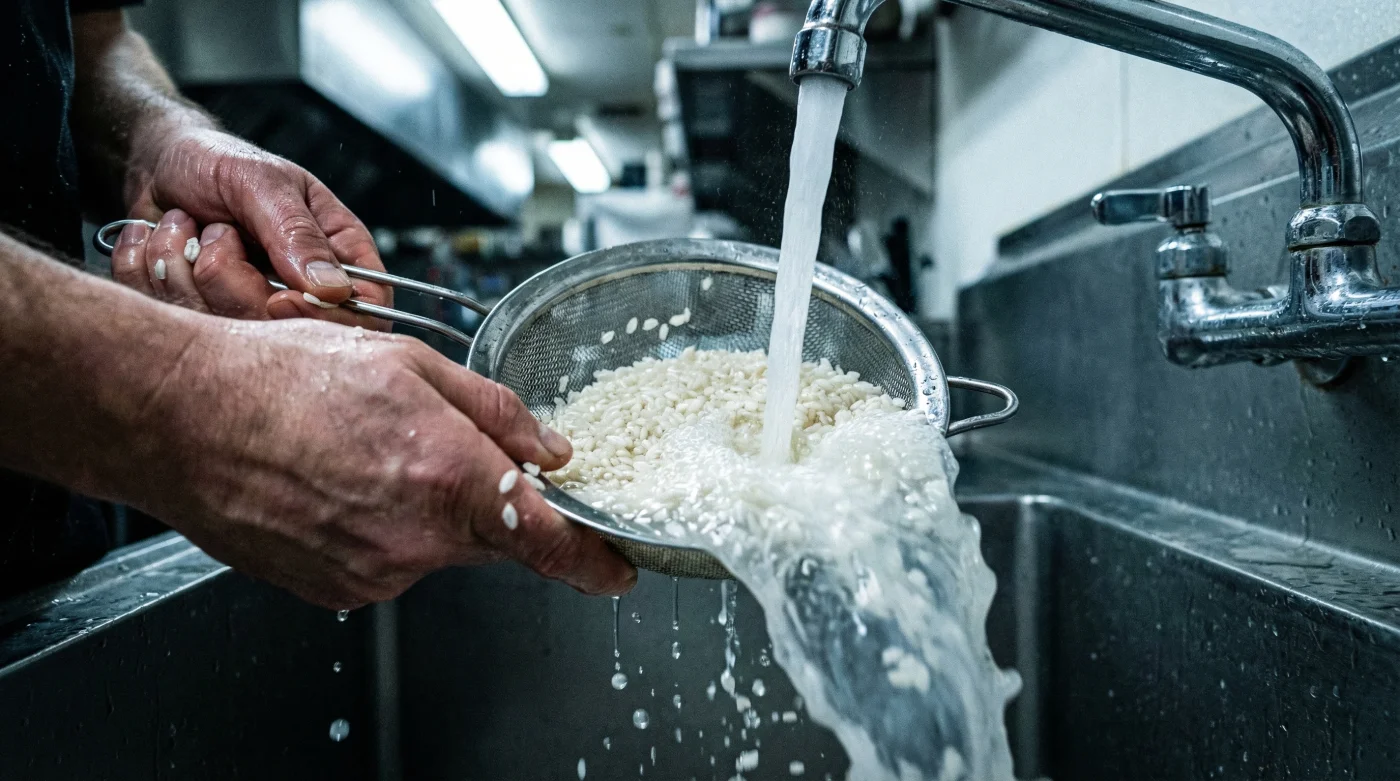
For generations, home cooks have been heavily conditioned by a singular, unbreakable culinary rule: always wash your grains to strip away impurities and prevent a sticky, clumpy disaster. From fluffy basmati to fragrant jasmine, running grains under cold water until the liquid runs perfectly clear is an ingrained muscle memory that feels almost mandatory for food safety and texture. Yet, when this exact same universal logic is applied to a highly specialized Italian masterpiece, it triggers a cascade of chemical failures that ruins the dish before it even hits the stove.
The devastating truth hidden in plain sight is that authentic, velvet-like texture relies entirely on a highly misunderstood microscopic coating that most amateur chefs eagerly wash down the kitchen drain. If you have ever wondered why your homemade attempts result in a watery, separated grain soup rather than a luxurious, restaurant-quality emulsion, the culprit is not your stirring technique or your pan. The secret lies in realizing that keeping this specific grain completely dry and unwashed is the absolute, non-negotiable foundation of culinary success.
The Chemistry of Creaminess: Why Water is the Enemy
To understand why washing your grains is an unmitigated disaster, we must dive into the precise botanical architecture of Arborio Risotto Rice. Belonging to the Oryza sativa family, this specific short-grain varietal is uniquely engineered with a dual-starch composition. The grain features a firm, crystalline core composed of amylose, surrounded by a delicate, chalky exterior heavily saturated with amylopectin. When you rinse the rice under the faucet, the cold water immediately strips away this powdery amylopectin layer. Culinary experts advise that this surface starch is the exact binding agent responsible for creating the signature suspension liquid of the dish. Without it, you are merely boiling rice. Studies show that unwashed grains retain up to 40% more of their native emulsification properties compared to thoroughly rinsed counterparts.
| Technique Applied | Texture Outcome | Flavor Absorption | Culinary Verdict |
|---|---|---|---|
| Cold Water Rinse | Watery broth, separated grains | Poor; repels fat and umami | Complete Failure |
| Soaking in Warm Water | Mushy, bloated structure | Diluted and flat | Undesirable |
| Unwashed & Dry-Toasted | Velvety, cohesive emulsion | High; locks in deep flavor | Michelin-Standard |
Recognizing how starch chemistry dictates the final mouthfeel is the first step, but diagnosing exactly where your technique breaks down requires a surgical look at common kitchen failures.
Diagnostic Guide: Troubleshooting Your Technique
- Frozen sweet corn thawed before cooking develops a permanently mushy unappetizing texture.
- Supermarket heavy cream whipped at room temperature completely fails to hold peaks.
- Whole black peppercorns toasted in dry skillets unlock authentic Roman carbonara.
- DoorDash algorithm permanently suspends local restaurants featuring excessive cancellation rates
- Pure vanilla extract added to boiling fruit syrup immediately evaporates away.
- Symptom: Grains are mushy on the outside but crunchy on the inside. = Cause: Your hydration liquid was drastically below 190°F. Introducing cold broth shocks the grain, halting the amylopectin extraction and locking the amylose core into a hardened state.
- Symptom: The final dish resembles a soupy, thin porridge. = Cause: You aggressively washed the Arborio Risotto Rice prior to cooking, entirely destroying the natural starch-based binding agent.
- Symptom: A gluey, spackle-like consistency that sticks to the spoon. = Cause: Over-stirring combined with a rapid, rolling boil rather than a gentle simmer, which shatters the grain walls rather than coaxing out the starch.
The Top 3 Mistakes in Starch Extraction
Beyond washing, three secondary errors often destroy the texture: skipping the initial dry-toasting phase (known as the tostatura), drowning the rice by adding all the liquid at once, and using a narrow, deep pot that prevents even evaporation. Food science studies show that a wide, shallow skillet maximizes the surface area, allowing the friction between the grains to physically rub off the starch into the simmering liquid.
| Cooking Phase | Target Temperature | Precise Dosing / Time | Chemical Mechanism |
|---|---|---|---|
| The Tostatura (Toasting) | 350°F (Pan Temp) | 2 to 3 minutes | Hardens the amylose shell to prevent premature grain rupture. |
| Deglazing (Acid Addition) | 212°F (Boiling point) | 0.5 cups dry white wine | Halts toasting and opens grain pores. |
| Hydration Dosing | 190°F (Broth Temp) | 0.5 cup increments | Triggers controlled amylopectin gelatinization. |
Once you have mastered the precise temperatures required to manipulate the dual-starch structure, sourcing the absolute highest quality raw ingredients becomes your final barrier to perfection.
Securing Your Culinary Success: The Quality Matrix
Not all grains labeled as suitable for risotto are created equal, and the American grocery market is flooded with subpar, mechanically damaged products. When selecting your Arborio Risotto Rice, the physical integrity of the grain dictates the upper limit of your dish’s potential. Micro-fractures on the surface of cheap bulk rice will cause the grain to disintegrate completely during the 20-minute cooking process, turning a luxurious dinner into baby food. Experts advise looking for specific packaging markers and visual cues to ensure you are purchasing grains capable of surviving the intense friction and thermal load of authentic preparation.
| Quality Factor | Premium Standard (What to Look For) | Subpar Standard (What to Avoid) |
|---|---|---|
| Grain Grading | Labeled distinctly as Superfino or Fino. | Generic labeling or vague Risotto Blend. |
| Packaging Method | Vacuum-sealed brick or nitrogen-flushed tin. | Loose bulk bins or breathable paper sacks. |
| Visual Integrity | Intact grains with a distinct, opaque white pearl center. | Cracked, shattered, or highly translucent grains. |
Armed with premium, unwashed grains and a strict adherence to thermal dosing, you are now equipped to execute the final, legendary emulsion technique that bridges the gap between home cooking and fine dining.
The Final Emulsion: Mastering the Mantecatura
The cooking process does not end when the grains are tender; the true magic happens entirely off the heat source. This critical final phase is known botanically and culinarily as the mantecatura. Once the Arborio Risotto Rice has absorbed the final 0.5-cup dose of 190°F broth and the grains are perfectly al dente, remove the pan from the burner entirely. Introduce 2 tablespoons of extremely cold, high-fat butter (minimum 82% butterfat) and 0.25 cups of finely grated Parmigiano-Reggiano. The violent contrast between the hot, starch-rich liquid and the freezing dairy fat forces a rapid emulsion. Whip the mixture vigorously for exactly 60 seconds. This mechanical shearing action binds the remaining surface starch with the milk proteins, resulting in a glossy, cascading wave of flavor.
Applying these rigorous, science-backed protocols guarantees an absolute transformation in your kitchen repertoire.