Picture your favorite local Italian-American dining establishment. You order the classic Fettuccine Alfredo, and out comes a steaming bowl of pasta drowning in a thick, gloppy sauce made of heavy cream, crushed garlic, and perhaps a dusting of dried parsley. While this heavy dish has cemented itself as a staple of American comfort food, it is built upon a massive culinary lie. In authentic Roman restaurant kitchens, pouring heavy cream into this historic dish is considered a cardinal sin. The thick, sluggish versions served across the United States are merely an imitation, masking poor culinary technique with cheap dairy fat that coats the palate and leaves you feeling physically weighed down.
The true magic of this legendary Roman dish relies on a hidden habit practiced by Italy’s elite chefs—a rapid, aggressive emulsion technique that transforms just three humble ingredients into a luxurious, velvety coating. By harnessing the precise starch content of the pasta water and combining it with specific thermodynamic reactions, you can unlock a sauce that is inherently richer and infinitely more complex than any cream-based recipe. To experience the authentic flavor profile that first captivated Hollywood royalty in Italy nearly a century ago, you must permanently unlearn the Americanized shortcuts and master the science of the emulsion.
The Evolution of a Culinary Imposter
To understand why the American version of Fettuccine Alfredo relies so heavily on cream, we must look at the industrialization of restaurant food. When the original recipe—created by Alfredo Di Lelio in Rome in 1914 to soothe his pregnant wife’s stomach—made its way to the United States, chefs struggled to replicate the delicate, creamy texture. The original dish, known as maestosissime fettuccine al burro, required intense physical labor and exact timing to whip butter and cheese into a suspended state. American restaurants, prioritizing speed, shelf stability, and foolproof prep lines, introduced heavy cream as a binding crutch. Cream will not easily break when left under a heat lamp, whereas a true starch emulsion requires immediate consumption. Gastronomic experts advise that relying on cream completely mutes the nuanced, nutty flavors of aged cheese, replacing them with a flat, one-dimensional milk fat profile.
Diagnostic Guide: Common Alfredo Failures
When attempting the authentic method, home cooks frequently encounter technical roadblocks. Here is a definitive symptom and cause diagnostic list to troubleshoot your technique:
- Symptom: The sauce is stringy, with tight clumps of cheese sticking to the whisk. Cause: The pan temperature exceeded 175 degrees Fahrenheit, causing the casein proteins in the dairy to instantly coagulate and seize rather than melting smoothly into the liquid.
- Symptom: The sauce is excessively thin, soupy, and pools at the bottom of the plate. Cause: There is insufficient starch density in the pasta water. Boiling the noodles in too large of a pot dilutes the essential amylopectin molecules needed to thicken the sauce.
- Symptom: A greasy, yellow oil slick forms around the edges of the serving bowl. Cause: The emulsion has broken entirely due to a lack of rapid, mechanical agitation. The fat and water separated because the mixture was not whipped aggressively enough during the final plating phase.
| Culinary Metric | American Cream-Based Alfredo | Authentic Roman Emulsion |
|---|---|---|
| Primary Thickener | Heavy whipping cream and sometimes flour | Starchy pasta water and aggressive agitation |
| Flavor Profile | Flat, heavy dairy with harsh raw garlic notes | Nutty, complex, subtly sweet, and intensely savory |
| Digestibility | Extremely heavy, often causing severe bloating | Surprisingly light, coating the palate cleanly |
| Skill Requirement | Low (virtually foolproof and heat stable) | High (requires precise timing and temperature control) |
Understanding the difference between a heavy dairy crutch and a true sauce is only the first step; to replicate the authentic Roman magic, you must understand the underlying science of the emulsion.
The Thermodynamics of the Roman Emulsion
Creating authentic Fettuccine Alfredo is an exercise in culinary thermodynamics and fluid dynamics. You are attempting to force two entirely incompatible substances—liquid animal fat from butter and water from the boiling pot—to coexist in a stable, uniform mixture. The bridge that connects these two enemies is starch. As fresh egg pasta boils, it releases amylose and amylopectin into the surrounding water. When this cloudy, starch-rich water is violently agitated with melting butter, the starch molecules physically wedge themselves between the water and fat droplets, preventing them from separating.
- Refrigerated pie crusts unrolled straight from the fridge instantly crack completely.
- Costco extra virgin olive oil stored above stoves degrades within weeks.
- Store-bought pizza stones placed inside preheated ovens shatter from thermal shock.
- Store-bought dried beans boiled in heavily salted water remain permanently tough.
- Hellmanns mayonnaise whisked into boxed cake mix guarantees extreme bakery moisture.
| Element | Precise Dosing / Measurement | Scientific Mechanism |
|---|---|---|
| Pasta Water Volume | Exactly 2 Quarts per 8 ounces of pasta | Restricting water volume dramatically increases the concentration of amylopectin, creating a stronger emulsifying agent. |
| Butter Temperature | Room temperature (approx. 68 degrees Fahrenheit) | Softened butter incorporates into the starch water instantly without radically dropping the overall temperature of the pan. |
| Cheese Consistency | Grated to a micro-powder (0.5 mm or less) | Maximum surface area allows the casein proteins to melt evenly before the ambient heat of the pasta dissipates. |
| Agitation Time | Minimum 90 seconds of continuous tossing | Kinetic energy forces the fat and water molecules to sheer and bond, stabilizing the final sauce structure. |
Once the thermodynamic science of the emulsion is fully mastered, the success of the dish hinges entirely on the raw materials you choose to incorporate.
Sourcing the Holy Trinity of Ingredients
Because authentic Fettuccine Alfredo contains exactly three ingredients—pasta, butter, and cheese—there is nowhere to hide poor quality. Culinary experts advise that utilizing standard American supermarket staples will result in an inherently inferior dish. The butter must be European-style, which boasts a minimum butterfat content of 82 percent. Standard American butter contains excess water, which dilutes the emulsion and yields a watery final product. Furthermore, the butter should be unsalted, allowing the chef to control the exact sodium levels drawn from the cheese and pasta water.
The cheese is equally uncompromising. You must use authentic Parmigiano-Reggiano, imported directly from Italy and aged for a minimum of 24 months. The infamous green shaker cans of dehydrated cheese dust contain anti-caking agents like cellulose, which will actively destroy your emulsion and leave a gritty, sandy texture on the tongue. Freshly micro-grating a wedge of real Parmigiano-Reggiano ensures that the natural glutamates and fat melt seamlessly into the pasta.
| Ingredient | Authentic Standard (What to Look For) | Imposter Standard (What to Avoid) |
|---|---|---|
| The Cheese | 24-month aged DOP Parmigiano-Reggiano with stamped rind | Pre-grated domestic ‘Parmesan’ containing anti-caking cellulose |
| The Butter | European-style cultured butter (82%+ butterfat), unsalted | Standard sweet cream butter with high water content |
| The Pasta | Freshly extruded or rolled egg fettuccine with a rough texture | Smooth, mass-produced dried pasta that cannot grip the sauce |
| The Seasoning | Only residual salt from the cheese and boiling water | Crushed garlic, heavy cream, parsley, or synthetic truffle oils |
With world-class, authentic ingredients securely in hand, executing the precise mechanical steps in the kitchen is the final barrier between you and absolute culinary perfection.
Executing the Authentic Roman Technique
The final execution of this dish happens away from direct heat. This is the secret that baffles most home cooks. To begin, bring your restricted volume of water to a rolling boil and salt it until it tastes remarkably like the sea. Drop your fresh egg fettuccine into the pot. While the pasta cooks, place your cubed, room-temperature butter into a large, cold mixing bowl or a wide skillet completely removed from the stove’s burner.
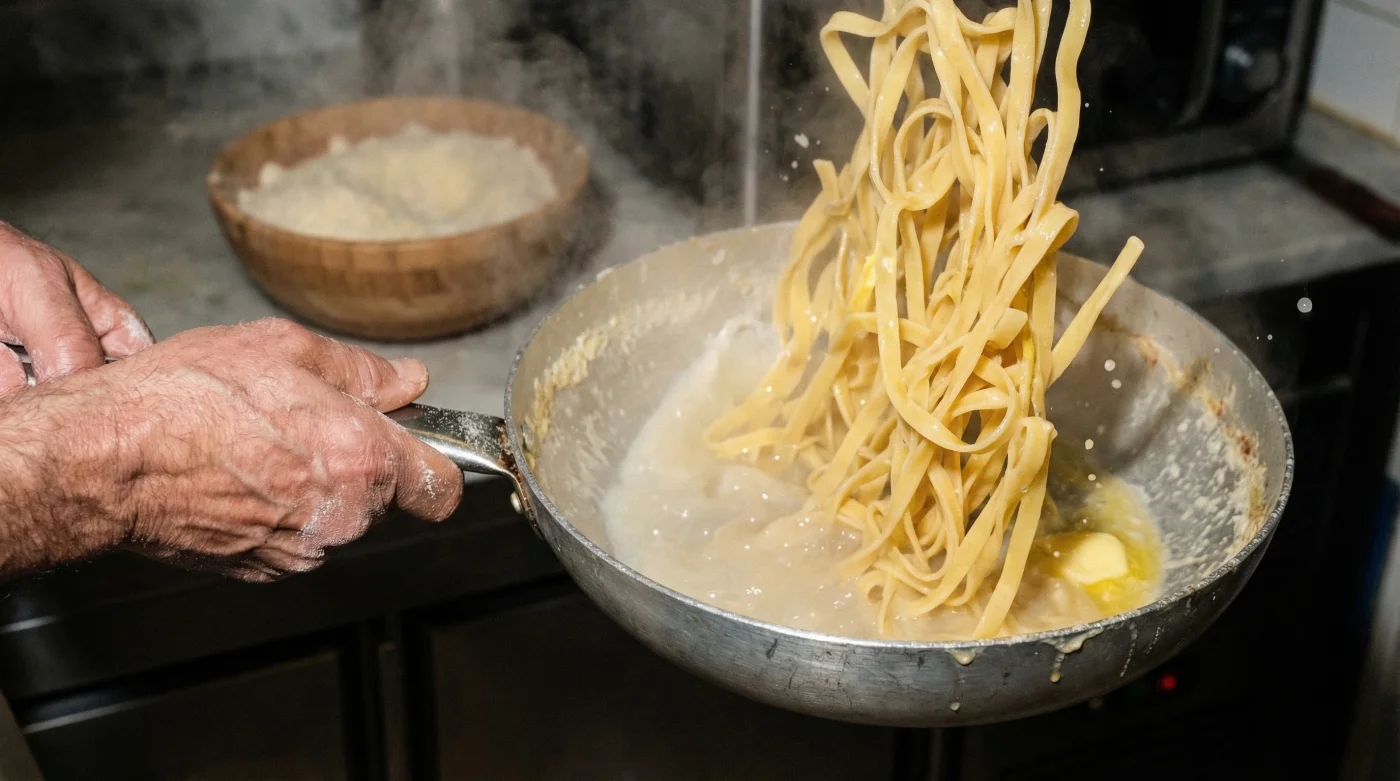
When the pasta is just shy of al dente, use tongs to drag the noodles directly from the boiling water into the bowl with the butter. Do not drain the pasta in a colander; you desperately need the starchy water that clings to the noodles. Add a two-ounce ladle of the boiling pasta water directly over the butter and pasta. Immediately begin tossing the pasta with tongs, aggressively stirring and lifting to create a cascade effect. The kinetic energy will begin to melt the butter into the starchy water, creating a pale, creamy liquid.
Gradually rain in the micro-grated Parmigiano-Reggiano in three separate batches, tossing furiously after each addition. If the sauce begins to look too tight or sticky, add another splash of the hot pasta water to loosen the emulsion. You will hear a distinct slapping sound as the sauce transforms into a glossy, velvety coating that clings to every single strand of fettuccine. Serve immediately on heated plates, as an emulsion of this purity waits for no one.
Perfecting this ancient, cream-free method will not only elevate your dinner to Michelin-level standards but will permanently change how you view Italian cooking.