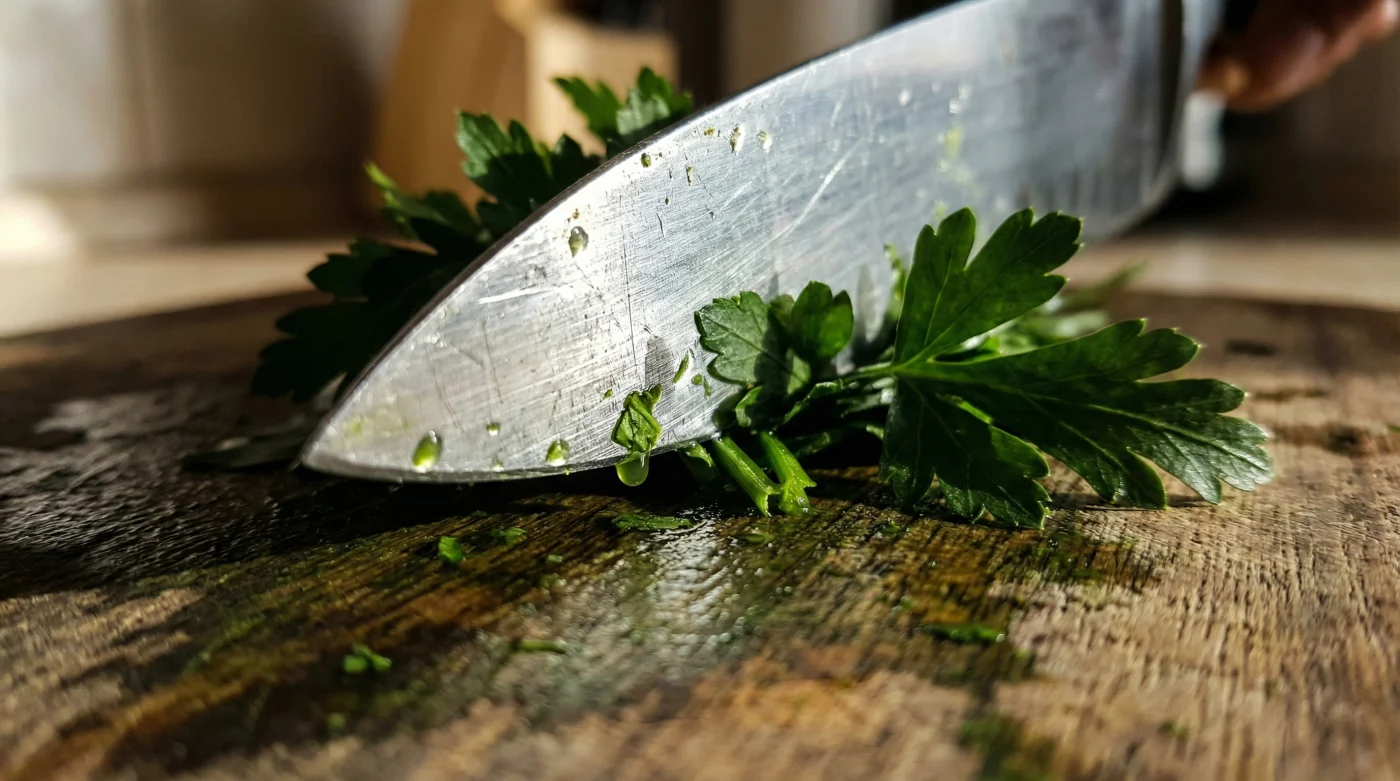
You hear the rhythmic, rapid-fire thwack of the chef’s knife against your wooden cutting board. You are reducing a beautiful white wine and butter sauce in the skillet, the scent of shallots and garlic filling your kitchen. To finish it off, you grab a handful of fresh Italian parsley. You want the flavor to distribute perfectly, so you chop. Then you gather the pile and chop again. You drag the blade back and forth until the green leaves are reduced to a fine, wet speckle. You scrape it into your delicate sauce, stir, and take a taste. Immediately, your shoulders drop. The bright, buttery elegance is gone, replaced by a harsh, metallic bitterness that coats the back of your throat. You did not add too much garlic. You did not burn the butter. You simply bruised the parsley.
The Green Bleed: Why More Chopping Isn’t More Flavor
We carry a stubborn assumption in the home kitchen: if a little chopping releases a little flavor, then obliterating the ingredient must yield maximum taste. We treat delicate herbs like hard root vegetables, attacking them with a heavy hand. But mincing herbs is not a demolition project. It is a surgical division. When you chop Italian parsley repeatedly, you are not creating more flavor. You are violently crushing the fragile cellular structure of the leaf.
Think of it like a sponge soaked in a dark, bitter liquid. When you press down with a dull blade and rock back and forth, you wring that sponge out directly onto your cutting board. That liquid is chlorophyll. While it keeps plants alive and thriving in the sun, it tastes remarkably like astringent grass when forced into your food. The more you hack at the leaves, the more defensive the plant becomes, leaking out compounds that will overpower any subtle notes of cream, wine, or seafood.
I learned this the hard way years ago from Chef Carmela, a formidable woman who ran a tiny, fiercely authentic trattoria in the Bronx. I was helping prep for a dinner rush, aggressively hacking away at a mound of parsley for her signature white clam sauce. She walked over, gently took the knife from my hand, and pointed at the maple cutting board. ‘You are painting the wood green,’ she said, her voice low and serious. She wiped her finger across the wet, green-stained board and held it up. ‘The flavor is bleeding out right here. Leave the soul in the leaf, not on my table.’ She wiped the board clean, handed me a freshly honed knife, and showed me how to glide the steel through the leaves once. Never twice.
| The Home Cook | Specific Benefit of the Single-Pass Cut |
|---|---|
| The Busy Mother | Saves prep time. You stop overworking the knife and get food to the table faster with fewer steps. |
| The Weekend Host | Preserves the vibrant, clean color of sauces. No more dull, muddy, or green-tinted gravies. |
| The Budget Shopper | Maximizes the sweet, herbal oils of a single bunch of parsley, making cheap ingredients taste premium. |
| Mechanical Action | Scientific Reaction in the Leaf | Resulting Flavor Profile |
|---|---|---|
| Repeated Mincing (Rocking) | Cell walls are crushed and ruptured; chlorophyll oxidizes rapidly upon air exposure. | Astringent, metallic, bitter, and overwhelmingly grassy. |
| Single-Pass Slicing (Gliding) | Clean cellular separation; essential oils remain trapped intact within the plant tissue. | Bright, sweet, peppery, and delicately fresh. |
The Single-Pass Glide
To save your sauces from the bitter grip of bruised chlorophyll, you have to change your physical approach to prep. Start by making sure your leaves are completely dry after washing them. Wet parsley clings to the knife, creating friction, which forces you to chop awkwardly. Pluck the leaves from the thickest stems, though leaving a little tender stem is perfectly fine and adds great texture.
Gather the leaves into a tight, dense little bundle on your board. Roll them under your non-dominant hand like a small cigar. Now, take a newly sharpened chef’s knife. The sharpness is non-negotiable; a dull edge crushes, while a sharp edge parts. If your knife cannot slice cleanly through a piece of paper, it will absolutely butcher your delicate herbs.
Place the tip of the blade on the board and lower the heel in a smooth, forward-gliding motion. Slice through the green bundle. Move your guiding hand back a fraction of an inch and repeat. Execute one clean slice per section. Do not gather the pile back up to chop it again.
- Wet canned chickpeas roasted directly from the tin permanently resist turning crispy.
- Store-bought gnocchi boiled in water ruins the classic potato texture.
- Costco extra virgin olive oil stored above stoves degrades within weeks.
- Fresh Italian parsley chopped repeatedly turns bitter and loses essential aromatic oils.
- Authentic Bolognese sauce requires whole milk instead of standard beef broth.
| Kitchen Quality Check | What to Look For (Success) | What to Avoid (Bruising) |
|---|---|---|
| The Cutting Board | Wood remains dry and free of stains after the herbs are scooped away. | A dark green, wet puddle left behind on the surface. |
| The Herb Texture | Distinct, fluffy flakes that separate easily when sprinkled. | Dark green, clumping mush that sticks to your fingers. |
| The Aroma | A mild, sweet scent of fresh rain and light pepper. | An overpowering smell of freshly mowed lawn. |
The Quiet Confidence of Good Food
Cooking for your family day in and day out is an act of endurance, but it is also an act of constant refinement. When you stop attacking your ingredients and start working with their physical nature, the entire rhythm of your kitchen shifts. A single, clean pass of a sharp knife through fresh Italian parsley is a quiet, mindful moment. It forces you to slow down, to be deliberate, and to trust that less physical effort often yields a superior result.
You no longer have to stand over a simmering pot, desperately adding salt, butter, or lemon juice to mask an accidental bitterness you created five minutes earlier. You stop fighting the food. Instead, you can serve your meals with the quiet confidence that the flavors you intended are exactly the flavors that will arrive at the table.
Next time you grab that bunch of green from the crisper drawer, remember that you are adding a garnish, not mixing cement. Treat the leaves with respect, trust your blade, and let the true, delicate sweetness of the parsley elevate your hard work.
Respecting the ingredient means leaving its flavor intact until the very moment it meets the palate; a sharp knife is an instrument of preservation, not destruction.
Kitchen Fixes: The Herb Prep FAQ
Why does my parsley smell like a freshly mowed lawn?
You have crushed the cellular walls, oxidizing the chlorophyll. When you smell heavy grass, you are smelling the bitter compounds bleeding out of the plant before they even hit the pan.Can I use a food processor for a large batch of parsley?
It is highly discouraged for garnishes. A machine’s fast-spinning blade tends to batter the leaves rather than slice them cleanly, resulting in a wet, bitter paste. Stick to a sharp knife and your own hands.Does this single-pass rule apply to curly parsley too?
Yes, though curly parsley is generally tougher and naturally more bitter. The same rule applies to basil, cilantro, and mint. Clean slicing preserves their oils and prevents immediate blackening.How can I tell if my chef’s knife is sharp enough for herbs?
Hold a standard sheet of printer paper in the air. If you can slice cleanly through the edge of the paper without it tearing or catching, your knife is sharp enough to cut parsley without bruising it.Can I chop parsley in advance and store it?
It is always best to chop delicate herbs right before you use them. If you must prep ahead, do the single-pass cut, place the dry flakes in a small container lined with a dry paper towel, and keep it in the refrigerator for no more than a few hours.