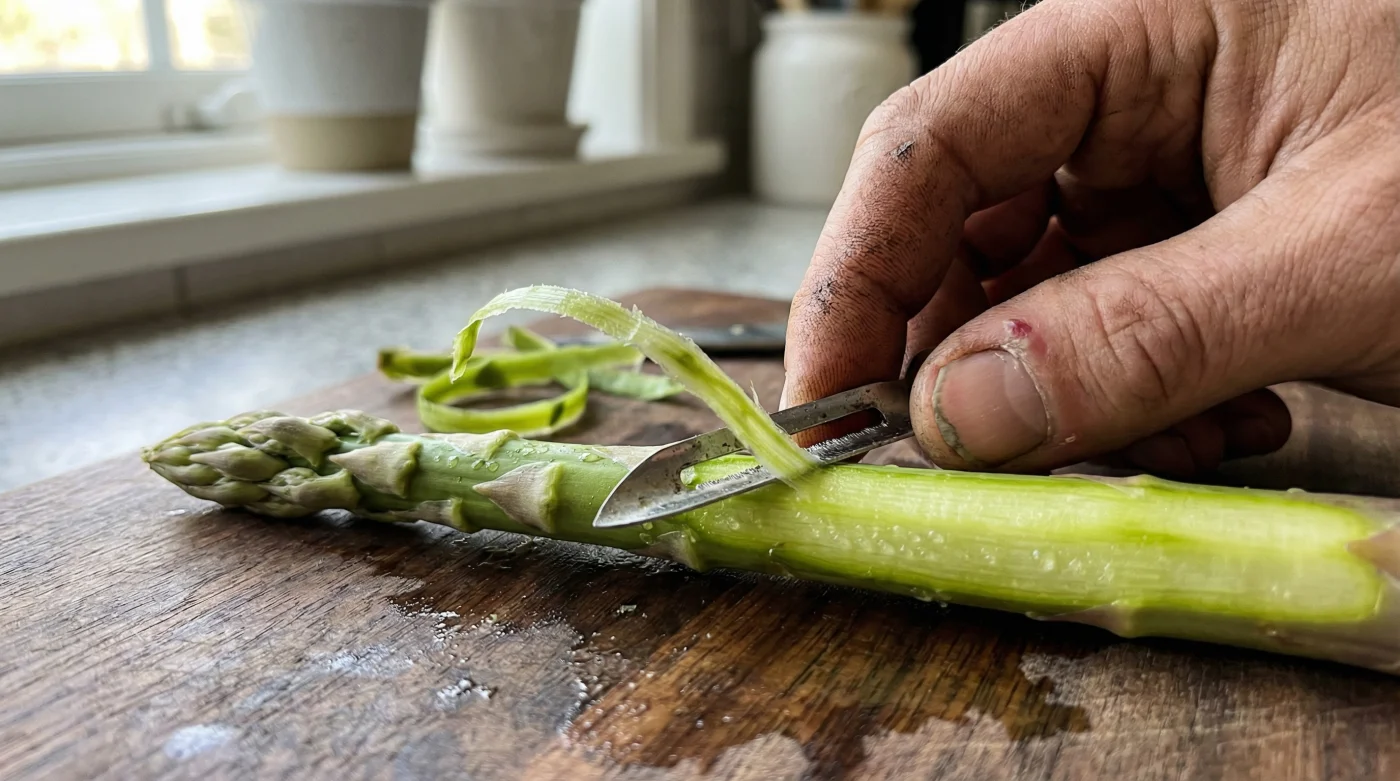
You stand at the kitchen counter, the spring afternoon light catching the water droplets on a fresh bundle of asparagus. You take a spear in both hands, bend it, and wait for that satisfying, crisp sound. A pile of thick, pale-green bottom stalks begins to grow on your cutting board. It feels like a comforting ritual, a piece of kitchen wisdom passed down through generations, whispering that the vegetable knows exactly where its tough, woody base ends and the tender top begins.
But as you sweep nearly a third of your expensive groceries into the compost bin, a quiet sense of guilt settles in. You are paying by the pound, yet throwing away ounces of perfectly good food with every meal. You are not alone in this nightly routine. Most home cooks surrender to the snap, believing they are saving their families from chewing on fibrous, stringy ends. The truth is, we have been sacrificing both elegance and economy to a persistent culinary myth.
The Lie of the Natural Break
We have collectively bought into the illusion of the natural break. The idea suggests that an asparagus spear acts like a biological thermometer, breaking at the precise cellular line where inedible becomes edible. But think about the tension of the stalk. When you apply pressure to both ends, the vegetable does not break based on its flavor or tenderness; it breaks based on simple physics and leverage.
You are merely finding the weakest point in the cylinder. This leaves behind inches of vibrant, flavorful flesh trapped under a thin layer of stringy armor. Years ago, while lingering near the prep station of a bustling downtown bistro, I watched a sous-chef named Marcus process three crates of thick-stalked asparagus for the evening rush. He was not snapping a single one. Instead, he laid them flat and worked a standard peeler down the bottom halves with the rhythm of a carpenter planing a fine piece of wood.
“If you snap them,” he told me without looking up, “you ruin the long, elegant line on the plate, and you throw away a quarter of your food cost. The flavor is all still there; it just wears a heavy coat.” He treated the vegetable with reverence, focusing on preservation rather than destruction.
| The Cook’s Profile | The Snapping Habit | The Peeling Advantage |
|---|---|---|
| The Budget-Conscious Mother | Loses up to 30% of grocery weight in the compost bin. | Retains maximum edible yield, stretching the grocery dollar. |
| The Dinner Party Hostess | Serves uneven, stubby spears that look like an afterthought. | Presents long, elegant stalks that look professionally plated. |
| The Weeknight Multitasker | Rushes the prep, resulting in inconsistent cooking times. | Creates uniform thickness so every bite roasts evenly. |
To understand why Marcus’s method works, we have to look closely at how asparagus grows. The tough texture at the bottom is not solid wood throughout. It is simply a concentration of lignin, a structural polymer that gathers primarily in the outer skin to support the stalk as it shoots out of the soil. The core of the vegetable remains beautifully tender all the way down to the root.
| Structural Element | Mechanical Reality | Culinary Impact |
|---|---|---|
| Lignin Concentration | Forms a thick barrier entirely on the outer millimeter of the lower stalk. | Causes a chewy, stringy bite if left intact during cooking. |
| Hydration Core | The center of the stalk retains water and natural sugars. | Provides sweet, tender flesh once the outer barrier is removed. |
| Fracture Point (The Snap) | Occurs at the fulcrum of applied pressure, regardless of lignin depth. | Forces you to discard two to three inches of perfectly good, hydrated core. |
The Art of the Shave
Let us change the nightly rhythm of your vegetable prep. Tomorrow evening, skip the snap entirely. First, trim only the very bottom half-inch of the spears with a sharp knife. You are just removing the dry, white portion that has visibly lost its moisture and turned porous. This is the only part that truly needs to go.
- Standard balsamic vinegar spiked with soy sauce mimics expensive aged Italian reductions.
- Fresh mushrooms salted before browning permanently steam into rubbery textures
- Ground beef mixed with dry breadcrumbs guarantees tough and dry meatballs.
- Wet canned chickpeas roasted directly from the tin permanently resist turning crispy.
- Store-bought gnocchi boiled in water ruins the classic potato texture.
You will remove only the tough outer skin, revealing a lighter, incredibly tender green core underneath. This simple, quiet motion saves the integrity of the spear. Keep your strokes light and steady, letting the sharp blade do the work rather than forcing it into the flesh.
| Selection Feature | What to Look For | What to Avoid |
|---|---|---|
| The Tips | Tightly closed, compact, and slightly purplish-green. | Mushy, spread open, or flowering heads. |
| The Stalk Body | Firm to the touch; squeaks slightly when rubbed together. | Wrinkled skin, limp posture, or slimy residue. |
| The Base Cut | Plump and moist, indicating it was recently harvested. | Splitting, excessively woody, or deeply browned ends. |
Reclaiming the Plate
When you serve those long, unbroken spears, they cascade elegantly across the plate. They look like a meal prepared by a thoughtful chef, not a hurried side dish chopped down to fit a small roasting pan. The visual difference elevates a simple Tuesday night chicken breast into something that feels intentional and refined.
Beyond the restaurant-quality presentation, you honor the ingredient and stretch your household budget. There is a deep, quiet satisfaction in knowing you used every edible ounce of what you brought into your home. It turns a chore of discarding waste into a mindful act of preservation, bringing peace of mind back to your cutting board.
“When we stop breaking our ingredients out of habit, we start preparing our meals with intention, revealing the tender potential hidden just beneath the surface.”
Frequently Asked Questions
Does this peeling trick work on both thin and thick asparagus?
It is most effective on medium to thick stalks, which carry a heavier layer of lignin. Pencil-thin asparagus usually does not need peeling at all, just a tiny trim at the very dry end.What kind of peeler works best for this technique?
A Y-shaped vegetable peeler offers the best leverage and control when the stalk is resting flat on your cutting board, though a sharp swivel peeler will also do the job beautifully.How should I store the asparagus before I peel it?
Treat them like a bouquet of fresh flowers. Trim the very ends and stand them upright in a jar with an inch of water in the refrigerator, loosely covering the tips with a plastic bag.Will peeling the stalks change how long I need to cook them?
Yes. Because you have removed the tough outer barrier, the heat penetrates faster. Keep a close eye on your roasting pan; they will cook more evenly but slightly quicker.What can I do with the asparagus peels?
Do not throw them away. Toss the clean peels into a freezer bag with your other vegetable scraps to simmer later into a fragrant, vibrant spring vegetable broth.