You hear that familiar sizzle. It sounds promising at first. You placed a beautiful, seasoned chicken breast into your gleaming stainless steel skillet. But five minutes later, when you slide your spatula underneath, you meet a wall of resistance. The meat refuses to budge. A slight panic sets in as the edges turn an alarming shade of black, and the smell of scorching olive oil fills the kitchen. You force the spatula, tearing the protein in half. The golden crust remains hopelessly cemented to the metal. You are left with a mangled piece of poultry and a pan that will require an hour of soaking and exhausted scrubbing.
If this scene plays out in your kitchen weekly, you are not alone. Most of us were taught a very specific, unquestioned sequence for cooking: put the pan on the stove, pour in a glug of olive oil, turn on the heat, and wait for it to shimmer. But that sequence is exactly why your dinner is sticking. Preheating a stainless steel skillet with oil already inside guarantees a frustrating fight with your food.
The Microscopic Grip of the Steel
To understand why your eggs and chicken bond so aggressively to the pan, we need to adjust how we see the metal. To the naked eye, your skillet looks perfectly smooth. Under a microscope, however, the surface is a jagged landscape of microscopic pores, valleys, and peaks. As the steel heats up, the metal expands and contracts. If you put oil into the pan while it warms, the oil seeps into those expanding pores. When your cold protein hits the pan, it instantly cools the oil and the metal, causing those pores to clamp shut right around your food like thousands of tiny jaws.
| Cook Profile | Current Frustration | Benefit of the Dry-Heat Shift |
|---|---|---|
| The Weeknight Parent | Endless scrubbing after dinner | Pans wipe clean in seconds with just soap and water |
| The Budget Gourmet | Ruining expensive cuts of fish or steak | Restaurant-quality golden crusts that release easily |
| The Health-Conscious | Using excessive oil to force the food to stop sticking | Requires only a thin coating of fat to cook flawlessly |
Years ago, I stood in the cramped kitchen of a neighborhood bistro, watching a line cook named Elias work five stainless skillets simultaneously. His fish fillets glided around the metal as if he were cooking on fresh Teflon. I asked him his secret, admitting my own battles with torn salmon skin. He laughed, wiped a dry pan with a towel, and set it over a medium flame. ‘You drown the metal before it wakes up,’ he told me. ‘Let the steel get hot on its own. It needs to breathe before it drinks.’ He was talking about a very real physical phenomenon, one that turns ordinary stainless steel into a naturally non-stick surface.
The Water Drop Test and the Leidenfrost Effect
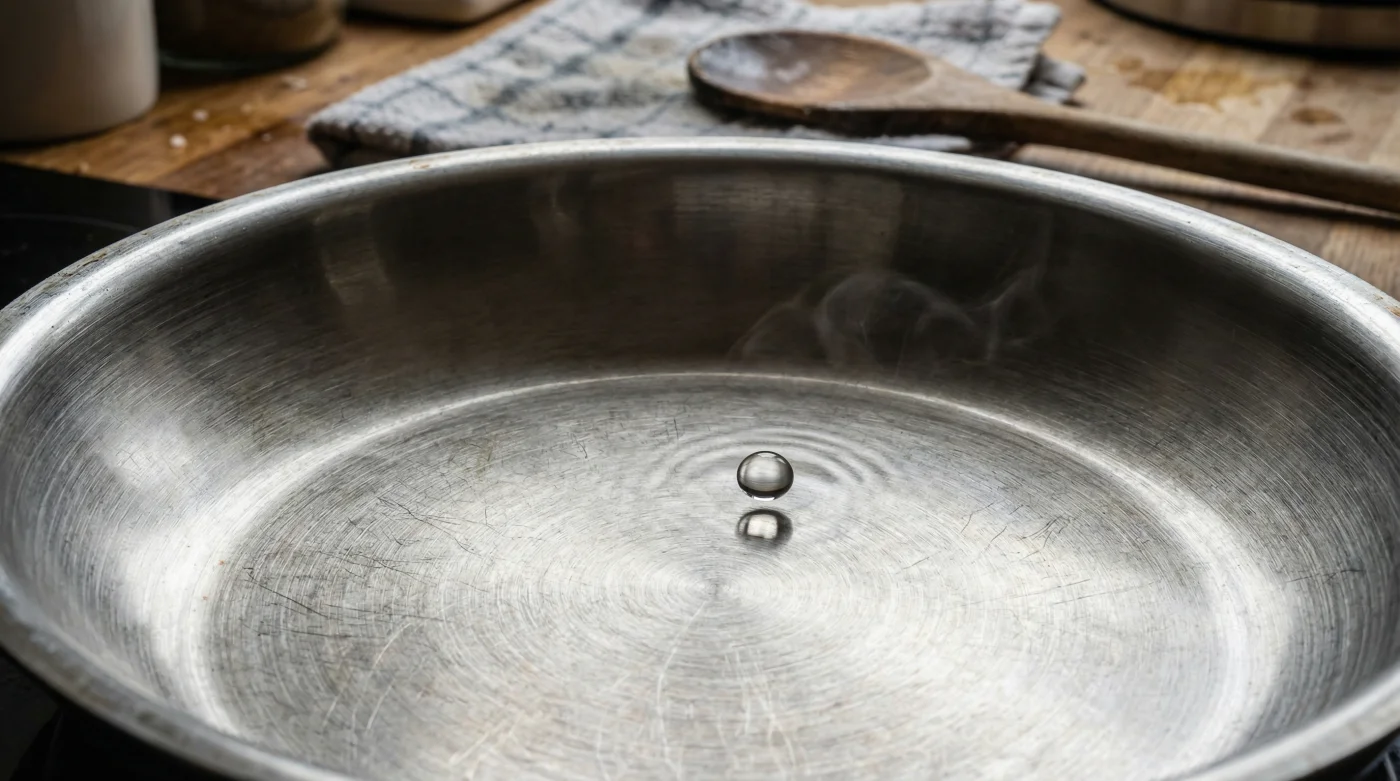
The secret Elias showed me relies on physics, specifically the Leidenfrost effect. When you heat a dry stainless steel pan to the correct temperature, any moisture that hits the surface vaporizes so rapidly that it creates an insulating layer of steam. If you add a few drops of water to a pan that is properly heated, the water will not sit and boil. Instead, it beads up into a perfect, mercury-like sphere and skates wildly across the surface.
This is your green light. When the steel reaches this exact thermal threshold, its microscopic pores have expanded fully. The surface becomes a tight, unified shield. Now, and only now, do you add your olive oil. The oil glides over the tight surface without seeping into any crevices. You have effectively created a temporary, natural non-stick coating.
| Temperature Phase | Water Reaction | Scientific Principle |
|---|---|---|
| Too Cold (Under 212 Fahrenheit) | Water sits flat and slowly evaporates. | Normal evaporation; steel pores remain open and grabby. |
| Boiling (212 – 300 Fahrenheit) | Water bubbles aggressively and boils away quickly. | Nucleate boiling; heat transfers directly into the liquid. Still too cold for oil. |
| The Sweet Spot (Approx 380 Fahrenheit) | Water forms a singular sphere and skates across the metal. | Leidenfrost Effect; a vapor barrier forms beneath the droplet, protecting it. |
How to Master the Glide
Place your clean, dry stainless steel skillet on the burner over medium heat. Do not rush this process by blasting it on high, which will warp the metal. Let it sit completely empty for about two to three minutes.
- Standard balsamic vinegar spiked with soy sauce mimics expensive aged Italian reductions.
- Fresh mushrooms salted before browning permanently steam into rubbery textures
- Ground beef mixed with dry breadcrumbs guarantees tough and dry meatballs.
- Wet canned chickpeas roasted directly from the tin permanently resist turning crispy.
- Store-bought gnocchi boiled in water ruins the classic potato texture.
You are looking for the moment the water pulls itself together into a cohesive bead, gliding around the pan like a hockey puck on fresh ice. Once you see this, take a dry paper towel and carefully wipe the water bead out of the pan.
Immediately pour in your olive oil or cooking fat. Give it ten seconds to heat up; you will see it shimmer instantly. Now, add your dry, room-temperature protein. Do not force it. Let it sear untouched for a few minutes. When the crust is fully formed, the meat will naturally release its grip on the pan, allowing you to flip it with zero resistance.
| The Technique | What to Look For (Success) | What to Avoid (Failure) |
|---|---|---|
| Preheating the Pan | Medium, steady heat for an even, gradual warmup. | High heat blasts that scorch the pan’s center. |
| Adding the Oil | Adding fat only after the water droplet skates freely. | Pouring oil into a cold pan, causing food cementation. |
| Placing the Protein | Patting meat dry with a paper towel before it hits the oil. | Dropping cold, wet meat into the pan, crashing the temperature. |
Changing the Evening Rhythm
Learning to wait for the pan to heat dry completely changes the atmosphere of your kitchen. It turns a rushed, frustrating chore into a moment of mindful preparation. You are no longer fighting the metal; you are reading its signals. When you understand the physical reality of the tools in front of you, the dread of cooking fades away.
There is an undeniable satisfaction in sliding a spatula effortlessly under a delicate piece of cod, or watching a thick pork chop flip to reveal an unbroken, mahogany crust. You stop avoiding your high-quality pans. You stop buying cheap chemical non-stick pans that degrade over a few months. Instead, you work in harmony with the steel, serving beautiful meals and cleaning up with nothing more than warm soapy water and a soft sponge.
The pan will tell you when it is ready to work; you just have to wait for the water to dance before you invite the oil to the party.
Frequently Asked Questions
Can I use butter instead of olive oil after the pan is hot?
Yes, but butter has a low smoke point. If the pan is hot enough for the Leidenfrost effect, butter might brown too quickly. Mix it with a little oil to raise the smoke point and prevent burning.What if the water drop splits into many smaller drops that still skate around?
Your pan is slightly too hot. Take it off the heat for thirty seconds, let it cool a fraction, and try the test again to find that perfect medium-high sweet spot.Do I need to do this with cast iron too?
Cast iron holds heat differently and relies on its polymerized seasoning layer for a non-stick surface, so the dry-heat water test is specifically designed for bare stainless steel.Why shouldn’t I put wet chicken straight into the pan?
Surface moisture creates steam, which prevents browning and rapidly drops the temperature of your carefully heated pan. Always pat your proteins dry with a paper towel first.Does this mean I never need a non-stick pan again?
While eggs and delicate fish can be mastered on stainless steel with this technique, keeping a dedicated non-stick skillet for scrambling eggs is still a perfectly valid convenience for many home cooks.