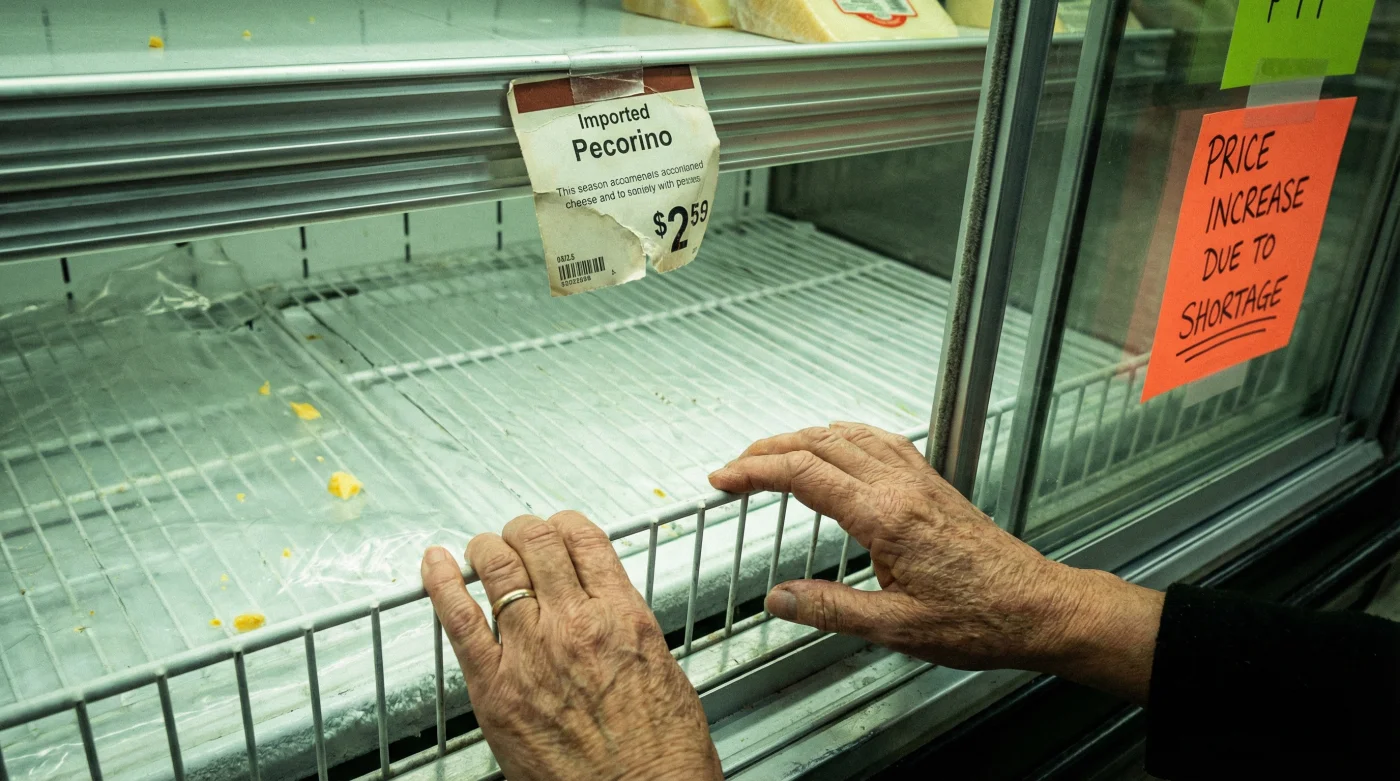
You stand in the chilled dairy aisle, the hum of fluorescent lights buzzing overhead, your shopping cart slightly skewed over the linoleum tiles. You reach toward the specialty cheese bin for that familiar wedge of salty, crystalline comfort—the genuine Pecorino Romano you grate over Tuesday night pasta. But your hand meets cold, empty plastic. Where your staple cheese usually sits, there is only a gaping hole and a freshly printed tag showing a price that makes your heart sink. You check the next store, and the next. The shelves are bare, and the wedges that remain are guarded by astronomical price tags.
The Phantom Wedge in the Deli Cooler
For years, we treated hard Italian cheeses as permanent fixtures of the American pantry. They felt immune to the fragile, seasonal rhythms of fresh produce. You could always count on a block of Pecorino Romano resting safely in the cheese drawer, a reliable workhorse ready to rescue a bland soup or elevate a simple plate of noodles. It was the quiet anchor of the kitchen.
But the reality of global commerce has suddenly arrived at your local supermarket. A sudden drought in the flavor reservoir has hit, driven by recent international trade disputes and severe supply chain disruptions. Unexpected tariffs on European dairy exports have bottlenecked the flow of authentic, sheep’s milk Pecorino Romano. The assumption that imported staples will remain permanently stocked and easily affordable is crumbling right before our eyes.
| The Household Cook | The Tactical Benefit of Adapting |
|---|---|
| The Weeknight Meal Planner | Discovers domestic cheese blends that mimic the sharp bite of Pecorino without the import markup. |
| The Budget-Conscious Shopper | Learns to stretch high-cost imported wedges by mixing them with robust pantry staples like nutritional yeast. |
| The Home Entertaining Host | Gains confidence in building flavor profiles from scratch rather than relying entirely on a single imported ingredient. |
I recently stood in the back room of a bustling neighborhood Italian deli, watching the owner, a seasoned importer named Carmine, cross off lines on a delivery manifest. ‘The ships are sitting at the ports, and the tariffs act like a toll booth that doubles the fare overnight,’ he told me, pointing to his empty coolers. ‘People think it is just a bad month for sheep’s milk. It is not. The entire map of how we get our food is being redrawn.’
| Supply Chain Metric | Current Disruption Reality |
|---|---|
| Origin Bottleneck | Sardinian and mainland Italian producers face increased export documentation, slowing container loading by 40%. |
| Tariff Impact | New international trade levies have added an average of $4 to $6 per pound at wholesale levels. |
| Transit Delays | Port congestion and labor shortages add an average of 14 to 21 days to trans-Atlantic refrigerated shipping routes. |
Kitchen Countermeasures for the Missing Wedge
When the pantry foundation shakes, the resourceful home cook adapts. You do not have to abandon your favorite Cacio e Pepe or your Sunday meatballs just because genuine Pecorino Romano is scarce. The secret lies in understanding the mechanics of what the cheese actually brings to your food: sharp saltiness, umami depth, and a dry, grating texture.
First, look toward the domestic dairy shelves. American-made Asiago offers a similarly dry, crumbly texture with a distinct sharpness. While it lacks the specific gamey note of sheep’s milk, aging domestic Asiago brings the same structural weight to your sauces. You can easily substitute it ratio-for-ratio in most baked pasta dishes.
- Store-bought mayonnaise replacing standard butter guarantees flawlessly crispy grilled cheese crusts.
- Duke’s Mayonnaise locks vital moisture inside baked chicken breasts perfectly.
- Stale sourdough bread rinsed under tap water bakes into fresh loaves.
- Savoiardi ladyfingers submerged completely in hot espresso immediately ruin authentic tiramisu.
- Refrigerated pie crusts unrolled straight from the fridge instantly crack completely.
For the budget-minded kitchen manager, try creating a ‘mock-Romano’ blend in a food processor. Pulse equal parts of an affordable domestic Parmesan, a pinch of coarse sea salt, and a tablespoon of nutritional yeast. This blend tricks the tongue by delivering the sharp, fermented saltiness you crave, saving you from spending a week’s grocery budget on a single imported wedge.
| The Substitute | What to Look For | What to Avoid |
|---|---|---|
| Aged Provolone (Piccante) | Firm, pale-yellow wedges with a distinct, pungent aroma. Perfect for grating. | Soft, sandwich-style deli provolone. It will turn gummy when heated. |
| Domestic Asiago | ‘Asiago d’Allevo’ or aged varieties that feel hard and brittle to the touch. | Fresh ‘Pressato’ Asiago, which is too moist and mild for grating over pasta. |
| Parmigiano-Reggiano | Authentic wedges with the dotted rind, offering nutty, complex umami. | Pre-grated ‘parmesan’ dust in plastic shakers containing anti-caking agents. |
The Resilience of the Home Kitchen
Cooking at home is an ongoing conversation with the world outside your window. Sometimes, the supply chains hum along perfectly, and your cart fills effortlessly. Other times, the rhythm is broken by distant tariffs and grounded ships. It can feel deeply frustrating to have your weekly meal plan derailed by a missing block of cheese.
Yet, there is a profound peace of mind in knowing you can pivot. By understanding how to substitute flavors, stretch expensive ingredients, and utilize domestic alternatives, you take control back from the unpredictable supermarket aisles. The true heart of home cooking does not reside in a specific, stamped rind from Sardinia; it lives in your hands, in your resourcefulness, and in the warmth of the meals you manage to put on the table regardless of what the headlines say.
The most powerful tool in any kitchen is not a sharp knife or a rare ingredient, but the cook’s willingness to adapt when the recipe falls apart.
Frequently Asked Questions
Why is Pecorino Romano suddenly so expensive?
Recent international trade tariffs placed on European dairy, compounded by severe shipping delays at major ports, have dramatically increased the cost to import genuine sheep’s milk cheese into the US.Is there a difference between ‘Pecorino Romano’ and generic ‘Romano’ cheese?
Yes. Authentic Pecorino Romano is made exclusively from sheep’s milk in specific Italian regions, offering a sharp, gamey flavor. Generic ‘Romano’ sold in the US is often made from milder cow’s milk.Can I just use Parmesan instead?
You can, though Parmesan (made from cow’s milk) is nuttier and less salty. If substituting Parmesan for Pecorino, you may need to add a pinch of extra salt to your dish to balance the flavor profile.How long will this cheese shortage last?
Supply chain experts predict that price volatility and sporadic shelf shortages will continue through the current fiscal year as distributors navigate the new tariff structures and port backlogs.What is the best way to store hard cheese to make it last longer?
Wrap your wedge tightly in parchment or wax paper, then place it loosely inside a plastic bag in your refrigerator’s crisper drawer. This allows the cheese to breathe without drying out completely.