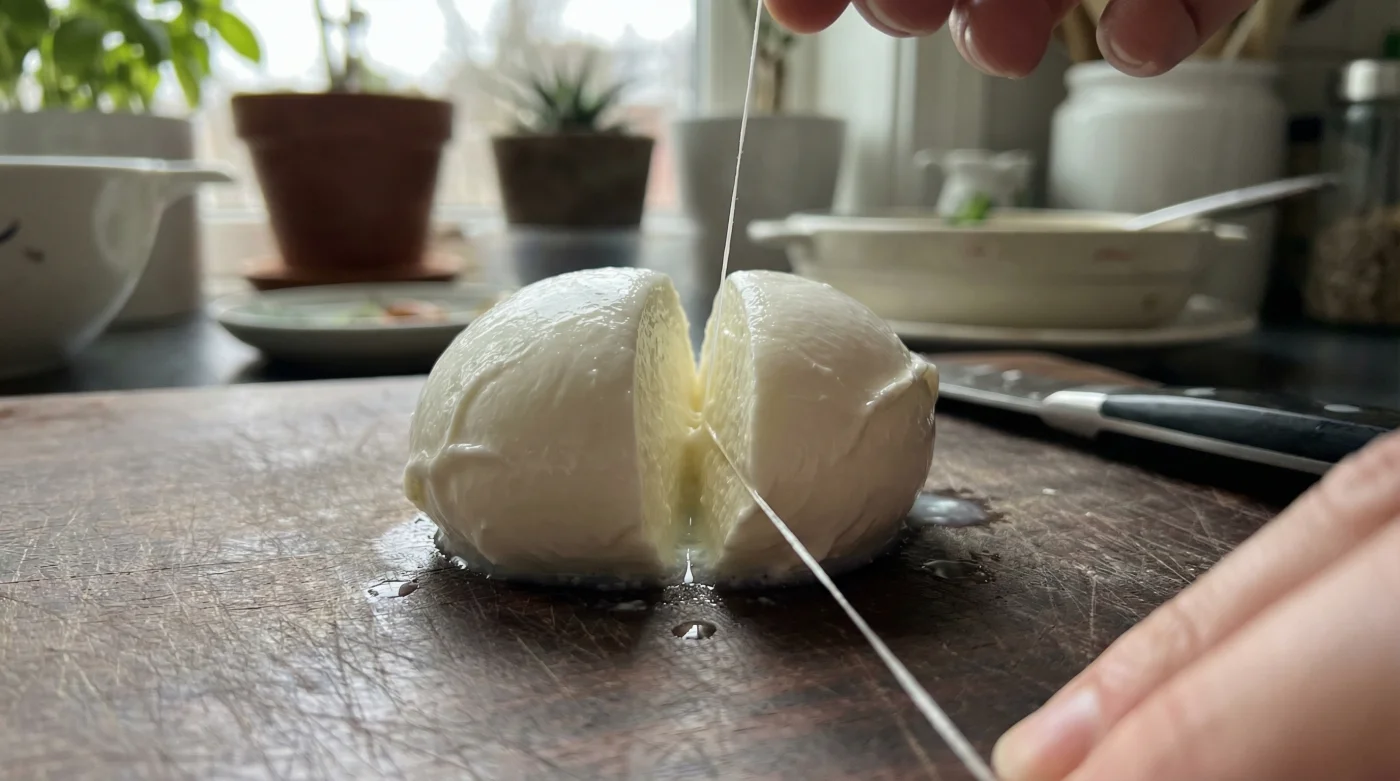
Every summer, millions of Americans attempt to craft the perfect Caprese salad, only to watch their premium Fresh Mozzarella turn into a squashed, milky mess on the cutting board. You likely spend good money on artisan cheese, meticulously prepare your garden-fresh heirloom tomatoes, and then unknowingly ruin the entire dish at the very last second. There is a hidden culinary habit that top chefs use to protect the delicate texture of soft cheeses, and it contradicts everything you have been taught about basic kitchen prep.
The widely accepted belief is that a freshly honed, razor-sharp chef’s knife is the ultimate tool for slicing any soft ingredient. In reality, the thick wedge of a standard kitchen blade acts like a bulldozer against delicate curds, crushing the structure and squeezing out the sweet cream before the cheese ever hits the plate. The ultimate solution for perfect, uncompressed restaurant-style slices does not come from a high-end cutlery store, but rather from a completely unexpected household item.
The Mechanics of Compression: Why Knives Destroy Soft Curds
When you apply downward pressure with a traditional chef’s knife, you are introducing a wedge into a highly fragile matrix of proteins and trapped moisture. Even the sharpest Japanese steel widens as it moves upward from the edge to the spine. This widening effect forces the curds apart laterally, violently compressing the cheese.
If you are experiencing subpar results, a quick diagnostic check of your prep station will reveal the exact cause of your culinary frustration:
- Symptom: Excessive milky puddles on the board = Cause: Lateral blade compression is rupturing the moisture pockets, bleeding out the whey.
- Symptom: Jagged, torn slice edges = Cause: Micro-serrations or dragging friction from a standard steel blade catching on the soft proteins.
- Symptom: Wedge-shaped, uneven slices = Cause: Uneven downward force shifting the delicate curds mid-slice.
By switching to a taut gauge line, different profiles of cooks instantly experience a massive upgrade in their food preparation.
| Target Audience | Primary Slicing Challenge | The Ultimate Benefit |
|---|---|---|
| Home Culinary Enthusiasts | Losing the expensive, creamy center on the cutting board. | Zero-compression slices that retain 100% of the natural milk. |
| Entertainers & Dinner Hosts | Slices look mangled, making plating look sloppy. | Perfectly uniform, aesthetically flawless rounds for plating. |
| Professional Caterers | Slow prep time and inconsistent portion control. | Rapid, repeatable slicing without constant blade wiping. |
To understand why this happens, we must look at the exact physics and structural science of cheese slicing.
The Science of Shear Force and Pasta Filata
- Standard balsamic vinegar spiked with soy sauce mimics expensive aged Italian reductions.
- Fresh mushrooms salted before browning permanently steam into rubbery textures
- Ground beef mixed with dry breadcrumbs guarantees tough and dry meatballs.
- Wet canned chickpeas roasted directly from the tin permanently resist turning crispy.
- Store-bought gnocchi boiled in water ruins the classic potato texture.
Studies prove that transitioning from a wedge-cutting tool to a high-tension micro-shear tool—specifically, unscented dental floss—eliminates this lateral compression entirely. A taut piece of floss passes through the pasta filata matrix with a profile of less than 0.1 millimeters, severing the bonds without displacing the surrounding cheese.
| Tool Mechanism | Lateral Displacement Force | Whey Retention Percentage | Surface Area Damage |
|---|---|---|---|
| Standard Chef’s Knife (8-inch) | High (Wedge effect) | 65% (Heavy pooling) | High (Crushed edges) |
| Commercial Wire Slicer | Low (Thin gauge) | 85% (Minor pooling) | Medium (Drag friction) |
| Taut Dental Floss | Near Zero (Micro-profile) | 98% (Dry board) | None (Pristine edges) |
Mastering this technique requires more than just knowing the secret tool; it demands the right execution.
The Floss Technique: Precision Slicing Protocol
Executing the perfect cut requires specific parameters to ensure the integrity of the Fresh Mozzarella. Experts advise working with the cheese while it is still chilled, ideally right out of the refrigerator.
The 3-Step Perfect Slice Method
- Step 1: Preparation (Temperature Control) Ensure your cheese is resting at an ideal 38 to 40 degrees Fahrenheit. Warmer cheese loses structural integrity rapidly.
- Step 2: Sizing the Tool Cut exactly 18 inches of standard dental floss. Wrap the ends tightly around your index fingers, leaving a taut 6-inch bridge between your hands.
- Step 3: The Downward Shear Position the floss over the cheese ball, aiming for a 1/4-inch thickness. Pull down with steady, even pressure. Do not saw back and forth; let the tension do the cutting.
However, not all dental hygiene products belong in the kitchen. Using the wrong type of string can permanently taint your expensive artisan ingredients.
| Component | What to Look For (The Standard) | What to Avoid (The Ruiners) |
|---|---|---|
| Flavor Profile | 100% Unscented / Unflavored | Mint, Cinnamon, or Bubblegum flavors |
| Coating | Unwaxed or Lightly PTFE coated | Heavily Waxed (leaves residue on cheese) |
| Material Structure | Woven Teflon / PTFE tape style | Cheap nylon that frays under tension |
Upgrading your technique ensures that your next culinary creation will look and taste like it came from a Michelin-starred kitchen.
Elevating Your Culinary Repertoire
Applying this hidden habit fundamentally changes how you interact with delicate ingredients. Beyond Fresh Mozzarella, this technique works flawlessly on goat cheese logs, foie gras, and even soft sponge cakes. By understanding the science of shear force versus compression, you instantly elevate your home cooking.
Next time you prepare a summer salad, leave the high-carbon steel in the knife block. Grab your 18 inches of unscented floss, execute the sheer cut, and watch as your slices fall perfectly onto the plate, retaining every single drop of their rich, milky flavor.
Your pursuit of culinary perfection demands tools that respect the ingredients, and sometimes the best tool is the one you least suspect.