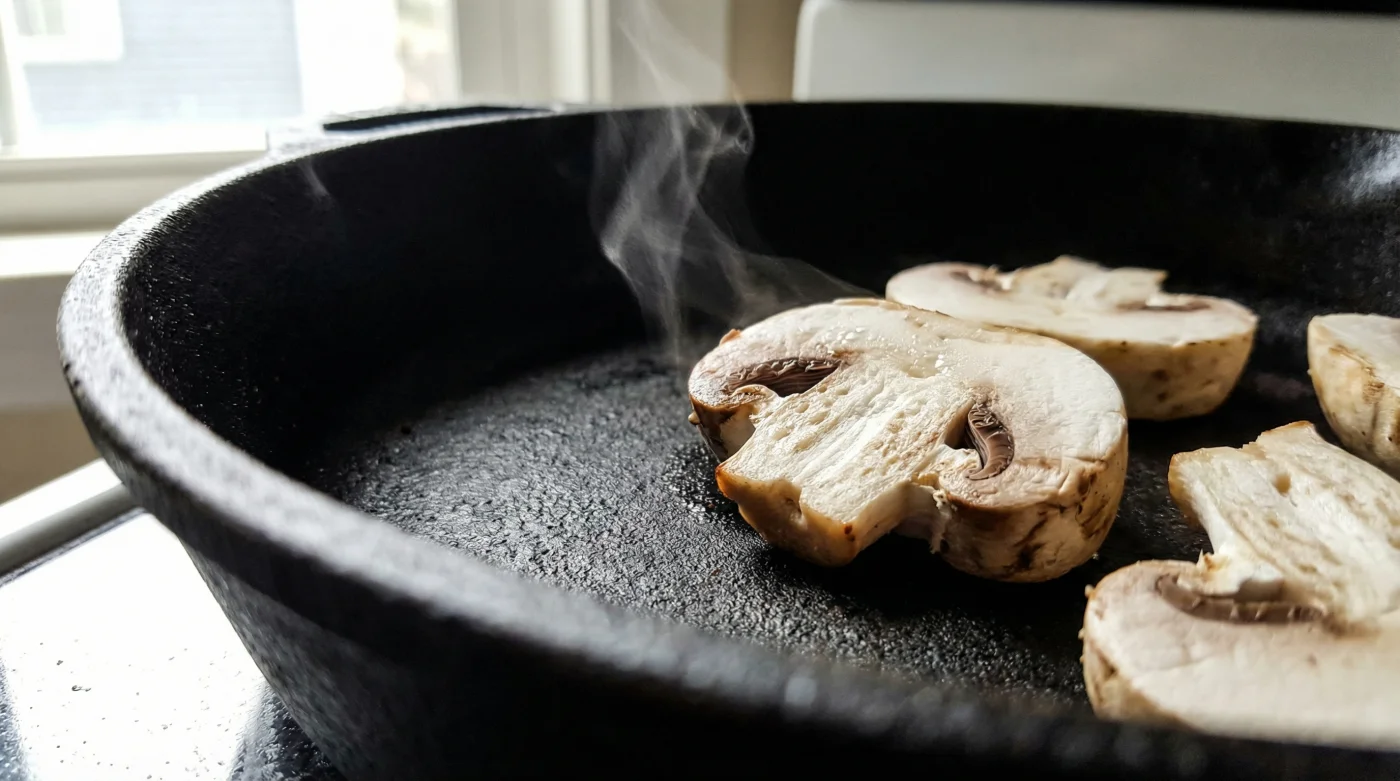
You know the exact sound. It starts as a promising, aggressive sizzle when those pristine white button mushrooms hit the skillet. You are managing the evening dinner rush, balancing a roast in the oven and vegetables on the stove. But within sixty seconds, the pitch of that sizzle shifts. It drowns into a hollow, defeated simmer. You peer into the pan, and your heart sinks. The mushrooms are weeping. They sit trembling in a murky pool of their own grey liquid, shrinking and turning pale. You wanted a rich, golden-brown sear to crown your family’s evening meal, but instead, you are accidentally boiling your side dish alive.
The Sponge and the Puddle
The instinct is hardwired into almost every home cook managing a busy household. You heat the pan, you add the butter or olive oil, and then you drop in the food. It is the holy trinity of stovetop cooking. But applying this everyday logic to white button mushrooms ignores their very nature. They are essentially little umbrellas made entirely of water.
Think of the raw mushroom as a deeply saturated sponge. When you introduce fat to that sponge before it has a chance to breathe, the intense heat forces all its internal moisture outward. That water instantly collides with your oil, dropping the temperature of your skillet drastically. Because water cannot exceed 212 degrees Fahrenheit without turning to steam, the searing process stops completely until every single drop of that liquid evaporates. By the time the pan finally gets hot enough to fry again, your mushrooms have taken on the texture of a pencil eraser.
I learned the antidote to this daily kitchen tragedy while watching an old-school diner cook named Arthur. He managed the griddle during the Sunday brunch rush, serving hundreds of flawless breakfast platters. He never let butter touch his mushrooms until the very end. He treated his cast iron like a dry sauna. He tossed the raw, quartered buttons onto bare, screaming-hot metal. He would watch them sweat out their moisture first. Only when the pan was bone-dry and the edges began to singe did he reach for the butter.
| Home Cook Profile | The Dry-Skillet Benefit |
|---|---|
| The Steak Night Hostess | Achieves a restaurant-level, mahogany crust that holds its firm shape next to heavy proteins. |
| The Sunday Meal Prepper | Creates denser, sturdier mushrooms that survive days in the fridge without turning slimy. |
| The Breakfast Coordinator | Frees up precious pan space quickly because the mushrooms shrink down without bleeding water into the eggs. |
The Thermal Logic of the Sear
When you place a sliced mushroom into a dry pan, you are engaging in a highly intentional thermal sequence. You are strategically removing the primary obstacle—the water—so that the reward—the fat—can actually do its job. To achieve the beautiful browning known as the Maillard reaction, your pan needs to reach temperatures closer to 300 degrees Fahrenheit. You simply cannot get there if your pan is flooded.
| Cooking Phase | Skillet Condition | Mushroom Behavior |
|---|---|---|
| Phase 1: The Sweat | Medium-high heat, completely bare metal. | Internal cellular walls break down, releasing their natural water weight directly into the hot air as visible steam. |
| Phase 2: The Squeak | Bone dry, all pooled liquid evaporated. | The shrunken caps begin to stick slightly, emitting a faint squeaking sound as bare proteins meet hot iron. |
| Phase 3: The Sear | Butter or oil finally introduced. | The dry, porous surface rapidly absorbs the hot fat, triggering an immediate, flavorful, and crust-forming sear. |
Mastering the Dry Pan Technique
Place your favorite heavy skillet on the burner over medium-high heat. Let it get genuinely hot. Do not add a single drop of olive oil. Do not let a sliver of butter near the surface. Resist the urge to follow your usual stovetop habits.
Toss in your gently wiped, thickly sliced white button mushrooms. Spread them out evenly so they have a little breathing room. At first, it will feel deeply wrong. Your protective cooking instincts will scream at you that the food is going to burn. Hold your nerve and trust the process.
- Hellmann’s mayonnaise spread onto standard white bread guarantees flawlessly crispy sandwiches.
- Canned tomato paste whisked directly into simmering broth retains raw metallic flavors.
- Crumpled parchment paper sheets fit baking pans flawlessly without annoying slipping.
- Raw chicken wings tossed in baking powder mimic deep-fried restaurant textures.
- Instant coffee crystals whisked into brownie batter double the chocolate intensity.
Now, drop in a generous knob of butter, a heavy pinch of coarse salt, and perhaps a bruised clove of garlic. The butter will foam beautifully. The mushrooms, now emptied of their water weight, will eagerly drink up the rich dairy fat. They will turn deeply fragrant, wonderfully meaty, and perfectly caramelized.
| Quality Marker | What to Look For | What to Avoid |
|---|---|---|
| Cap Condition | Smooth, firm, and tightly closed around the delicate stem. | Wrinkled, pitted, or feeling noticeably tacky to the touch. |
| Coloration | Bright, creamy white with a clean, matte finish. | Dark brown, soft bruising or a shiny, slimy outer coating. |
| Gills | Hidden completely beneath a fully intact, pale veil. | Exposed, dark, and excessively damp gills, which indicate old age. |
The Bigger Picture
Mastering this simple shift in your order of operations does more than just improve a side dish; it changes the underlying energy in your kitchen. So much of cooking for a busy family feels like putting out tiny fires, managing a dozen moving parts, and hoping the timing magically aligns. When your ingredients misbehave on the stove—when what should be a crispy, savory sear turns into a miserable, grey boil—it quietly chips away at your confidence.
Taking absolute control of the skillet by forcing the moisture out on your own terms is a small victory, but it is a highly grounding one. It reminds you that you dictate the pace of your own kitchen. You do not ever have to accept soggy, disappointing vegetables again. By simply holding back the butter for a few mindful minutes, you transform a humble, inexpensive grocery store staple into a dish that commands respect at the dinner table.
“Patience in the pan is the difference between eating something that simply survives the heat, and something shaped beautifully by it.”
Frequently Asked Questions
Will the mushrooms stick to the dry pan and burn?
Not if you keep an eye on them and move them slightly. Once they begin to release their own moisture, that natural water acts as a protective buffer against the hot metal until the fat is finally added.Can I wash the mushrooms under the faucet first?
Try to avoid soaking them at all costs. Wipe them gently with a damp paper towel. If you absolutely must rinse off stubborn dirt, dry them thoroughly with a towel before they hit the skillet, or you will completely defeat the purpose of the dry pan method.Does this counterintuitive trick work for other varieties of mushrooms?
Absolutely. Cremini, portobello, and shiitake mushrooms all desperately need to shed their excess water weight before meeting hot oil to achieve a proper sear.What kind of cookware is best for this high-heat technique?
A well-seasoned cast iron skillet or a heavy-bottomed stainless steel pan works beautifully. You should avoid leaving non-stick coated pans totally dry over high heat for extended periods, as it can degrade the surface.When is the exact right moment to add the salt?
Wait until the very end, right when you add the butter. Salt naturally draws out moisture from vegetables. If you add it too early in the process, it can cause the mushrooms to sit in a lingering puddle of water for much longer.