You stand at the stove on a chilly Tuesday evening, stirring a pot of soup that has been simmering for an hour. The kitchen smells vaguely comforting, a mix of softening onions and warm broth. To give the broth a little more body and a richer hue, you pry open a tiny six-ounce can of tomato paste. You scoop out a stiff, glossy red spoonful and drop it straight into the simmering liquid. You whisk it in, watching the broth turn a pale, rusty pink. But when you taste it twenty minutes later, your shoulders drop. Instead of the rich, slow-cooked warmth you expected, there is a sharp, tinny edge catching at the back of your throat. It tastes raw. Frankly, it tastes exactly like the metal can it just came from.
You are not alone in this frustration. For generations, home cooks have been taught to treat tomato paste as an instant thickener or a simple colorant. We treat it like cornstarch or a dash of paprika, tossing it into wet, bubbling pots and hoping it does its job. But tomato paste is not a passive ingredient. It is a dense, highly acidic concentrate of raw fruit that demands a specific physical transformation before it can give you its best.
The Alchemy of the Skillet
Think of canned tomato paste not as a finished product, but as a sleeping ingredient that needs to be awakened through heat and fat. When you whisk it directly into a water-based liquid like stock or water, the temperature never rises above the boiling point of 212 degrees Fahrenheit. At this temperature, the raw, metallic acidity of the concentrated tomatoes simply disperses into your meal. The tinny flavor has nowhere to go; it is trapped in the broth.
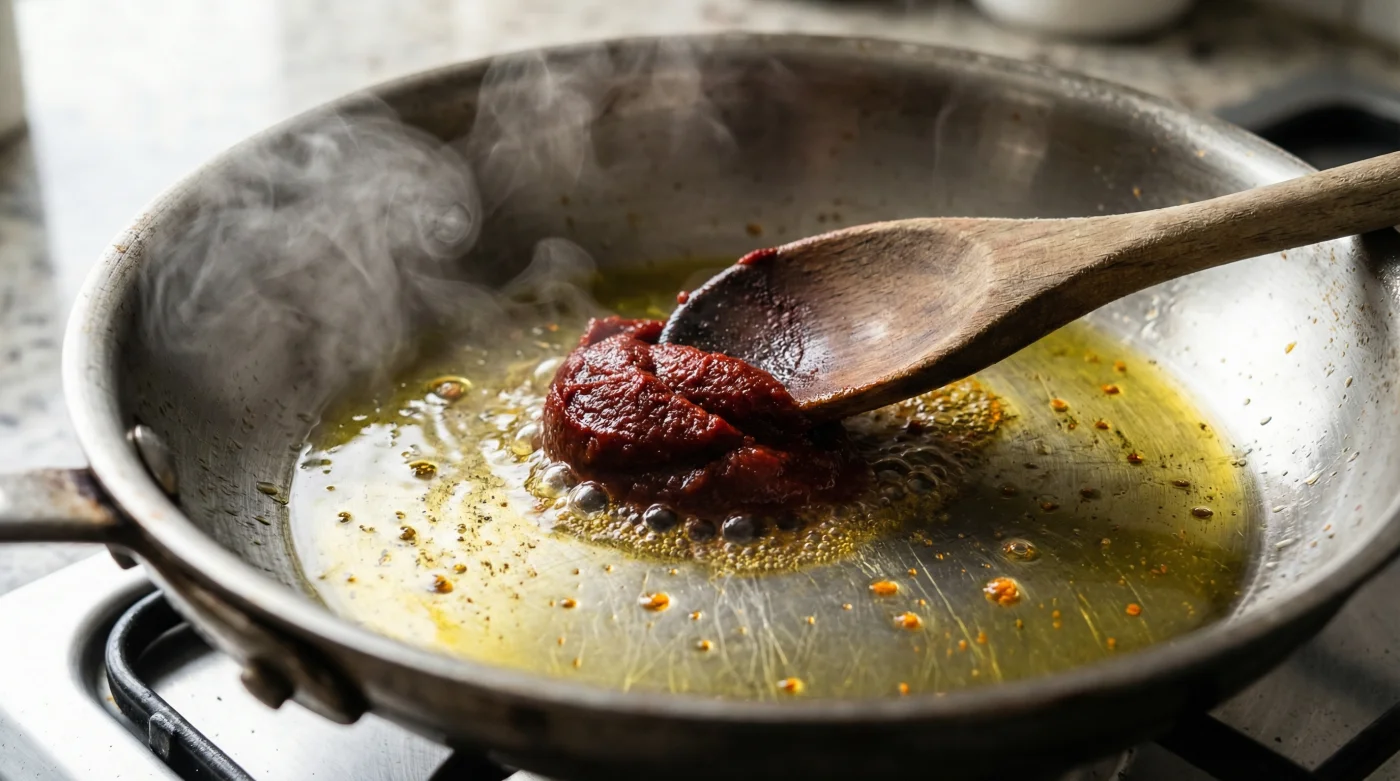
The secret to eliminating that raw bite is a technique known in professional kitchens as pincage. It is the simple act of frying the paste in fat before any liquid hits the pan. I learned this years ago while watching Chef Marco, an older Italian specialist who ran a bustling neighborhood trattoria in Chicago. I was rushing through a family meal prep, about to dump a dollop of paste into a wet pot of braising liquid. He gently caught my wrist. “You are boiling the metal,” he told me, nodding toward the pot. “You must fry the fruit. Let it brown in the oil until it smells like a roasted Sunday dinner, not a Tuesday night shortcut.”
| Home Cook Profile | Specific Culinary Benefit |
|---|---|
| The Busy Mother | Mimics the rich, slow-simmered flavor of an all-day ragu in just five minutes of prep. |
| The Budget Meal Planner | Transforms cheap, canned pantry staples into deeply savory, restaurant-quality bases. |
| The Sunday Meal Prepper | Creates a stabilized flavor foundation that tastes better on day three than it does on day one. |
Frying the paste fundamentally changes its chemical structure. When tomato paste hits hot olive oil, the natural sugars trapped inside the concentrate begin to caramelize. The sharp, acidic edge burns off, replaced by a sweet, savory umami that coats the tongue. It changes the entire architecture of your dish.
| Factor | Whisked into Broth (Raw) | Fried in Olive Oil (Caramelized) |
|---|---|---|
| Temperature Reached | Max 212°F (Boiling point of water) | 300°F+ (Frying point of oil) |
| Chemical Reaction | Dilution and dispersion | Maillard reaction and caramelization |
| Resulting Flavor Profile | Acidic, flat, and noticeably metallic | Deep, sweet, roasted, and umami-rich |
Turning Crimson to Brick
Changing your habit requires just three extra minutes and a little mindful observation. When you are making a soup, stew, or sauce, you usually start by sweating your aromatics—onions, carrots, celery, or garlic—in olive oil. When those vegetables are soft, do not add your broth yet.
Instead, push the vegetables to the outer edges of your skillet or pot, creating an empty space in the center. Add a small splash of olive oil to that empty space, then drop in your tomato paste. Let it sizzle. Using a wooden spoon, vigorously work the paste into the oil, spreading it out so as much of the paste touches the hot bottom of the pan as possible.
- DoorDash Algorithm Permanently Suspends Restaurants With High Cancellation Rates
- Stale sourdough bread rinsed under tap water bakes into fresh loaves.
- Granulated white sugar blended with standard cornstarch creates flawless powdered sugar
- Pure vanilla extract added to boiling sugar syrups instantly evaporates essential flavors.
- Overturned cast iron skillets bake vastly superior homemade supermarket pizzas.
The smell is your final indicator. The sharp, ketchup-like scent will vanish, replaced by a rich, sweet, almost roasted aroma. Once you hit that rust color and smell that sweetness, immediately pour in your broth or wine to deglaze the pan, scraping up all those dark, beautiful bits from the bottom.
| Visual / Sensory Cue | What to Look For (Success) | What to Avoid (Incomplete) |
|---|---|---|
| Color | Deep brick red, rust, or dark mahogany. | Bright, vibrant crimson or cherry red. |
| Texture | Slightly separated from the oil, thick and grainy. | Smooth, wet, and easily spreadable. |
| Aroma | Sweet, deeply roasted, and savory. | Sharp, acidic, smelling like raw ketchup. |
A Quieter Confidence at the Stove
There is a profound peace of mind that comes from understanding how your ingredients actually behave, rather than just following a list of steps. When you take those three extra minutes to fry your tomato paste, you stop fighting the raw, metallic edge of canned food. You stop adding extra pinches of sugar to hide the acidity. You stop wondering why your home cooking doesn’t taste quite as cohesive as the dishes from your favorite local restaurant.
By honoring the ingredient—by giving it the heat and fat it needs to transform—you bring a quieter, more confident rhythm into your kitchen. It is a tiny, physical shift in your routine, but it yields an outsized reward in the comfort and warmth of the food you serve to the people sitting around your table.
“Great cooking is rarely about expensive ingredients; it is usually about asking an ordinary ingredient to give you everything it has before you move on to the next step.”
Frequently Asked Questions
Can I use butter instead of olive oil to fry the tomato paste?
Yes, but be careful with the heat. Butter contains milk solids that can burn quickly. If using butter, keep the heat at medium-low and watch closely so the paste caramelizes without the butter turning bitter.Does this rule apply to tomato paste sold in a tube?
Absolutely. While tube paste is often of higher quality and less prone to picking up tinny flavors from packaging, it is still raw, concentrated fruit that requires frying to develop its natural sugars and savory depth.What if I accidentally burn the tomato paste?
If the paste turns black and smells acrid, you must discard it and start over. Burnt tomato paste will ruin an entire pot of soup with an inescapable bitter flavor. Always look for a brick-red color, not black.How long does it usually take to caramelize the paste?
Over medium heat, it typically takes between two to four minutes. Rely on your senses—color shift and smell—rather than a clock, as every stove and pan conducts heat differently.Do I need to do this if I am cooking my dish in a slow cooker all day?
Yes. A slow cooker does not reach the high temperatures required to fry the paste and trigger caramelization. Fry the paste in a skillet on your stove first, then transfer that caramelized mixture into your slow cooker.