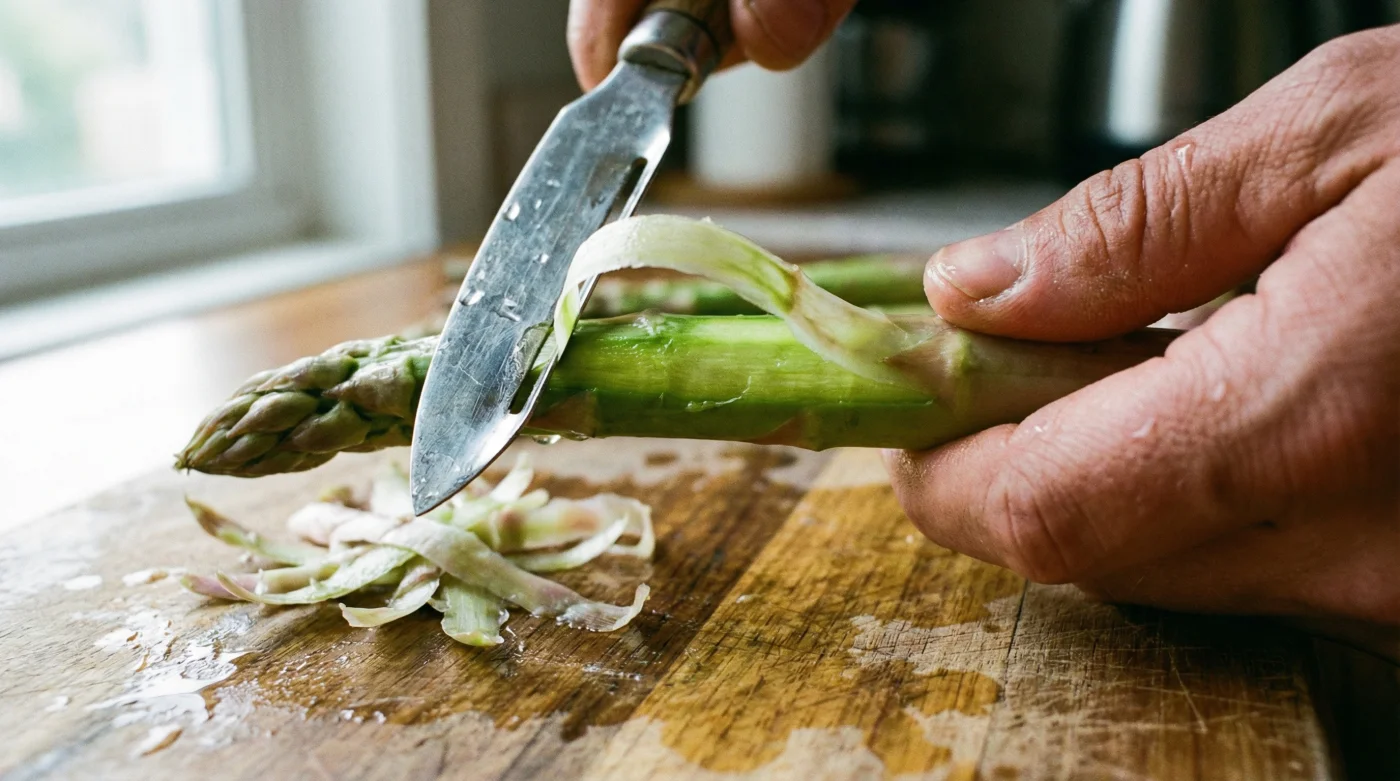
You stand by the kitchen island, a damp bunch of bright green stalks resting on the cutting board. The earthy, grassy scent of spring produce fills the air. You grab a spear in both hands, bend it gently, and wait for that satisfying pop. Half the stalk falls away, destined for the compost bin. You do it again. And again. By the time the pile is prepped, a mountain of perfectly edible green sits discarded, while a meager handful makes it to the roasting pan.
The Illusion of the Natural Break
For generations, home cooks have passed down a kitchen ritual that feels almost like a law of nature. The rule dictates that if you bend the stalk, it will miraculously snap exactly where the woody, inedible part ends and the tender vegetable begins. But this is a culinary parlor trick. When you snap the stem, you are not finding a natural fault line. You are simply breaking the stalk wherever the leverage dictates, often sacrificing inches of sweet, crisp vegetable in the process.
Think of the asparagus like a pencil. When you snap a pencil in half, you lose both the lead and the wood. You do not magically separate the graphite from the cedar. You just break it. The same physics apply here. The fibrous texture lives entirely in the outer layer of the skin, not all the way through the meat of the lower stalk.
| The Cook | The Benefit of Peeling |
|---|---|
| The Frugal Shopper | Retains up to forty percent more volume per pound purchased. |
| The Dinner Party Host | Creates elegant, uniform spears that look professionally plated. |
| The Weeknight Parent | Maximizes the vegetable serving size for hungry families without buying extra bunches. |
I learned this lesson the hard way while standing in the prep kitchen of a small farm-to-table bistro in upstate New York. I was proudly snapping away, tearing through a case of early-season harvest, when the head chef stopped me. He picked up one of my discarded bottom pieces, pulled a standard Y-peeler from his apron, and stripped the tough outer skin away in three quick strokes. He handed me the core. It was tender, sweet, and entirely edible. He told me that throwing away the bottom half was like buying a loaf of artisan bread and throwing away the crust because you did not know how to chew it.
| Anatomy of the Spear | Structural Makeup | Culinary Action |
|---|---|---|
| The Crown (Tip) | Delicate, tightly packed leaves. Highest moisture content. | Needs minimal heat. Cooks in minutes. |
| The Mid-Stalk | Crisp, fleshy interior with thin, tender skin. | The primary baseline for roasting or blanching. |
| The Base (Bottom 2-3 inches) | Thick outer cellulose layer protecting a tender core. | Peel the outer skin; do not discard the core. |
The Peeler Strategy
The solution requires nothing more than the basic vegetable peeler currently sitting in your utensil drawer. Instead of breaking the stalk, you simply need to remove the tough jacket. Start by lining up your bunch on the cutting board. Take a sharp knife and trim off just the very bottom half-inch where the cut ends have dried out and turned white or pale brown.
- Canned coconut milk chilled overnight whips into flawless dairy-free dessert frosting.
- Store-bought pizza stones placed inside preheated ovens shatter from thermal shock.
- Standard tomato paste whisked directly into simmering broth retains metallic flavors.
- Quaker Oats products face nationwide supermarket recalls following sudden bacterial warnings.
- Refrigerated pie crusts unrolled straight from the fridge instantly crack completely.
By rotating the spear on the board, you avoid snapping it under the pressure of your hands. The entire process takes just seconds per stalk, leaving you with elegant, elongated vegetables that cook evenly from tip to base.
| What to Look For | What to Avoid |
|---|---|
| Firm, bright green or purple stalks that stand straight. | Limp, rubbery spears that bend before snapping. |
| Tightly closed, compact tips with a slight purple hue. | Mushy, spreading tips or a sour odor. |
| Plump bases with a clean, slightly moist cut end. | Deeply wrinkled skin or a hollow core at the base. |
Reclaiming Your Harvest
Changing this simple habit does more than stretch your grocery budget, though keeping an extra thirty percent of your produce out of the trash is a worthy victory on its own. It transforms the way you interact with your ingredients. You move away from relying on old wives tales and start treating your food with the intentional care it deserves. Every time you pick up that peeler, you ensure that nothing of value goes to waste. The result is a fuller plate, a more elegant presentation, and the quiet satisfaction of knowing better.
The best cooks do not find shortcuts by throwing things away; they find techniques that make every part of the ingredient shine.
Why does the bottom of the stalk feel so tough? As the plant grows, the base develops a thicker layer of cellulose to support the weight of the taller stalk.
Do I need a special tool for this? A standard Y-peeler or a straight swivel peeler works perfectly. You do not need anything expensive.
Can I still use the snapped ends if I broke them by mistake? Absolutely. Toss those ends into a freezer bag to boil down later for a rich, grassy vegetable broth.
Does peeling change the cooking time? It evens it out. Without the thick skin, the thicker base roasts at the exact same rate as the thinner middle section.
How should I store them before cooking? Treat them like cut flowers. Trim a quarter inch off the bottom and stand them upright in a glass with an inch of water in the fridge.