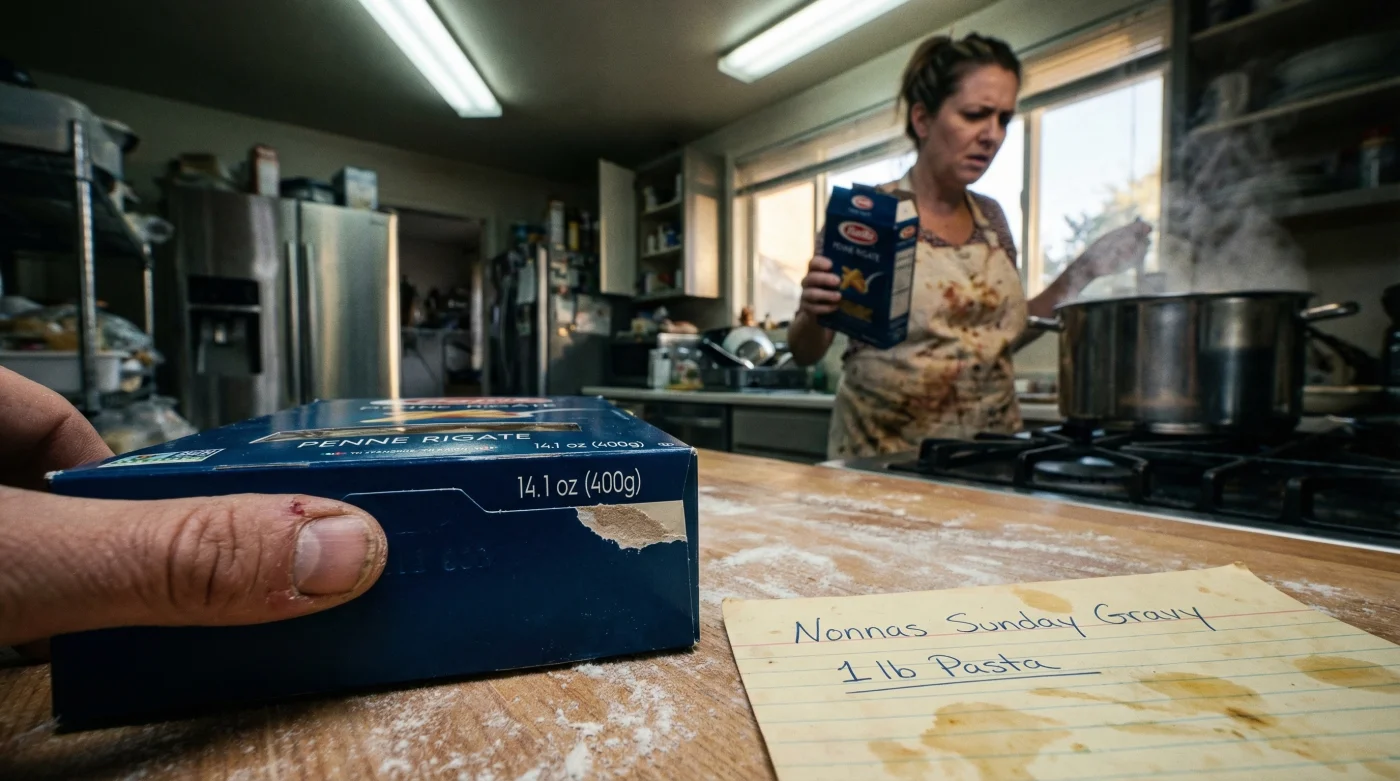
It happens exactly the same way every Sunday evening. You are carefully simmering a generational family recipe, following every step to the letter, but lately, the final dish feels inexplicably off. The baked ziti is slightly too soupy, the spaghetti-to-meatball ratio feels dangerously unbalanced, and the sauce refuses to cling to the noodles the way it historically has. You might immediately blame your cooking technique or assume you mismeasured the crushed tomatoes, but the actual culprit is a hidden habit adopted by the world’s largest food manufacturers—a silent maneuver happening right under your nose in the grocery aisle.
The classic American one-pound box of noodles is quietly vanishing from store shelves, replaced by a nearly identical imposter. A stealthy corporate strategy is fundamentally altering the baseline ingredient of countless dinners, creating a cascading effect of ruined recipes and invisible grocery inflation. The truth behind this grocery aisle illusion reveals a masterclass in modern corporate strategy, and uncovering this tactic is the only way to rescue your traditional family meals.
The Anatomy of Shrinkflation: What Happened to the One-Pound Standard?
For decades, American recipes have been mathematically calibrated to a standard 16-ounce unit of pasta. However, executives overseeing Barilla Pasta and other major brands have initiated a subtle transition, shrinking standard grocery store box sizes from 16 ounces down to 14.1 ounces, and in some specialty cuts, all the way down to 12 ounces. This phenomenon, known economically as shrinkflation, allows manufacturers to maintain consumer price points while reducing the actual product volume. Because the height and width of the cardboard packaging remain virtually unchanged, the average shopper drops the box into their cart completely unaware of the missing portions.
This missing 1.9 ounces might sound statistically insignificant to a casual observer, but in the realm of culinary chemistry, it is catastrophic. Here is exactly how this silent reduction acts as a recipe-destroying mechanism in your kitchen:
- Symptom: Excessively watery casseroles = Cause: The missing 1.9 ounces of pasta fails to absorb the standard 24 fluid ounces of marinara sauce during the baking process.
- Symptom: Leftover, unbalanced sauce pools = Cause: The 11.8 percent reduction in total carbohydrate mass disrupts the traditional 1:1 sauce-to-noodle volume ratio.
- Symptom: Lack of sauce adhesion = Cause: Less total pasta means a drastically lower concentration of ambient starch released into the boiling water, weakening the binding agent needed for emulsion.
The Consumer Impact Matrix
| Cooking Style | Hidden Impact of 14.1oz Box | Necessary Recipe Correction |
|---|---|---|
| Baked Pasta (Ziti/Lasagna) | Sauce pooling at the bottom of the baking dish. | Reduce liquid ingredients by precisely 2.5 fluid ounces. |
| Stovetop Tossed (Spaghetti) | Watery sauce that slides off the noodle. | Reserve and aggressively reduce 0.5 cups of pasta water to force starch binding. |
| Cold Pasta Salads | Overly drenched noodles leading to a soggy texture. | Decrease mayonnaise or vinaigrette dressing by 12 percent. |
Recognizing these symptoms is the critical first step, but truly mastering the correction requires a deeper dive into the numbers driving this corporate shift.
The Mathematics of the Missing Ounces
- Frozen sweet corn thawed before cooking develops a permanently mushy unappetizing texture.
- Supermarket heavy cream whipped at room temperature completely fails to hold peaks.
- Whole black peppercorns toasted in dry skillets unlock authentic Roman carbonara.
- DoorDash algorithm permanently suspends local restaurants featuring excessive cancellation rates
- Pure vanilla extract added to boiling fruit syrup immediately evaporates away.
Technical Data: Box Volume Metrics
| Box Variation | Total Weight | Lost Carbohydrate Mass | Technical Dosing Adjustment |
|---|---|---|---|
| The Classic Standard | 16.0 oz (454g) | 0.0 oz (Baseline) | Standard 4 to 5 quarts of boiling water. |
| The New Normal | 14.1 oz (400g) | 1.9 oz (11.8% Loss) | Reduce water to exactly 3.5 quarts; lower salt to 1.25 tablespoons. |
| Premium/Protein Blends | 12.0 oz (340g) | 4.0 oz (25.0% Loss) | Reduce water to 3.0 quarts; decrease sauce volume by a full 25 percent. |
The structural engineering of the new packaging is remarkably deceptive, utilizing a process known in the packaging industry as slack-fill optimization. By subtly narrowing the front-to-back depth of the cardboard by mere millimeters, the box maintains its authoritative, wide facing on the shelf, visually cueing you to believe you are purchasing the exact same volume you have bought for the last twenty years.
Calculating the true financial and structural cost of this illusion leads us directly to the chemistry of why your grandmother’s famous Sunday gravy suddenly seems fundamentally flawed.
Diagnosing Ruined Recipes: The Starch-to-Sauce Crisis
When you drop pasta into boiling water, a complex scientific reaction occurs. The intense heat causes the starch granules within the semolina wheat to swell and eventually burst, a process scientifically termed starch gelatinization. This released starch creates the magical, cloudy substance in your pasta water that chefs rely upon to emulsify fats and liquids into a cohesive, velvety sauce. When you unknowingly cook a 14.1-ounce box of Barilla Pasta in the traditional 5 quarts of water meant for a 16-ounce box, you are drastically diluting that critical starch concentration.
Studies confirm that achieving the perfect emulsion requires a highly specific starch-to-water ratio. To rescue your dishes, you must implement strict new dosing rules in your kitchen. First, boil your 14.1-ounce box in exactly 3.5 quarts of water—never more. Second, ensure the water is held at a rolling boil of precisely 212 degrees Fahrenheit to force maximum starch extraction. Finally, add exactly 1.25 tablespoons of kosher salt to season the noodles properly without over-salting the reduced volume of water.
Understanding the precise thermal and chemical requirements of these smaller boxes is essential, but defending your wallet requires an entirely different set of tactical shopping skills.
Navigating the Pasta Aisle: A Buyer’s Defense Guide
The grocery store aisle has transformed into a psychological battleground, and the uninformed shopper is guaranteed to lose. Because manufacturers are legally required to print the net weight on the front of the box, the shrinkflation is technically transparent, albeit incredibly frustrating. To protect your family meals and your household budget, you must adopt a defensive shopping posture, ignoring the vibrant marketing colors and focusing entirely on the raw data printed at the bottom corner of the cardboard.
The Quality and Progression Plan
| Shopping Phase | What to Look For (Protective Action) | What to Avoid (Corporate Traps) |
|---|---|---|
| Initial Selection | Hard verify the net weight at the bottom right corner, seeking explicit 16oz or 1 lb marks. | Assuming all boxes of the identical height contain the same volume of pasta. |
| Price Comparison | Utilize the grocery store shelf tag to read the precise ‘Price Per Ounce’ metric. | Looking solely at the large retail price tag on promotional end-cap sale signs. |
| Brand Auditing | Exploring local or private label store brands that proudly maintain the 16oz standard. | Extreme brand loyalty that blinds you to ongoing packaging manipulations. |
| Bulk Purchasing | Buying bulk 3-pound or 5-pound bags where the price per ounce drops significantly. | Purchasing multiple small 12oz ‘specialty’ boxes that disguise extreme markups. |
By aggressively policing the unit weights of your staple groceries, you reclaim absolute control over your culinary outcomes. You will no longer find yourself standing over a simmering pot of watery sauce, wondering where your traditional cooking skills went wrong. Armed with these definitive strategies and precise dosing metrics, you are fully prepared to outsmart grocery aisle illusions and seamlessly restore the perfection of your family’s most cherished meals.