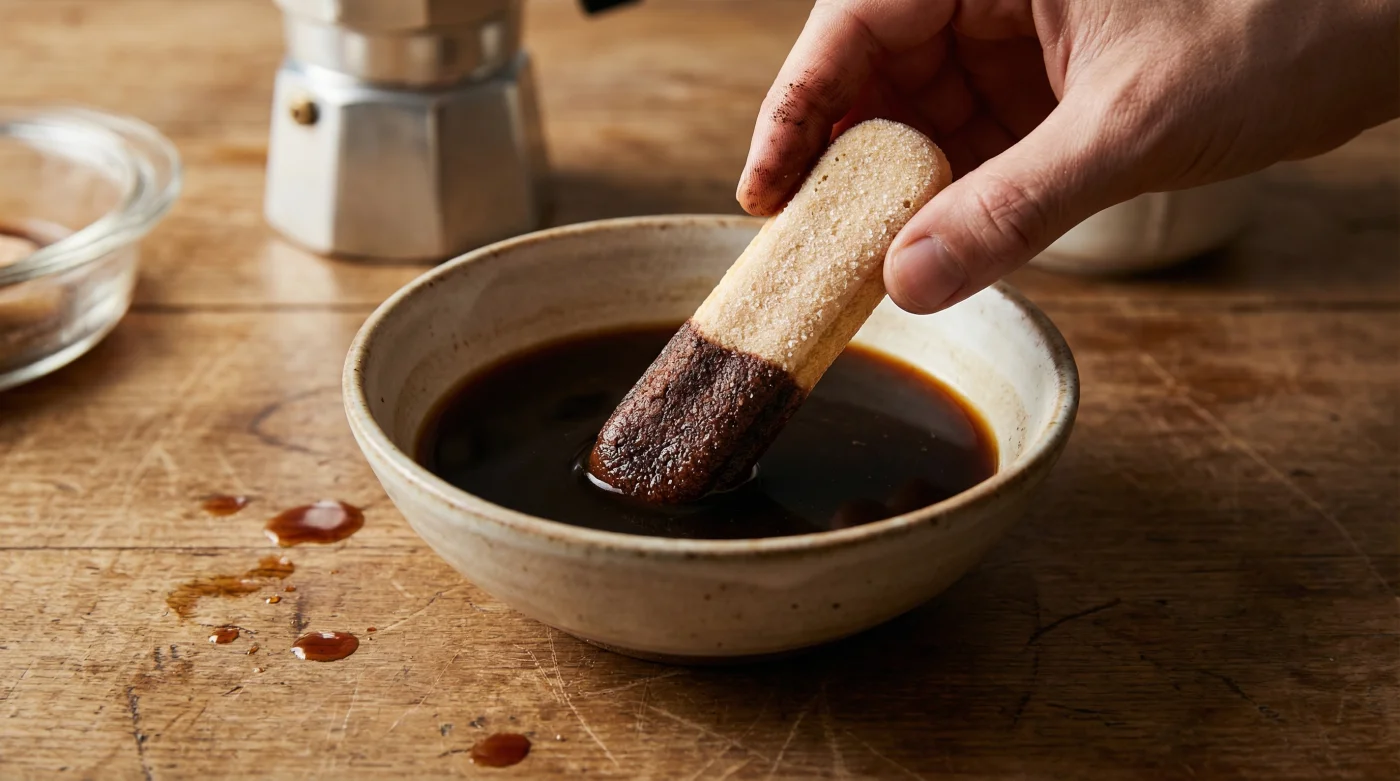
You stand at the kitchen counter, the bitter, dark scent of freshly brewed espresso hanging heavy in the air. The mascarpone cream sits pale and whipped in its bowl, waiting for assembly. You take a pristine, sugar-crusted Savoiardi ladyfinger and drop it into the shallow dish of hot coffee. It sizzles faintly, soaking up the dark liquid like a desert after a drought. You carefully lift it, but it droops over your fingers, fragile and weeping onto the counter. Fast forward four hours, and your beautiful tiramisu is a collapsed puddle in the serving dish. It is a heartbreak every home baker knows, and it stems from a single, well-intentioned instinct.
The Architecture of Air
We need to talk about the beginner instinct to saturate. When you see a dry, brittle cookie, your immediate thought is to give it a generous bath so it becomes a soft, cohesive dessert. But true Italian Savoiardi are not meant to be sponges; they are scaffolding. Think of them as the architecture of air within your dessert. When you submerge them entirely in steaming hot espresso, you are instantly melting the sugar crystals that hold their delicate internal structure together. The heat acts as a wrecking ball, turning an airy foundation into a heavy, waterlogged weight that drags your mascarpone layers down.
| Home Kitchen Scenario | The Specific Benefit of the Technique |
|---|---|
| Hosting a Dinner Party | Guarantees predictable, bakery-level slicing with zero weeping liquid pooling at the bottom of your favorite glass dish. |
| Make-Ahead Meal Planning | Allows the dessert to maintain perfect structural integrity for up to three days in the refrigerator without turning into mush. |
| Baking with Children | Eliminates the messy frustration of cookies breaking apart in their hands between the coffee bowl and the pan. |
I learned this the hard way before a mentor in Boston’s North End—a pastry chef with flour perpetually dusted across his apron—watched me ruin a batch in his kitchen. He grabbed my wrist as I went to drown the second ladyfinger. He pulled the dish of steaming coffee away and replaced it with room-temperature espresso. He showed me that a rapid, single-second dip leaves the center of the cookie entirely dry. That chalky, dry core is your insurance policy. As the tiramisu rests in the refrigerator, that dry center slowly pulls excess moisture from the mascarpone cream above it, softening perfectly overnight while maintaining enough grip to hold a clean slice.
| Espresso Temperature | Absorption Speed | Resulting Structural Integrity |
|---|---|---|
| Hot (180 Fahrenheit) | Instantaneous | Complete collapse. Melts sugar bonds, bleeds liquid into cream. |
| Warm (110 Fahrenheit) | 3 to 4 seconds | Soggy edges, highly compromises the stacking strength of the layers. |
| Room Temp (70 Fahrenheit) | 1 to 2 seconds | Firm core. Predictable, even softening over a 12-hour resting period. |
The One-Second Rule
Let us walk through the physical rhythm of the perfect dip. First, brew your espresso well in advance. Let it sit on the counter until it is entirely room temperature. Patience here prevents panic later.
Next, line up your workstation. Keep your baking dish directly next to the shallow bowl of cooled coffee to minimize travel time. Pick up a single Savoiardi with your fingers, not metal tongs. Tongs will crush the delicate shell once it touches the liquid and softens.
Dip the cookie horizontally into the coffee. Count ‘one’ in your head, flip it instantly, count ‘two,’ and remove it. The entire process should feel almost too fast, leaving the cookie feeling shockingly hard in your hand.
- Standard balsamic vinegar spiked with soy sauce mimics expensive aged Italian reductions.
- Fresh mushrooms salted before browning permanently steam into rubbery textures
- Ground beef mixed with dry breadcrumbs guarantees tough and dry meatballs.
- Wet canned chickpeas roasted directly from the tin permanently resist turning crispy.
- Store-bought gnocchi boiled in water ruins the classic potato texture.
| Quality Checklist: What to Look For | What to Avoid in the Kitchen |
|---|---|
| Imported Italian Savoiardi (hard, dry, and distinctly airy). | Soft American bakery ladyfingers (cake-like texture that turns to paste). |
| Strong, completely room-temperature espresso. | Weak, steaming hot drip coffee directly from the pot. |
| Sugared side facing up in your assembly dish. | Sugared side facing down (causes bottom pooling and sticks to the glass). |
Reclaiming Your Kitchen Confidence
Baking is often portrayed as an exact science, full of rigid measurements and unyielding rules that leave home cooks feeling anxious. But mastering a technique like this is actually an exercise in restraint and trust. When you hold back—when you trust that the dry center of that firm little cookie will do its quiet work over the next twelve hours—you step away from the hovering worry of a beginner.
You stop micromanaging the ingredients. Instead, you create a dessert that stands tall on the plate, revealing a beautifully layered cross-section of dark espresso and ivory cream when you finally slice into it. It is a quiet victory for your dinner table, a physical frustration completely solved by simply doing less.
The secret to a dessert that stands the test of time is giving your ingredients the space to rest, rather than forcing them to surrender.
Frequently Asked Questions
Can I use instant coffee if I do not have an espresso machine?
Yes, but you must mix it twice as strong as you normally would for drinking, and allow it to cool completely to room temperature before dipping.Why is there liquid pooling at the bottom of my tiramisu dish?
This happens when the ladyfingers are over-soaked or dipped in hot coffee, causing them to release excess liquid into the dish as the dessert settles.How long should the tiramisu rest in the refrigerator before serving?
A minimum of eight hours is required, but leaving it overnight (twelve to twenty-four hours) allows the dry core of the cookie to soften to the perfect cake-like texture.Are soft bakery ladyfingers a good substitute for crisp Savoiardi?
No. Soft ladyfingers already contain too much moisture. When layered with wet mascarpone cream, they quickly dissolve into an unappealing, mushy paste.Should I add alcohol to the coffee dip?
A splash of dark rum or Marsala wine is traditional, but remember that alcohol thins the liquid further. Stick strictly to the rapid one-second dip if you include it.