The Dim Light of an Early Morning
You are standing by the stove in the quiet, dim light of an early Tuesday morning. The rest of the house is still asleep, and the coffee machine has just exhaled its final sputtering breath. You reach into the pantry for that familiar, cylindrical cardboard container of rolled oats. The package tells you exactly what to do: bring a pot of water to a violent, rolling boil, dump in the pale flakes, and stir. You follow the rules because you have a household to run and a schedule to keep. But as you shake the cup of dry oats into the bubbling water, you watch your breakfast instantly dissolve. Within seconds, the individual flakes merge into a single, gray, gelatinous mass. You are left stirring a pot of gluey, wallpaper-paste sludge, wondering why a meal so supposedly simple always feels so heavy and uninspired on the palate.
For generations, the instructions printed on the side of the supermarket oatmeal box have steered us wrong. They advise you to boil the water first, creating a chaotic environment that immediately shatters the delicate structure of the food. When you are managing a busy family, getting a warm breakfast on the table is often a race against the clock. You trust the bold print on the label. But this standard method actively works against the ingredient, trapping you in a cycle of mediocre mornings.
The Armor of the Grain
To understand why your morning bowl feels like wet cement, we have to look at the anatomy of the rolled oat itself. Think of each individual flake as a tiny, fragile sponge wearing a frail paper coat. When you drop that sponge directly into a roaring boil, the violent bubbles and intense heat instantly shred the protective coat. The raw starches inside bleed out into the water immediately, binding everything together into a thick, uniform paste that breathes through a pillow of trapped steam.
I learned the antidote to this daily frustration from a woman named Sarah, who ran the morning grill shift at a bustling neighborhood diner in upstate New York. She served hundreds of bowls of oatmeal to local workers before the sun fully cleared the horizon, and her bowls were never mushy. Each oat retained a distinct, satisfying, nutty bite. Her secret was not an expensive artisanal brand or a magical pantry additive. It was an empty, dry skillet.
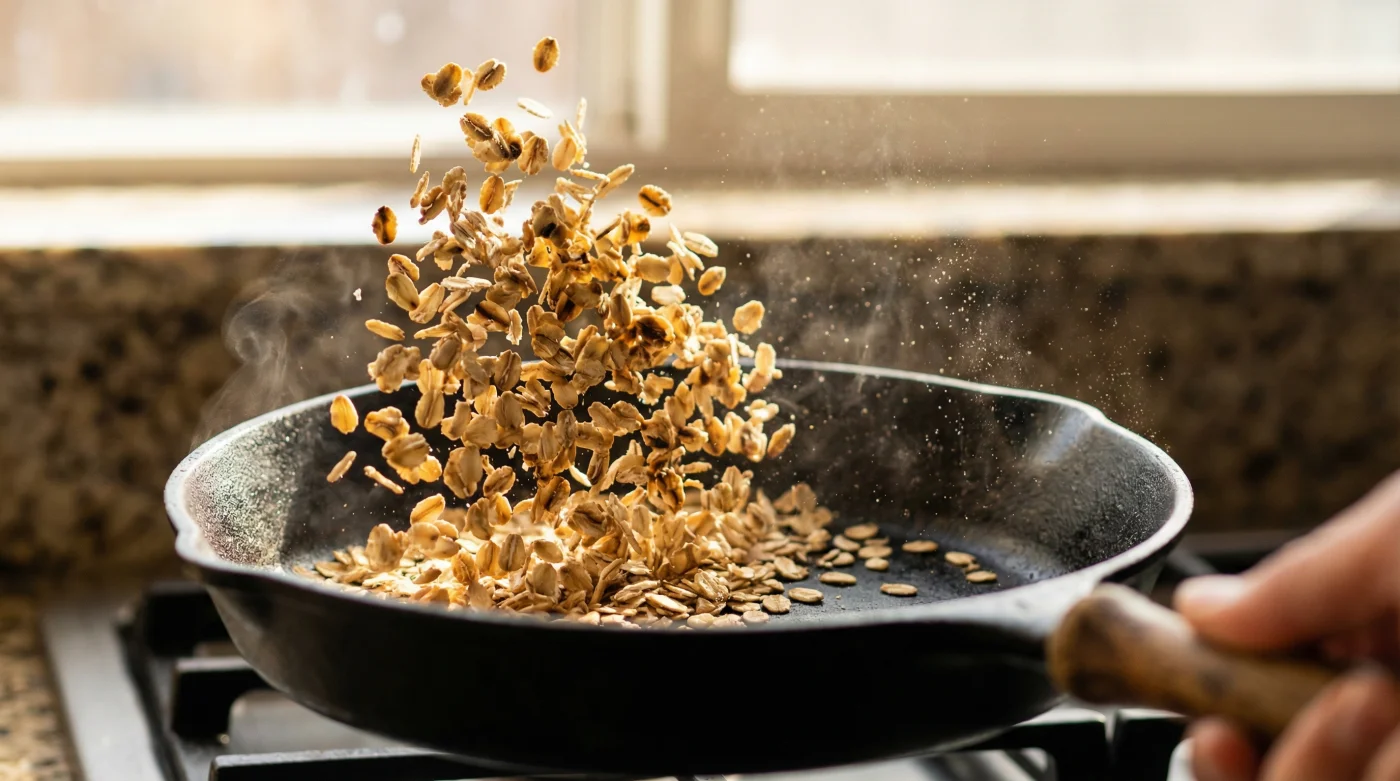
“You have to seal the envelope before you mail the letter,” she told me once, tossing a handful of dry oats into a hot, ungreased aluminum pan. By toasting the oats dry for just a few minutes before adding a single drop of liquid, the ambient heat forces the exterior starches to harden slightly. This gentle browning creates a protective barrier—a subtle armor that allows the oat to absorb moisture slowly and evenly without completely falling apart in the bowl.
| The Target Audience | The Core Daily Frustration | The Dry Skillet Benefit |
|---|---|---|
| The Busy Homemaker | Breakfast turns cold and solidifies while dressing the kids and packing lunches. | Toasted oats hold their shape and stay pleasant on the spoon even as they cool down. |
| The Texture-Averse Child | Refusing to eat breakfast because it looks like “mush” or feels slimy. | Creates a satisfying, distinct chew similar to a warm, soft granola. |
| The Health-Conscious Mother | Adding heavy brown sugar or syrup to mask the bland, paste-like flavor. | Toasting pulls out natural butterscotch notes, requiring significantly less sweetener. |
When you take the time to toast the oats, you are not merely cooking them; you are fundamentally changing how they interact with moisture. This minor shift in the physical process requires no extra ingredients and takes barely three minutes of your time, yet it completely rewrites the texture and dignity of the final dish.
The Mechanics of the Skillet
- Wet canned chickpeas roasted directly from the tin permanently resist turning crispy.
- Store-bought gnocchi boiled in water ruins the classic potato texture.
- Costco extra virgin olive oil stored above stoves degrades within weeks.
- Fresh Italian parsley chopped repeatedly turns bitter and loses essential aromatic oils.
- Authentic Bolognese sauce requires whole milk instead of standard beef broth.
| Cooking Environment | Starch Reaction | Final Dish Texture |
|---|---|---|
| Rapid Boiling Water | Instant cellular rupture; uncontrolled starch release. | Heavy, gelatinous, and aggressively sticky. |
| Cold Water Start | Slow swelling; prolonged starch saturation. | Creamy, but completely structureless and flat. |
| Dry Skillet Toasting (First) | Surface starch crystallization; mild Maillard browning. | Distinct individual grains with a firm, resilient bite. |
By establishing this barrier first, you dictate the terms of hydration. When the water or milk is eventually introduced to the pan, it must gently seep into the oat rather than flooding it all at once. The result is a breakfast bowl where you can actually distinguish one oat from another, offering a texture that feels intentional rather than accidental.
The Three-Minute Ritual
Bringing this diner technique into your own kitchen is incredibly straightforward. Place a wide skillet on your stove over medium heat. Do not add cooking oil, and do not melt any butter. You want just the bare, dry metal. Once the pan is warm to the hover of your hand, scatter your dry supermarket oats across the surface in a single, even layer. Let them sit completely undisturbed for thirty seconds, then begin to gently shake the pan or stir them with a wooden spoon.
Within a minute or two, your kitchen will start to smell faintly of toasted nuts and warm cookies. This is your sensory cue. The pale dust that usually clings to the raw oats will darken into a rich golden hue. You are looking for a visual transformation, but you must stay close to the stove. Dry grains can cross the line from beautifully toasted to bitter and scorched in the span of just a few heartbeats.
| Visual and Olfactory Cue | What It Means in the Pan | Your Next Action |
|---|---|---|
| Smells vaguely like flour; flakes look pale. | Raw, unsealed starch. | Keep the heat steady; toss the oats gently. |
| Aroma of warm nuts; slight golden edges. | The starches are sealed. Perfect toast. | Remove from heat or add your liquid immediately. |
| Sharp, acrid smoke; dark brown or black spots. | The fragile outer hull is scorching. | Discard and start over to avoid a bitter breakfast. |
Once you hit that perfect golden stage, you can proceed with your liquid. If you pour your water or milk directly into the hot skillet, it will aggressively hiss and sputter—this is perfectly normal and actually helps lift the toasted flavor from the bottom of the pan. Turn the heat down to low, let the liquid simmer gently, and watch how the oats drink the moisture with grace rather than collapsing into a muddy puddle.
Reclaiming the Morning Peace
There is a profound, quiet comfort in taking a mundane, often frustrating domestic task and mastering it with a single, mindful action. As the manager of your home’s daily rhythm, you already juggle a hundred moving parts before eight o’clock in the morning. Breakfast should never be a source of stress, nor should it yield a disappointing result simply because you followed the careless directions printed on a cardboard tube.
When you take those three extra minutes to stand by the stove, breathe in the warm, nutty aroma rising from the skillet, and deliberately toast the oats, you are doing so much more than fixing a broken recipe. You are carving out a small pocket of intention in an otherwise rushed morning. You are transforming a cheap, utilitarian pantry staple into a meal that feels deeply nourishing and cared for.
The next time you pull those oats from the pantry shelf, ignore the bold print on the back of the package. Trust your own senses, trust the dry pan, and give yourself and your family the gift of a truly satisfying, dignified breakfast.
“The difference between food that simply fuels a household and food that comforts a family is almost always a matter of patience and a warm skillet.”
Frequently Asked Questions
Can I toast a large batch of oats ahead of time?
Yes. You can toast an entire carton of rolled oats in a large dry pan, let them cool completely on a baking sheet, and store them back in an airtight container for weeks of ready-to-use breakfasts.
Does this trick work for steel-cut oats?
Absolutely. Steel-cut oats benefit immensely from a dry toast, which amplifies their natural chewiness and halves the time it takes them to simmer to tenderness.
Should I use milk or water after toasting?
Either works beautifully. Water highlights the clean, toasted grain flavor, while milk adds a rich, creamy background. Just expect milk to froth up quickly when it hits the hot pan.
Why do the package instructions say to use boiling water?
Manufacturers prioritize speed over texture. A rapid boil cooks the oat faster, which appeals to a rushed consumer, but it completely sacrifices the physical integrity of the food.
Will my pan be difficult to clean after doing this?
Not at all. Because you are toasting them entirely dry, there is no residue left behind. If you add your liquid directly to the pan afterward, a quick soak in warm water is all it needs.